
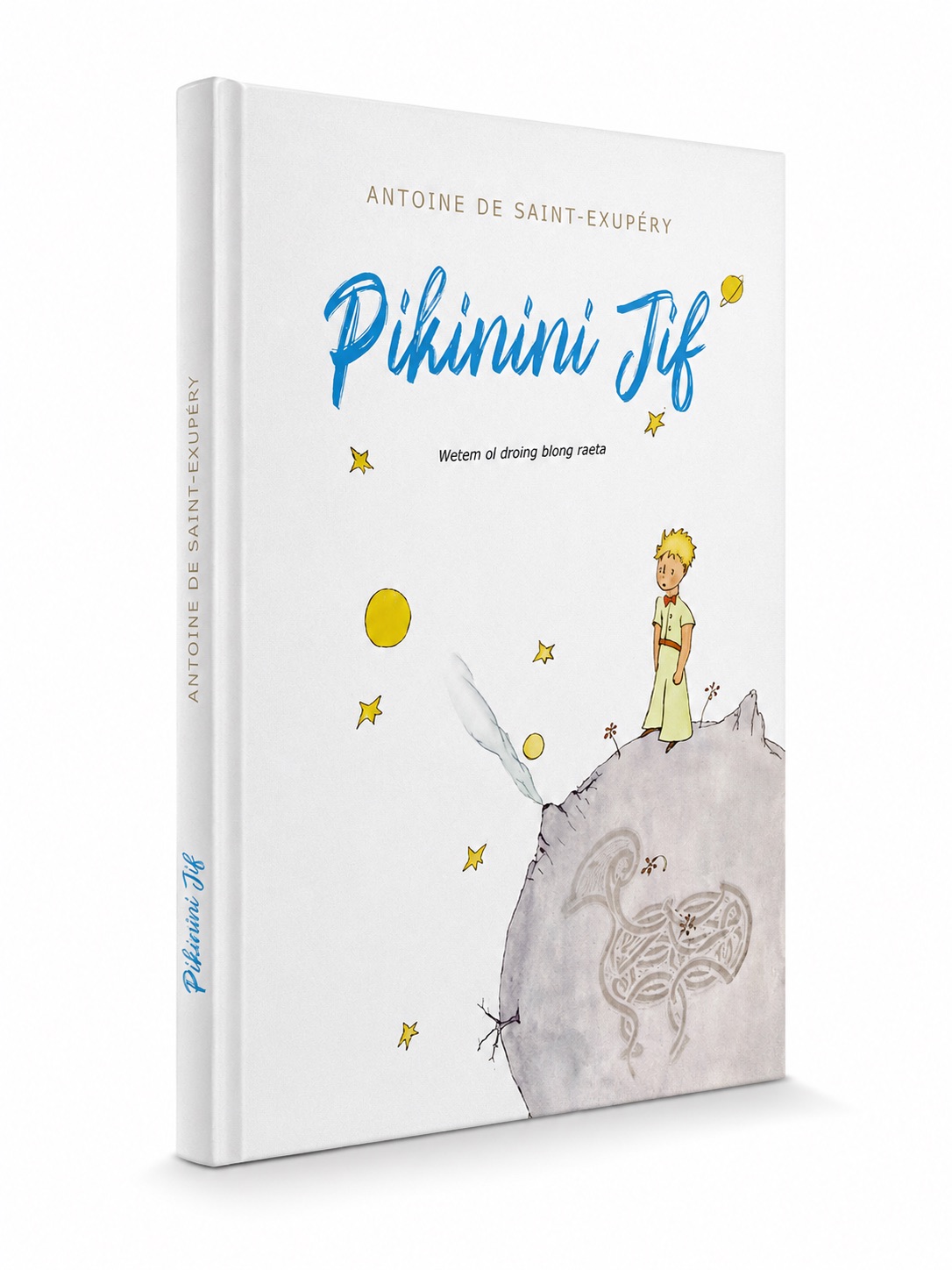
Pikinini Tif — in Bislama creole.
Bislama is the national language of Vanuatu, an archipelago of some eighty islands scattered across the southwestern Pacific between Fiji and New Caledonia, and it occupies one of the more unusual positions in the linguistic geography of the region: it is a creole — specifically an English-based creole with substantial French and Oceanic substrate influences — that has become the primary vehicle of inter-ethnic communication in one of the most linguistically dense places on earth. Vanuatu’s approximately three hundred thousand inhabitants speak somewhere between one hundred and fifteen and one hundred and thirty distinct indigenous languages, giving it the highest density of languages per capita of any country in the world. These languages belong almost entirely to the Oceanic branch of Austronesian, but they have diverged so radically over the three thousand years since Austronesian speakers first settled the archipelago that neighbouring villages on the same island may be mutually unintelligible. Bislama emerged from this extraordinary fragmentation as a practical necessity — a shared medium through which a ni-Vanuatu from Tanna could speak with one from Espiritu Santo, neither surrendering their own language nor requiring the other to learn it.
The origins of Bislama lie in the brutal labour trade of the nineteenth century, when ni-Vanuatu men were recruited — often by force or deception — to work on sugar plantations in Queensland and Fiji. On the plantations, workers from dozens of different island groups developed a pidgin English as their only common medium, and when they returned home they brought it with them. The name itself derives from bêche-de-mer — sea cucumber — the trade commodity that first brought European ships regularly into Pacific waters and whose French name gave the early pidgin one of its several designations. Under the Anglo-French Condominium that governed the New Hebrides from 1906 until independence in 1980, both English and French were official languages, and both left their mark on Bislama’s vocabulary and structure. Independence, which Vanuatu achieved under the name it chose for itself from its own languages, elevated Bislama to constitutional status alongside English and French — a recognition that the creole, whatever its origins in colonial violence and displacement, had become something genuinely the people’s own.
Linguistically, Bislama is a textbook illustration of the processes by which creoles develop systematic grammatical complexity from pidgin beginnings. Its vocabulary is predominantly English in origin but often transformed beyond immediate recognition — gras blong fes (grass belonging to face) means beard, ston blong yia (stone belonging to ear) means earring — whilst its grammar draws heavily on the underlying Oceanic languages, producing structures that are neither English nor any specific Vanuatu language but a genuinely new synthesis. It is fully capable of expressing nuance, abstraction, and poetry, and has a growing body of literature, radio broadcasting, and political oratory. The indigenous Oceanic languages of Vanuatu — Bislama’s substrate — remain vigorously alive alongside it, spoken at home and in village contexts, used in ceremony and song, carrying the deep cultural knowledge that no creole, however expressive, can fully inherit. The relationship between Bislama and the island languages is thus one of functional complementarity rather than competition: Bislama connects Vanuatu to itself and to the world, whilst the island languages connect each community to its particular history, land, and ancestors — a division of linguistic labour that Vanuatu has, more successfully than many post-colonial states, managed to sustain.