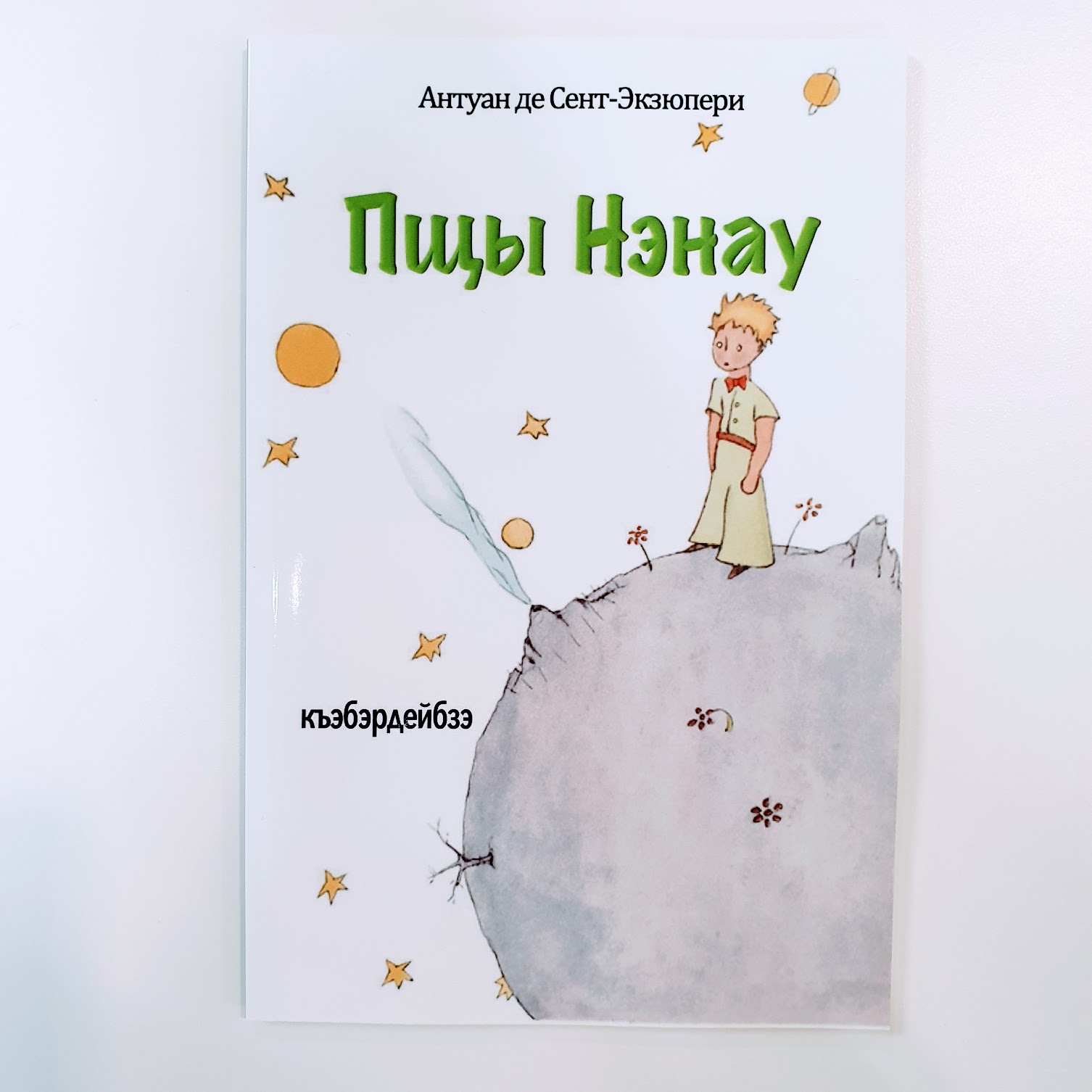
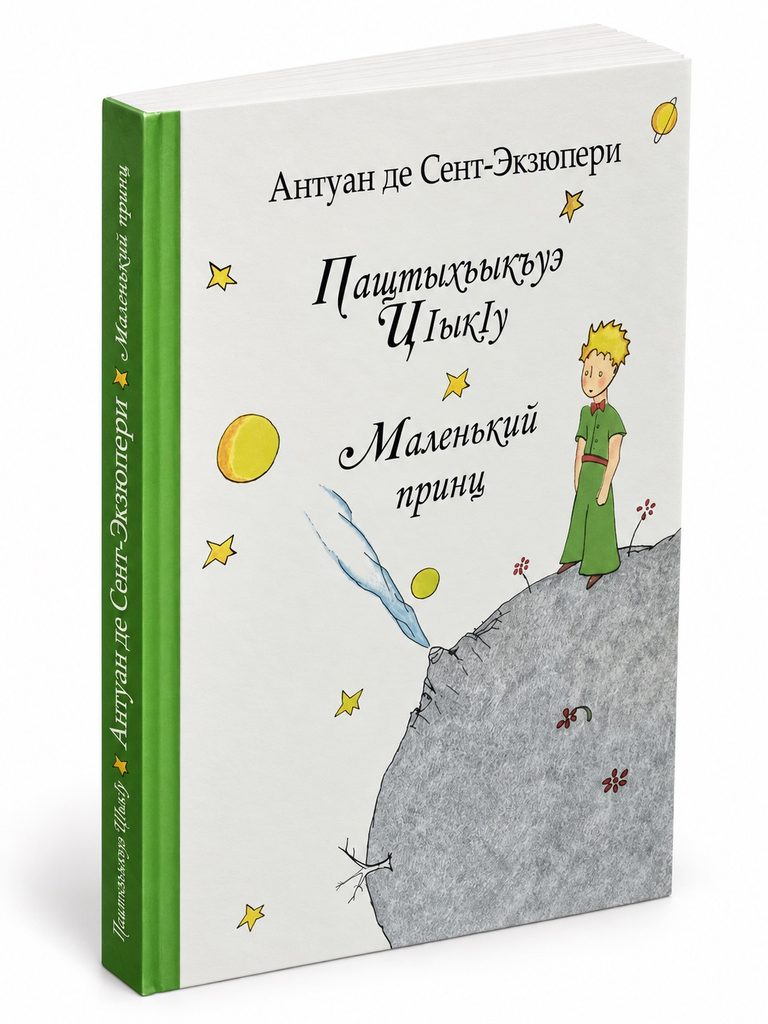
Пащтыхъыкъу ЦӀыкӀу (Pashtykhyku Tsykyu) — in Kabardian language.
Kabardian, къэбэрдейбзэ (Qebardeybze), or sometimes rendered more fully as къэбэрдей адыгэбзэ (Qebardey Adygebze, “Kabardian Adyghe”), belongs to the Northwest Caucasian family, a small and rather isolated group also called Abkhaz-Adyghe, whose only other living members are Adyghe (West Circassian), Abkhaz, and Abaza, with the once-spoken Ubykh now extinct. Kabardian and its close cousin Besleney together form the “East Circassian” branch, set against West Circassian (Adyghe proper) on the far side of the same continuum; the two are often likened, in the degree of their kinship, to Portuguese and Spanish, or Czech and Slovak — close enough for a broad understanding, distant enough to trip over the details. Speakers of both nonetheless refer to their tongue by the shared, older name адыгэбзэ (Adygebze, “the Adyghe language”), since every Circassian, whichever variety he speaks, calls himself Adyghe first.
The language’s fortunes have been shaped by a history of considerable grandeur followed by calamity. From the sixteenth to the eighteenth century, the Kabardian principality was the foremost power of the North Caucasian plain, its aristocracy — the пщы (pshy, “prince” or feudal lord) — cultivated and courted even by Moscow; a Kabardian noblewoman, Maria Temryukovna, became Tsaritsa as the second wife of Ivan the Terrible, and Circassian princes subsequently rose to high office within the Russian court itself. That eminence was undone by the Russian-Circassian War of 1763 to 1864, whose final, genocidal phase in 1862–64 saw the great majority of the Circassian nation killed or driven into exile across the Ottoman Empire. The consequence endures to this day: barely half a million Kabardians remain in their homeland of Kabardino-Balkaria, where the language nonetheless holds official status beside Russian, while a diaspora several times that size — well over a million in Turkey alone, together with substantial communities in Jordan, Syria, and beyond — carries the name of the nation far outside the Caucasus, even as many descendants there have long since shifted to Turkish or Arabic. What survived the catastrophe was preserved above all orally: in the Нарт (Nart) sagas, the great heroic epic cycle shared across the Caucasus, and in Адыгэ Хабзэ (Adyghe Khabze), the unwritten code of conduct — governing hospitality, restraint, and honour — that Circassians still describe as the true architecture of their identity, arguably more binding upon them than any statute.
Linguistically, Kabardian is a small marvel of imbalance: it commands an enormous consonantal inventory, reckoned in the dozens once its ejective, pharyngealised, and labialised series are all counted, set against a vowel system so pared down that some analyses recognise barely two or three vowel qualities in total. Its grammar is polysynthetic and markedly prefixing — an eccentricity by world standards, since most languages favour suffixes — with ergative alignment binding a small library of grammatical information onto the verb, so that a single word may do the work of an entire English sentence. This singularity is thrown into sharper relief by its setting, for the Caucasus is famously the most linguistically chaotic patch of ground in Eurasia, once dubbed by Arab geographers “the Mountain of Tongues”: within a few hundred kilometres one finds three wholly unrelated indigenous families — Kabardian’s own Northwest Caucasian, the quite separate Northeast Caucasian tongues of Chechen and the Daghestani languages, and the South Caucasian family containing Georgian — interwoven further with Indo-European Ossetian and several Turkic languages, Balkar chief among them, spoken by Kabardian’s own neighbours and cohabitants within Kabardino-Balkaria itself. Amid that thicket, Kabardian remains utterly unintelligible with everyone around it save its own Circassian kin, a solitary linguistic island that has absorbed loanwords from Turkic, Arabic, Persian, and Russian across the centuries of contact without ever surrendering the peculiar architecture that makes it, and its endangered West Circassian sister, unlike anything else spoken on earth.
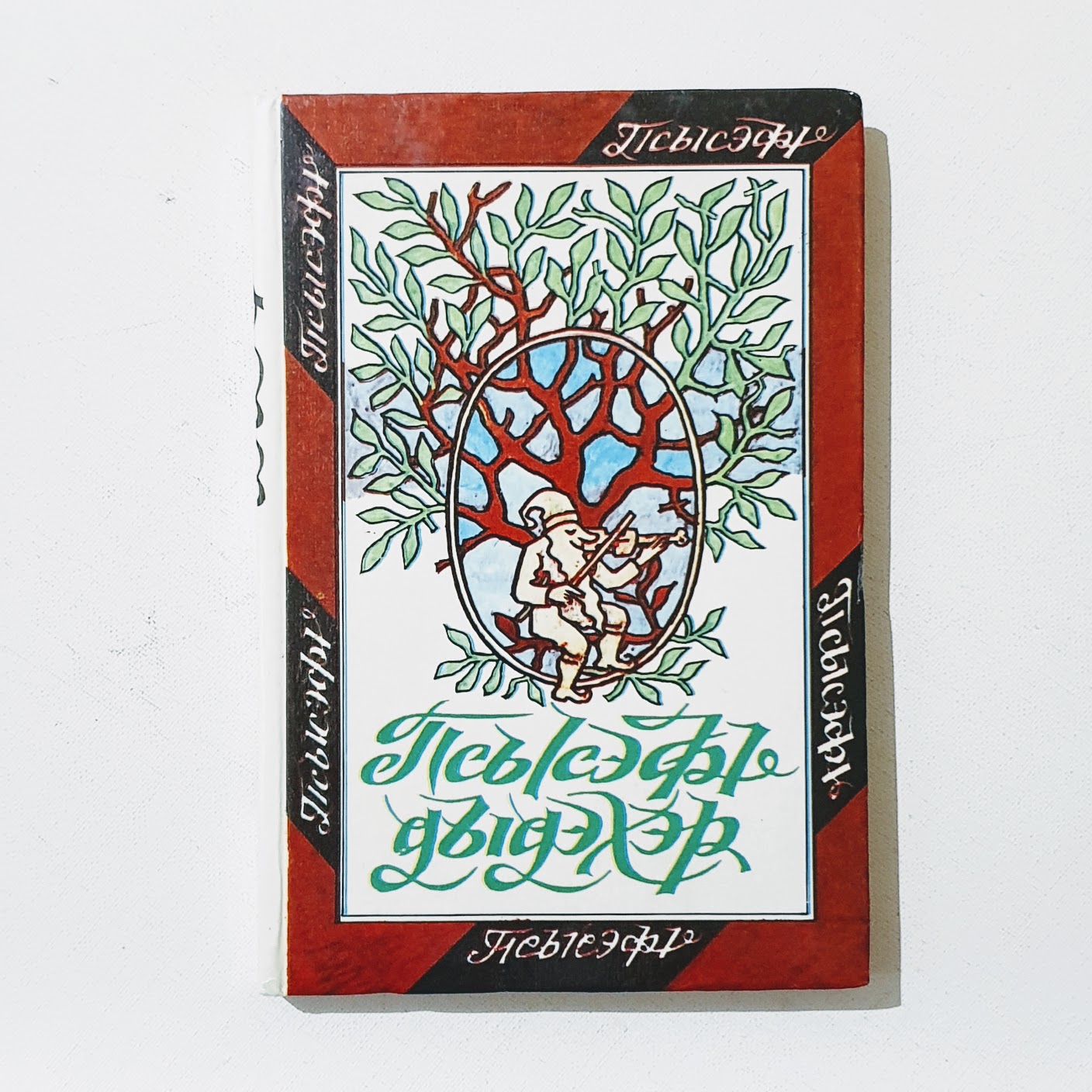
Пщы Нэнау и Псысэ — Pshchy Nenau i Psyse.
This is one of the stories inside a story collection “Псысэфӏ Дыдэхэр” (Psysef Dydekher) in Kabardian / адыгэбзэ / къэбэрдей адыгэбзэ / къэбэрдейбзэ or East Circassian.