
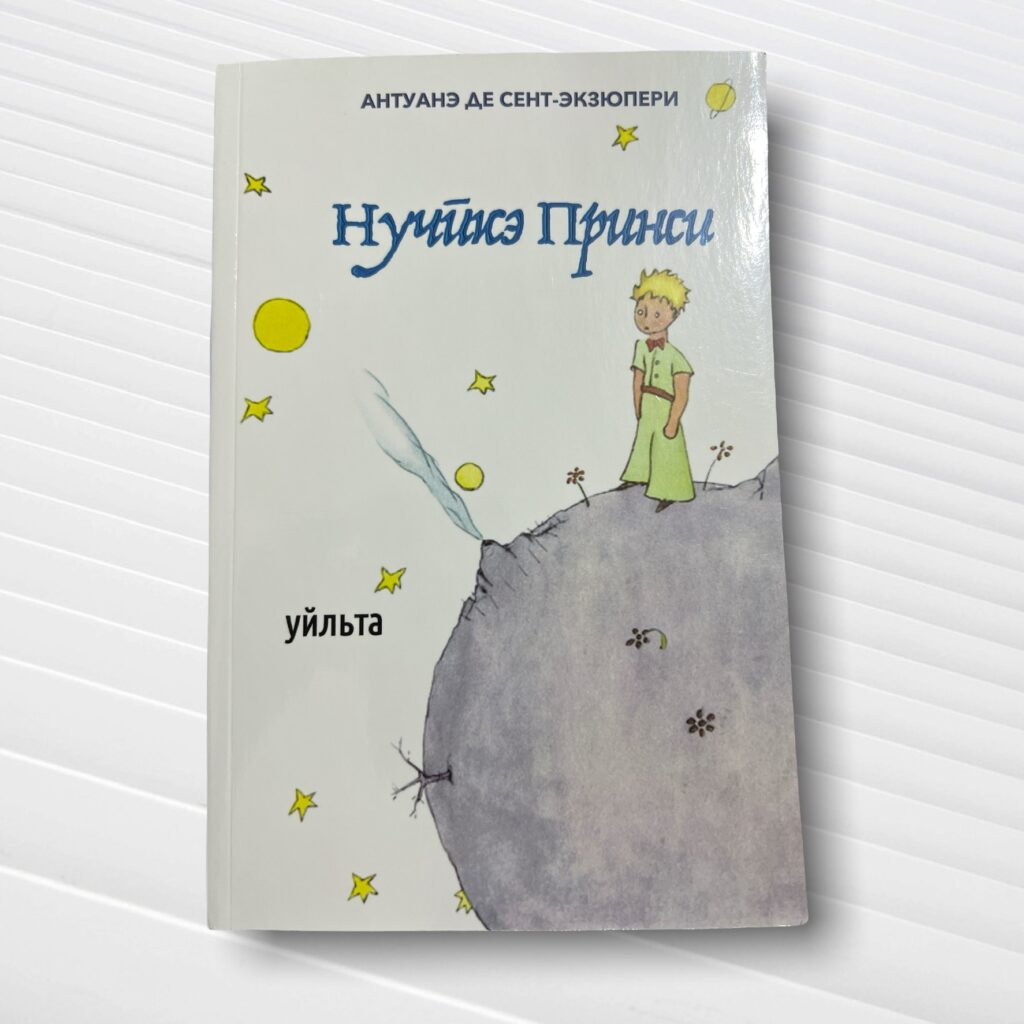
Нучӣкэ Принси / Nutshiike Prinsi — in Uilta language.
Uilta (ульта, likely from ulaa, domestic reindeer, the animal at the very centre of the people’s identity) is a Southern Tungusic language, closest in kinship to Nanai and Ulcha on the mainland opposite, though for over a century outsiders knew it chiefly as Orok. It survives today only on Sakhalin Island, split between a northern Doronneni dialect around the Tym river village of Val and a southern Poronaysk dialect, and by the most recent counts barely eight to ten people still speak it fluently, out of some three to four hundred who claim Uilta descent, ranking it among the most critically endangered languages anywhere on earth.
Traditionally the Uilta herded reindeer through Sakhalin’s forests, fished salmon each summer, and revered the bear as the most sacred of spirits, trading for centuries with their island neighbours the Ainu and the Nivkh and, through them, with Manchu and Chinese posts across the Bay of Tartary. That ancient web of contact was severed when Russia and Japan drew a border across the island at the fiftieth parallel in 1875, then further disrupted under Japanese rule after 1905, when in 1926 authorities forcibly gathered Uilta and Nivkh families into the purpose built village of Otasu and schooled their children in Japanese language and Shinto ethics rather than their own, leaving a whole generation quietly ashamed to speak Uilta at all. Even so, those same families were denied Japanese citizenship until 1945, the very years in which roughly thirty young Uilta men had already been conscripted as covert border scouts against the Soviet Union.
Grammatically Uilta rewards close attention: eight vowels with contrastive length and fourteen consonants build words under a strict vowel harmony that keeps its close, neutral and open vowel classes from ever mixing within one word, while every syllable must run to at least two morae, ruling out the short blunt monosyllables common elsewhere in Tungusic. With no fixed writing system until a first primer appeared in 2008, and living fluent speakers now countable on two hands, Uilta occupies an extraordinarily narrow meeting point of three worlds at once, its Tungusic mainland cousins Nanai and Ulcha across the strait, the wholly unrelated isolates Nivkh and Ainu sharing its own island, and the Russian and Japanese state tongues that, between them, have done more than any grammatical feature to decide whether it survives at all.
Download the PDF file here: [LINK]