
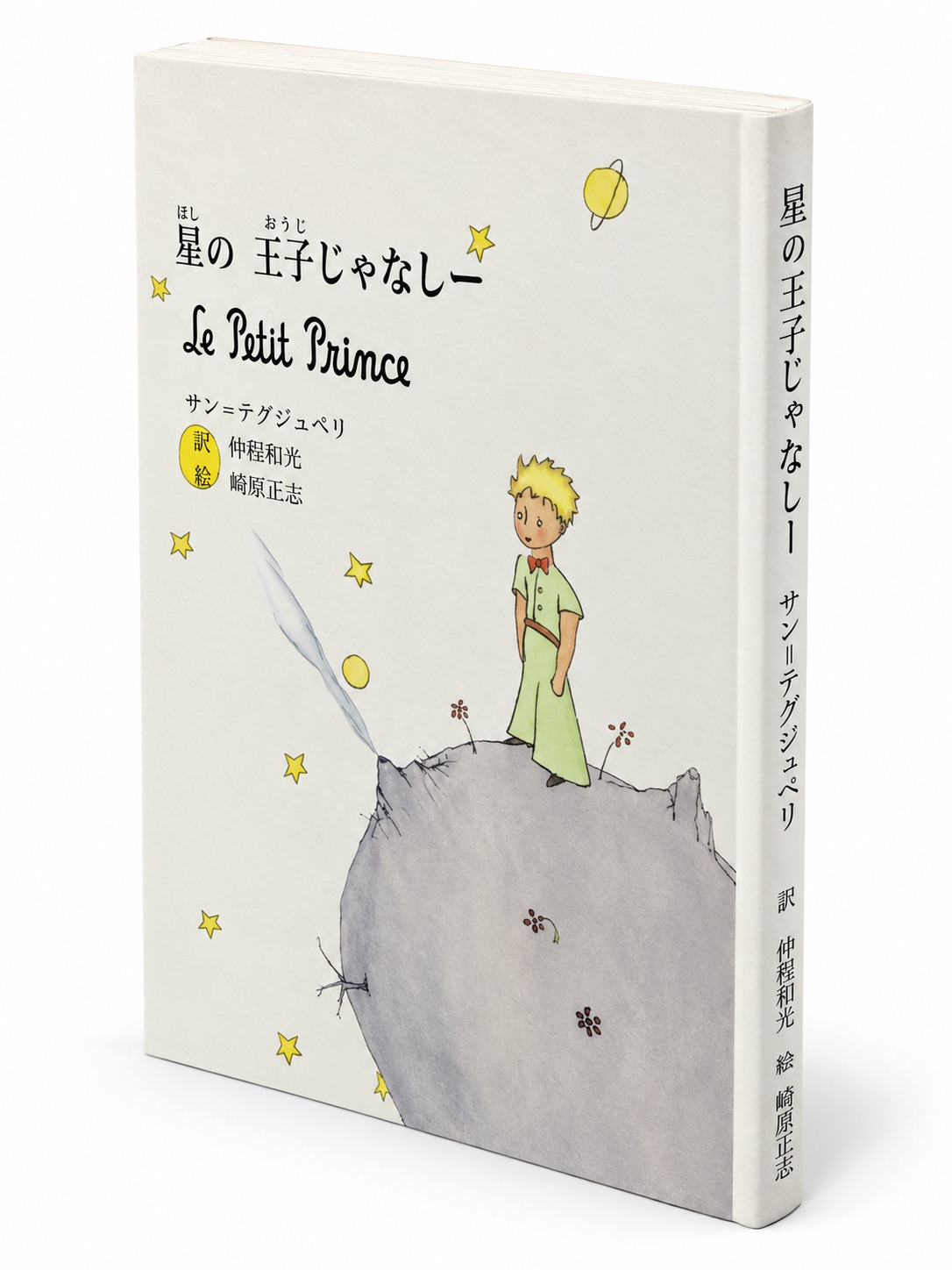
星の王子さま (ほしのおうじさま — Hoshi no Ōjisama), in Kunigami language.
Kunigami (山原言葉, Yanbaru kutuba) belongs to the Japonic language family, in its Ryukyuan branch alongside Amami and Okinawan. It’s usually classified as Northern Ryukyuan, distinct from the Southern Ryukyuan languages (Miyako, Yaeyama, Yonaguni) further south. Within Northern Ryukyuan, scholars debate its exact placement. Some group it simply as “Northern Okinawan,” a close sister to Central/Southern Okinawan (the Shuri-Naha-based Uchinaaguchi); others cluster it with southern Amami dialects based on shared sound features. Either way, it’s a close relative of Okinawan, not the same language.
Geographically, Kunigami is native to Yanbaru, which is the mountainous, densely forested northern third of Okinawa Island (today’s Kunigami District and Nago), plus a few outlying islands. This territory corresponds to the old kingdom of Hokuzan, one of three rival polities on Okinawa before their unification into the Ryukyu Kingdom in 1429. Hokuzan’s former capital, Nakijin, still serves as the reference dialect, much as Shuri speech anchors standard Okinawan. Set apart from the courtly culture of Shuri, Kunigami culture grew instead around Yanbaru’s forestry, subsistence farming, and fishing (one of Japan’s most biodiverse regions) with local folk songs and oral tradition carrying the language, which speakers themselves often call kutuba or simaagutsii (“island speech”).
Kunigami and mainland Japanese split from a common ancestor well over a thousand years ago, so it’s a sister language to Japanese, not a dialect of it — comparable to how Dutch relates to German. Japan long called it a hōgen (“dialect”) anyway, a framing reinforced by assimilationist policies like the hōgen fuda, which shamed schoolchildren for speaking Ryukyuan languages, and by postwar spread of Standard Japanese. UNESCO now classifies it as endangered, with only a small, aging population of fluent speakers remaining, kept alive mainly through local heritage and revitalization efforts.