
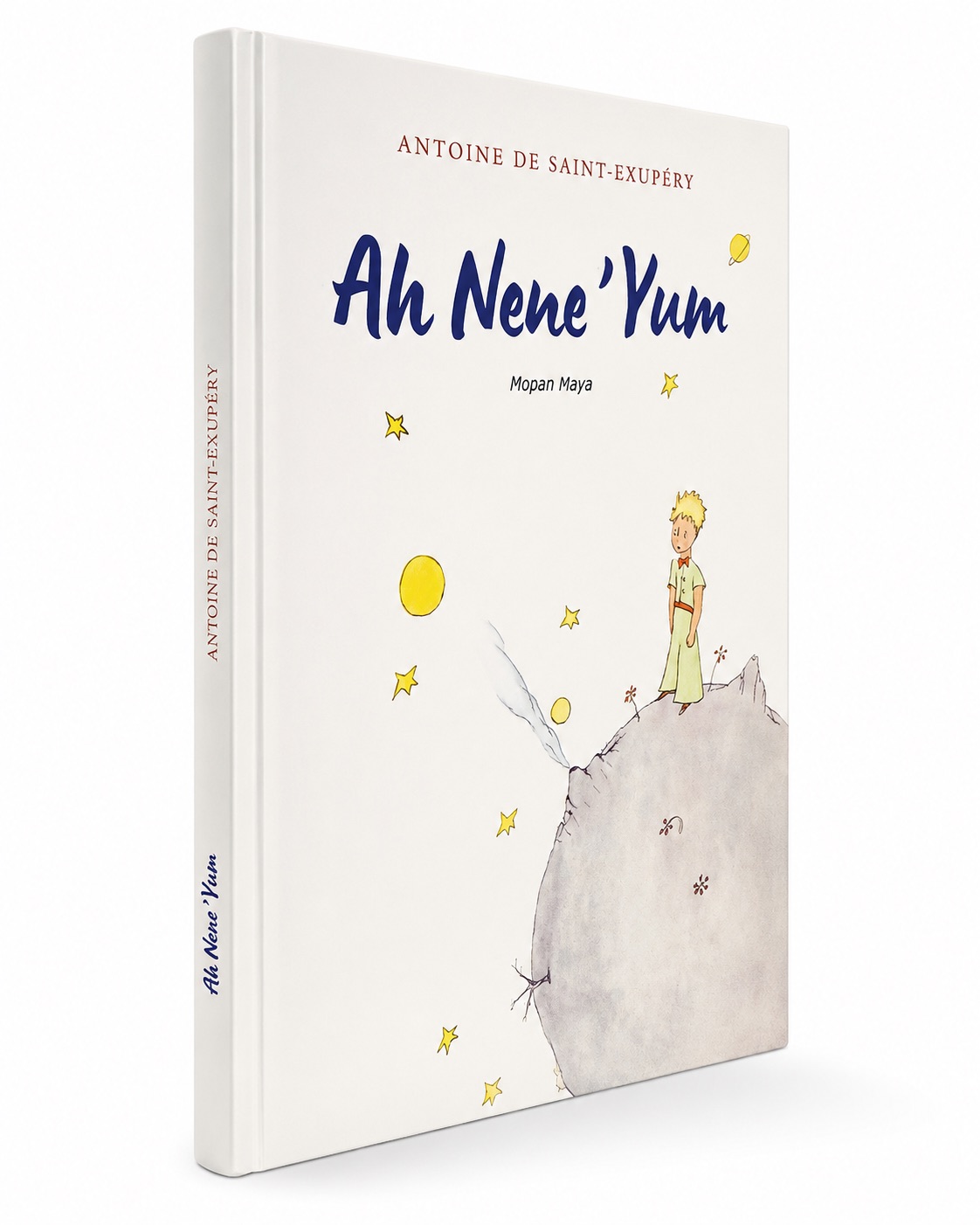
Ah Nene’ Yum — in Mopan language.
Mopan is a Mayan language spoken by approximately ten thousand people in the Toledo District of southern Belize and in the Petén region of northeastern Guatemala, making it one of the smaller surviving members of the Yucatecan branch of the Mayan family. Its closest relative is Itzaj, a critically endangered language of the Guatemalan Petén with only a handful of fluent elderly speakers remaining, and together they form the Mopan-Itzaj subgroup within Yucatecan — distinct from the far larger Yucatec Maya, spoken by several hundred thousand people across the Mexican Yucatán peninsula, though sharing with it the characteristic phonological and grammatical features that mark the Yucatecan branch: a complex system of aspect rather than tense, elaborate positional vocabulary, and the ergativity that characterises Mayan languages generally. More distantly, Mopan belongs to the broader Mayan family of some thirty languages stretching from the Yucatán through Guatemala and into Chiapas and Honduras — a family whose internal diversity is roughly comparable to that of the Romance languages, and whose speakers have maintained continuous cultural presence in Mesoamerica for at least four thousand years.
The Mopan Maya are the descendants of communities who retreated southward into the forests of the Petén and Toledo during the prolonged disruptions of the colonial period, maintaining a degree of cultural and linguistic autonomy that the more accessible Yucatec communities could not. Their territory in southern Belize — a region of limestone hills, karst rivers, and dense subtropical forest — was among the last areas of Central America to experience sustained colonial penetration, and this relative isolation preserved both the language and the ceremonial life that accompanies it. Mopan culture is organised around the agricultural cycle of maize, beans, and squash, with an elaborate ritual calendar governing planting, harvest, and the propitiation of the earth lords — tzultac’as — whose goodwill determines whether the milpa yields or fails. The Catholic faith brought by Spanish missionaries was absorbed into this cosmological framework rather than replacing it, producing the syncretic religious practice common across Mayan communities, in which Christian saints and pre-Columbian earth spirits occupy the same devotional universe without apparent contradiction.
The Mopan language faces the pressures common to small indigenous languages in postcolonial states — the dominance of Spanish in Guatemala and English in Belize in education, employment, and media creates powerful incentives for linguistic assimilation among the young, and the community’s small size limits the resources available for revitalisation. Nevertheless, Mopan maintains a committed speaker community and has benefited from documentation and literacy efforts by both academic linguists and community organisations. Ah Nene’ Yum — the Mopan title of Le Petit Prince, in which ah nene’ denotes a young male person of small stature and yum carries connotations of lordship or mastery — is a translation of considerable cultural significance, situating Saint-Exupéry’s wandering prince within a linguistic tradition whose own literature encompasses some of the most sophisticated astronomical, calendrical, and philosophical texts produced anywhere in the pre-Columbian Americas. That the little prince’s questions about what matters, what endures, and what the eye alone cannot perceive should be posed in Mopan is entirely fitting: they are, after all, the questions that the Maya have been asking, in their many tongues, since long before any European set foot in the forests of the Petén.