
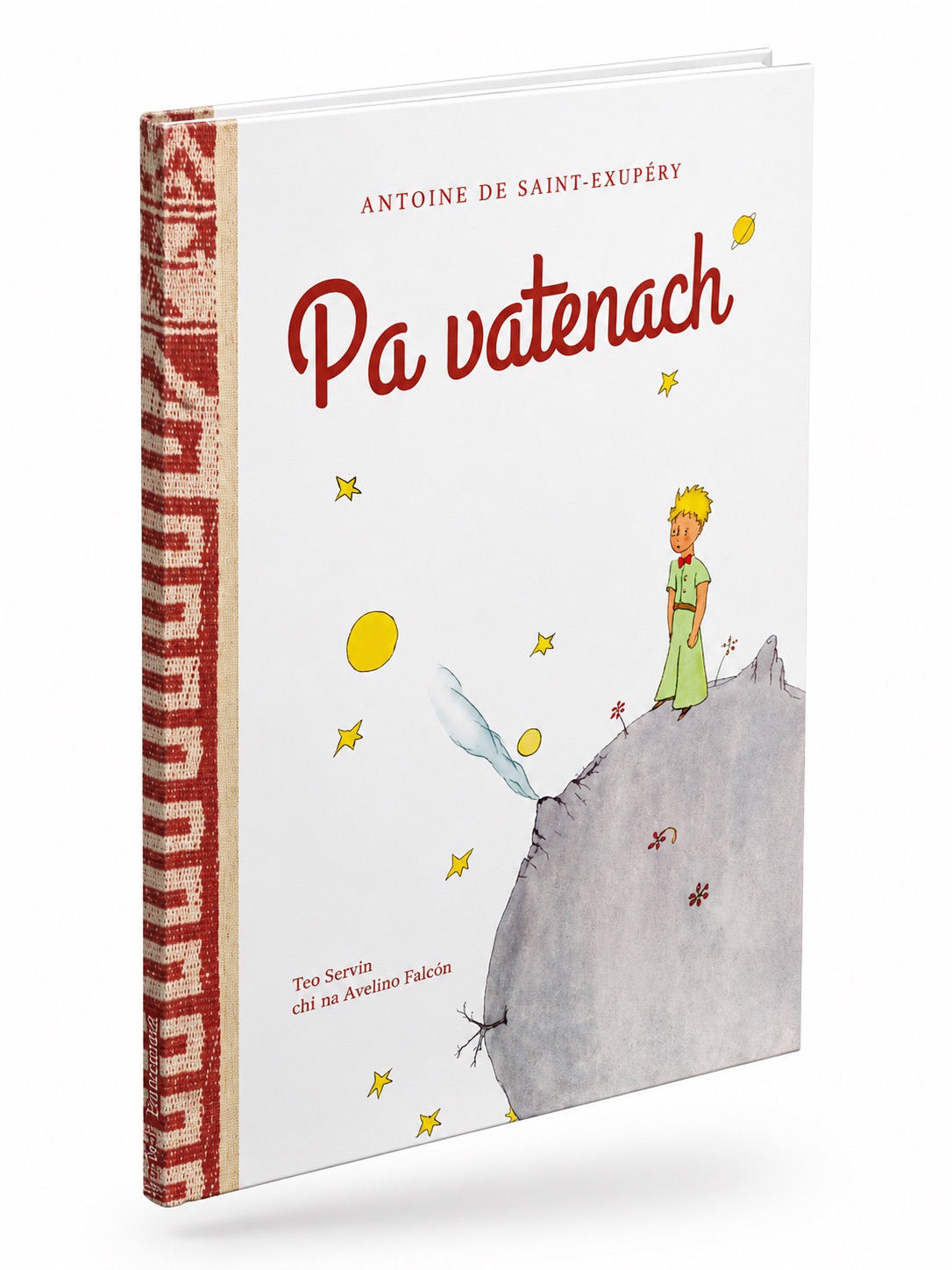
Pa Vatenach — in Nivaclé language.
Nivaclé, known in older literature by the exonym Chulupí or Ashluslay, is a language of the Gran Chaco, the vast semi-arid lowland plain stretching across western Paraguay, northeastern Argentina, and southeastern Bolivia. It belongs to the Matacoan family, a group of perhaps five related languages indigenous to the Chaco region, whose other members include Wichí, Chorote, and Maká — languages sharing structural and lexical features that distinguish them clearly from the surrounding Tupian, Quechuan, and Guaicuruan families whilst remaining unrelated to any language group outside the Chaco itself. Nivaclé is spoken by approximately fifteen thousand people, principally in the Paraguayan Chaco west of the Paraguay River and in the Argentine province of Salta, making it one of the more robust indigenous languages of the southern cone in terms of intergenerational transmission. Its immediate neighbours include Wichí and Chorote of the same Matacoan family, Toba Qom and Pilagá of the Guaicuruan family to the southeast, and Guaraní — the great vehicular language of Paraguay — whose influence permeates the linguistic landscape of the entire region and with which Nivaclé speakers are frequently bilingual.
The Nivaclé are traditionally a semi-nomadic people of hunters, fishers, and gatherers who exploited the Chaco’s demanding environment with considerable ecological sophistication — tracking seasonal water sources, harvesting the pods of the algarrobo tree, fishing the rivers that drain the plain, and hunting the peccaries, tapirs, and rheas that populate the thornbush. The Chaco itself is one of South America’s most challenging ecosystems: brutally hot in summer, subject to periodic flooding, and characterised by an impenetrable thornbush vegetation that defeated Spanish colonial penetration for centuries and earned the region the name Gran Chaco Boreal — the great hunting ground — from the Quechua. The Nivaclé resisted missionisation and incorporation into the colonial economy until the late nineteenth and early twentieth centuries, when a combination of military campaigns, land alienation, and Anglican and Mennonite missionary activity transformed their circumstances radically. Today the majority of Nivaclé communities are settled, many in close association with Mennonite agricultural colonies in the Paraguayan Chaco, a juxtaposition of Low German religious conservatism and indigenous Chaco culture that is one of the more improbable and quietly fascinating social arrangements in the Americas.
Nivaclé is a polysynthetic language of considerable morphological complexity, capable of encoding in a single verbal form information about agent, patient, direction, aspect, evidentiality, and social relationship that English would require an entire sentence to express. It is tonal, with a system of pitch distinctions that carry grammatical as well as lexical weight, and it possesses a rich system of spatial and environmental vocabulary reflecting the Chaco landscape and the ecological knowledge its speakers have accumulated across millennia. The language faces the familiar pressures of Guaraní dominance in Paraguay and Spanish in Argentina, with younger generations increasingly bilingual and the prestige of indigenous language transmission eroding under economic and educational pressure.
The title Pa Vatenach — in which pa functions as a determiner and vatenach carries the sense of smallness and youth — places the little prince immediately within a Nivaclé conceptual world, and the translation itself represents both a literary achievement and a statement of cultural vitality: that a language of the thornbush and the river, spoken by fifteen thousand people in one of South America’s most remote regions, is adequate to the questions that Saint-Exupéry considered universal — because, as the Nivaclé have always known, they are.