
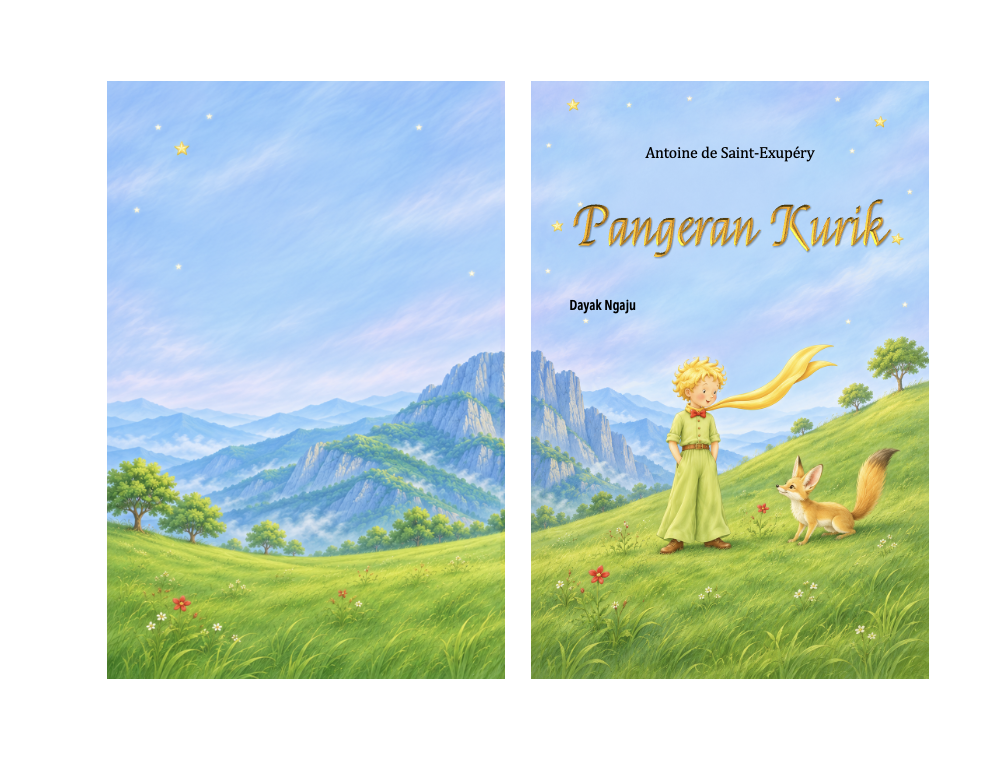
Pangeran Kurik — in Dayak Ngaju language.
Ngaju (Basa Ngaju) belongs to the Barito branch of the Austronesian family, spoken along the great brown rivers of Central Kalimantan, the Kahayan, the Kapuas and the Katingan, and around the provincial capital of Palangka Raya, where it serves not only as the mother tongue of the Ngaju Dayak but as a widely used lingua franca among the province’s many Dayak peoples. Its place in the family tree holds one of the most astonishing stories in all of linguistics, for the Barito languages of southern Borneo are the closest relatives of Malagasy, spoken some seven thousand kilometres away across the Indian Ocean in Madagascar, the legacy of seafarers who set out from this region well over a millennium ago and carried their speech to the coast of Africa, so that a Ngaju speaker and a Malagasy villager still share, beneath the drift of the centuries, words for the same rice, the same rivers and the same ancestors.
The Ngaju world was traditionally ordered around the riverside longhouse (huma betang) and the indigenous faith of Kaharingan, whose cosmos is held in balance between the upper world of Ranying Mahatala Langit, associated with the hornbill, and the underworld of Jata, embodied in the water serpent, a duality that runs through Ngaju art, architecture and ritual. Its greatest ceremony is the tiwah, an elaborate secondary funeral in which the bones of the dead are exhumed, purified and placed in a carved ossuary (sandung) so that the soul may complete its journey to the village of the ancestors, and its priests, the basir, chant in a distinct sacred register known as the language of the Sangiang, the divine beings, a ritual tongue rich in parallelism and poetic metaphor that lies quite apart from everyday speech. Kaharingan was officially recognised in 1980 under the umbrella of Indonesian Hinduism, an arrangement that allowed this ancient Bornean faith to endure within the modern state.
Ngaju also earned an unusual early place in written scholarship, for in the 1850s the Rhenish missionary August Hardeland published a grammar and a dictionary of the language together with Bible translations, making it one of the first languages of Borneo to be systematically documented and giving it a literary standard long before most of its neighbours. Within the Barito family it sits in the western group alongside closely related Kapuas, Katingan, Ot Danum and Bakumpai, the last spoken by Muslim communities who share much of Ngaju’s vocabulary while following a different faith, while to the east stand Ma’anyan and its kin, the nearest of all to Malagasy. Around it the Malayic Banjar of the coastal trading towns has long exerted a strong pull through commerce and Islam, and Indonesian now presses in through schools and administration, yet Ngaju remains the confident voice of the Central Kalimantan interior, a language of rivers and longhouses whose distant echo can still be heard, quite improbably, on the far side of an ocean.