
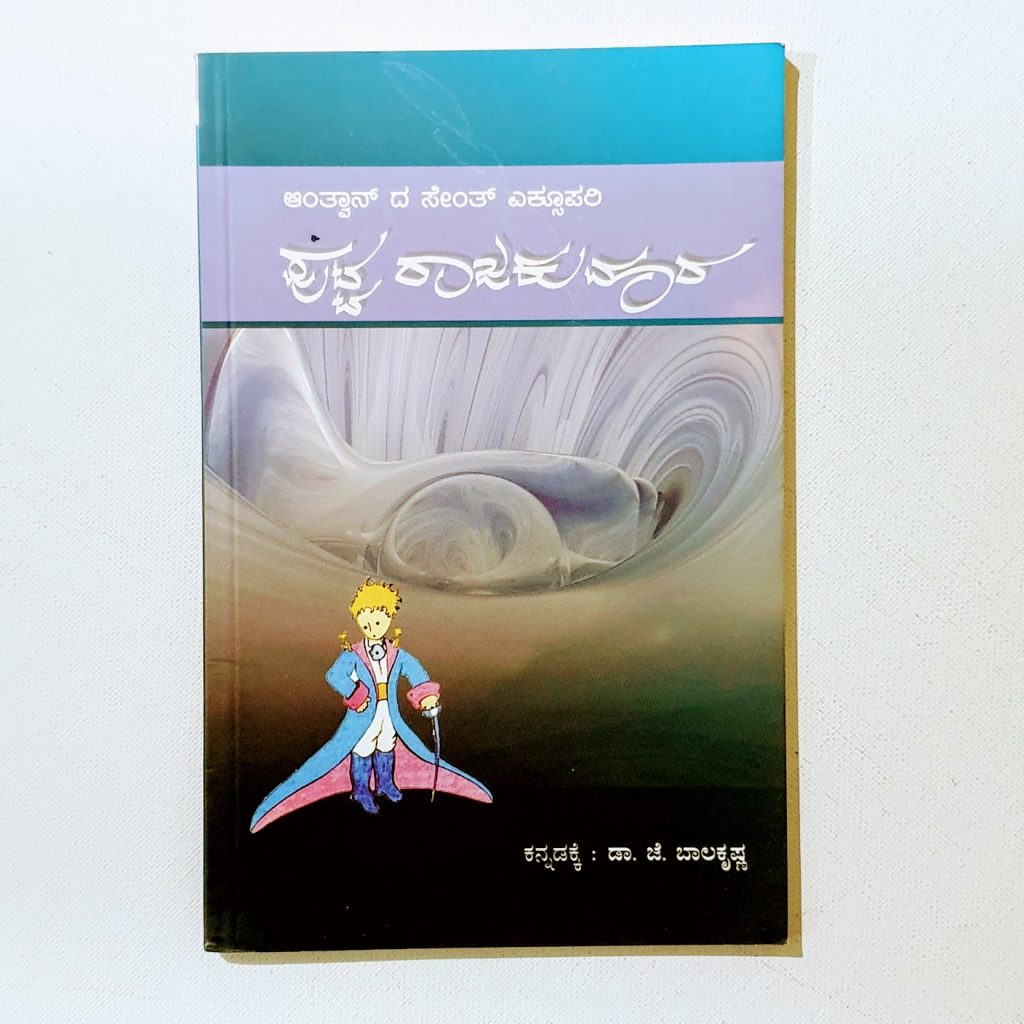
ಪುಟ್ಟ ರಾಜಕುಮಾರ (Putta Rajakumara) — in Kannada.
Kannada (ಕನ್ನಡ) belongs to the Southern branch of the Dravidian family, placing it alongside Tamil, its closest major relative, and Malayalam and Tulu, both spoken within shouting distance of Kannada country itself, all four descending from a common Proto South Dravidian ancestor quite unrelated to the Indo-European languages that surround them across most of the rest of India. That deep independence has not meant isolation. Centuries of contact with Sanskrit, arriving through religion, court life and scholarship rather than conquest, left Kannada with a vast layer of Sanskrit loanwords sitting atop a thoroughly Dravidian grammar, so that a single sentence can carry Sanskritic vocabulary inflected by endings and agglutinative structures that Sanskrit itself never had.
Kannada’s own recorded history reaches back further than most of its neighbours can claim in writing. The Halmidi inscription, dated to around 450 CE, stands as the oldest surviving specimen of Kannada prose, and by the ninth century the language already possessed a sophisticated treatise on poetics, the Kavirajamarga, written for a Rashtrakuta king. Pampa, celebrated as the father of Kannada poetry, gave the language its epic voice in the tenth century, and by the twelfth the Vachana movement, a body of plain spoken devotional verse associated with the social reformer Basavanna, turned Kannada into a vehicle for radical religious and social thought written not for courts but for ordinary people. In recognition of this unbroken literary depth, the Indian government named Kannada one of the country’s classical languages in 2008, a status shared with only a handful of others including Tamil, Telugu and Sanskrit itself.
Kannada writes itself in a script descended, like Telugu’s, from the old Kadamba and Chalukya varieties of Brahmi, giving the two languages visibly related but no longer identical alphabets, each rounded letterform a distant cousin of the other’s. Phonologically it keeps the retroflex consonants and vowel length distinctions typical of Dravidian languages, layered with a rich system of noun cases and verb agglutination that lets a single Kannada word do the work of an entire English phrase. Spoken today by around forty five million people concentrated in Karnataka, with Tulu and Kodava as smaller Dravidian relatives still spoken within the same state, Kannada stands as one of the clearest living demonstrations that India’s linguistic story was never simply an Indo-Aryan one, but has always run in at least two deep, independent streams at once.