
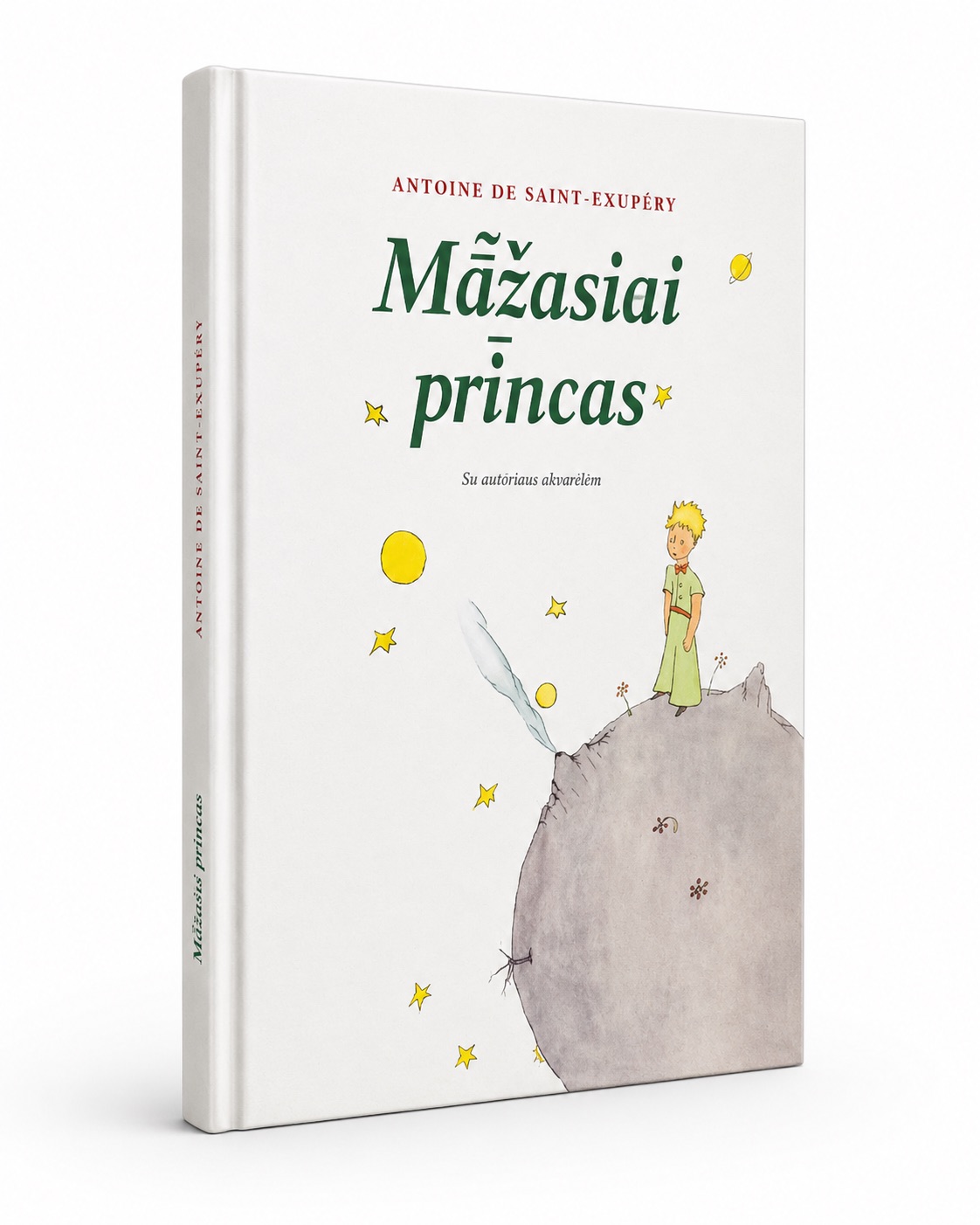
Mã̄̃žasiai Pri̇̄ncas — in Aukshtaitian language.
Aukshtaitian — from Lithuanian aukštas, meaning high, and denoting the highland dialects of the Lithuanian interior — is one of the two principal dialect groups of Lithuanian, the other being Samogitian, spoken in the lowland northwest. Within Aukshtaitian, the major division falls between Western and Eastern varieties, with the Eastern Aukshtaitian dialects further subdivided by region: the Utena dialect — uteniškių šnekta — used in the translation Māžasiai Princas belongs to this eastern grouping, spoken in and around the town of Utena in northeastern Lithuania. Lithuanian itself occupies a position of extraordinary interest in Indo-European linguistics: it is the most conservative living Indo-European language, preserving features of Proto-Indo-European phonology and morphology that have been lost in virtually every other branch of the family. The Lithuanian word for god, dievas, is directly cognate with Sanskrit deva, Latin deus, and Greek Zeus — a thread of linguistic continuity stretching back five thousand years that has led generations of comparative linguists to regard Lithuanian as an indispensable witness to the reconstructed ancestral language of half the world’s speakers.
Baltic as a branch of Indo-European comprises only two surviving languages — Lithuanian and Latvian — with the closely related Old Prussian having succumbed to Germanisation by the early eighteenth century. Lithuanian and Latvian are sufficiently distinct to be mutually unintelligible in ordinary conversation, though a linguistically trained speaker of one can identify much in the other. Latgalian, spoken in eastern Latvia, occupies the familiar disputed territory between dialect and language. The Baltic languages are geographically surrounded by Slavic to the east and south, Germanic to the west, and Finnic to the north — a position that has exposed them to centuries of contact influence whilst preserving a core of archaic Indo-European structure that neither Slavic nor Germanic maintained. Lithuanian in particular resisted the simplification of its case system and verbal morphology that most Indo-European languages underwent, retaining seven cases and a pitch-accent system that functions similarly to the tonal distinctions of Lithuanian’s distant cousin Sanskrit.
The Utena dialect rendered in Māžasiai Princas is identified on the title page with scholarly precision as Rytų aukštaičių uteniškių šnekta — Eastern Aukshtaitian, Utena subdialect — and the book’s prefatory material, authored by Prof. Vytautas Kardelis and Dr. Daiva Kardelytė-Grinevičienė, constitutes a miniature dialectological primer, explaining to readers unfamiliar with the dialect its three-way vowel length distinction, its distinctive consonantal softening, and the specific orthographic conventions adopted to represent sounds that Standard Lithuanian orthography does not encode. This scholarly apparatus is characteristic of Lithuanian dialect literature, which has long been accompanied by the self-consciousness of a small nation acutely aware that its linguistic diversity is a form of cultural wealth requiring active documentation.