
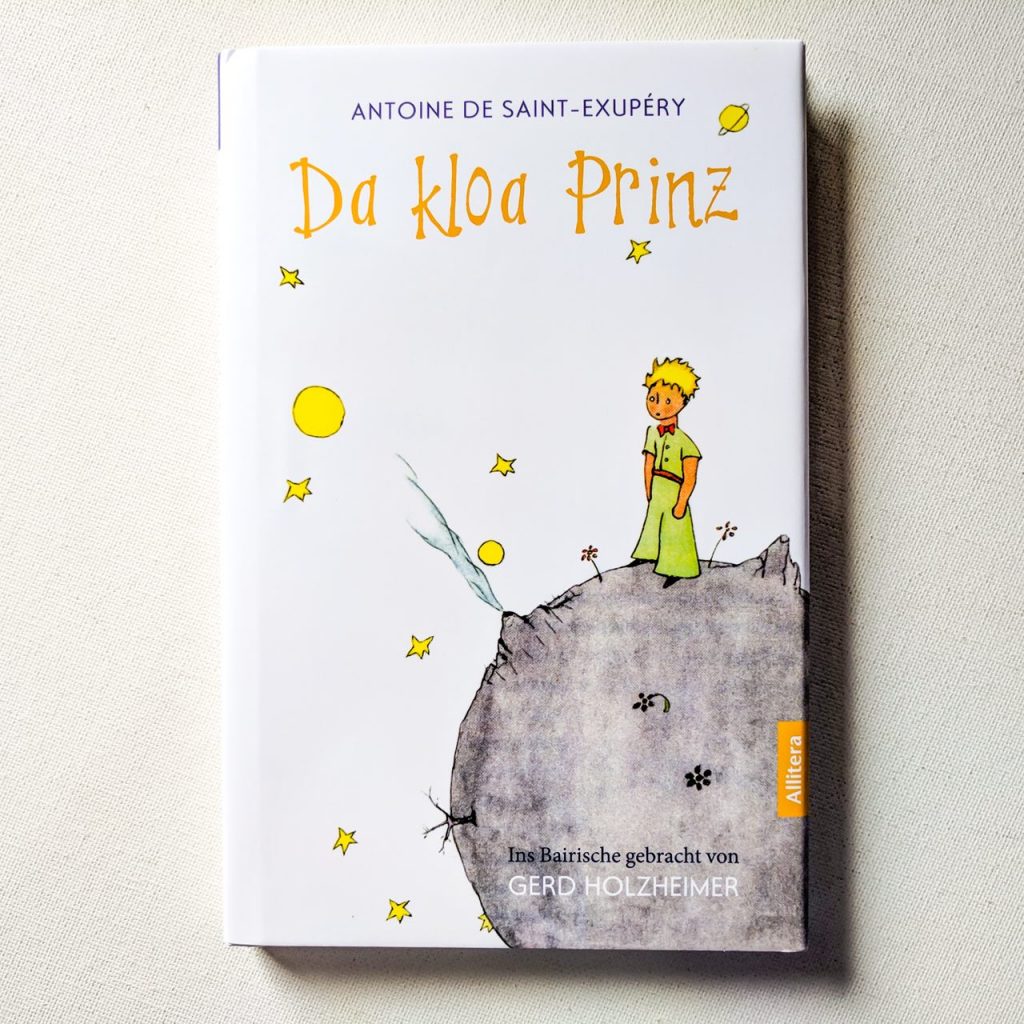
Da Kloa Prinz – in Bavarian.
Bavarian (Bairisch) belongs to Upper German (Oberdeutsch), the branch of the German dialect continuum that carried the High German consonant shift all the way through, rather than absorbing it only partially as the Central German dialects further north tend to, making Bavarian the fullest, southernmost expression of that historic sound change. The divergence from standard German runs deep enough that UNESCO’s own atlas of endangered languages classifies Bavarian not as a mere dialect but as a distinct language in its own right, definitely endangered, spoken not only across most of the modern German state of Bavaria but also, rather strikingly, across almost the whole of neighbouring Austria, including Vienna, and in the German speaking valleys of South Tyrol (Südtirol) in northern Italy, meaning Bavarian speech spills confidently across three modern national borders without much regard for where any of them happen to run.
That confidence has genuinely deep historical roots. The Bavarian tribes, the Baiuvarii, coalesced in late antiquity out of a mix of Germanic settlers and the remaining Romanised population of the former Roman provinces along the upper Danube, their very name thought to mean people of Baiahaim, the land of the Boii, pointing back to an earlier Celtic presence and a westward migration story stretching all the way to Bohemia. From that early medieval beginning, Bavaria enjoyed an unusually long and stable political existence, ruled continuously by the Wittelsbach dynasty from 1180 until 1918, over seven centuries under a single ruling house, a continuity few other German speaking territories can match and one that has left Bavarians with an exceptionally strong, settled sense of regional identity, one many still place comfortably alongside, if not occasionally above, their identity as Germans.
The practical result of all this is a spoken language that a listener unfamiliar with it may struggle to follow at all, its vowels diphthongised, its consonants pushed further than standard German ever went, and, as in most everyday spoken German, its simple past tense largely abandoned in favour of the perfect tense in ordinary conversation. Bavarian identity today expresses itself through the familiar shorthand of Lederhosen, Oktoberfest, and the proudly defiant local phrase mia san mia, we are who we are, yet perhaps its most telling detail is a quieter one: Vienna, the elegant former imperial capital of an entirely separate country since 1918, still speaks its own variety of Central Bavarian (Mittelbairisch), the very same broad dialect family as Munich, a reminder that this particular linguistic identity settled into the eastern Alps long before modern states ever thought to draw a border through the middle of it.