
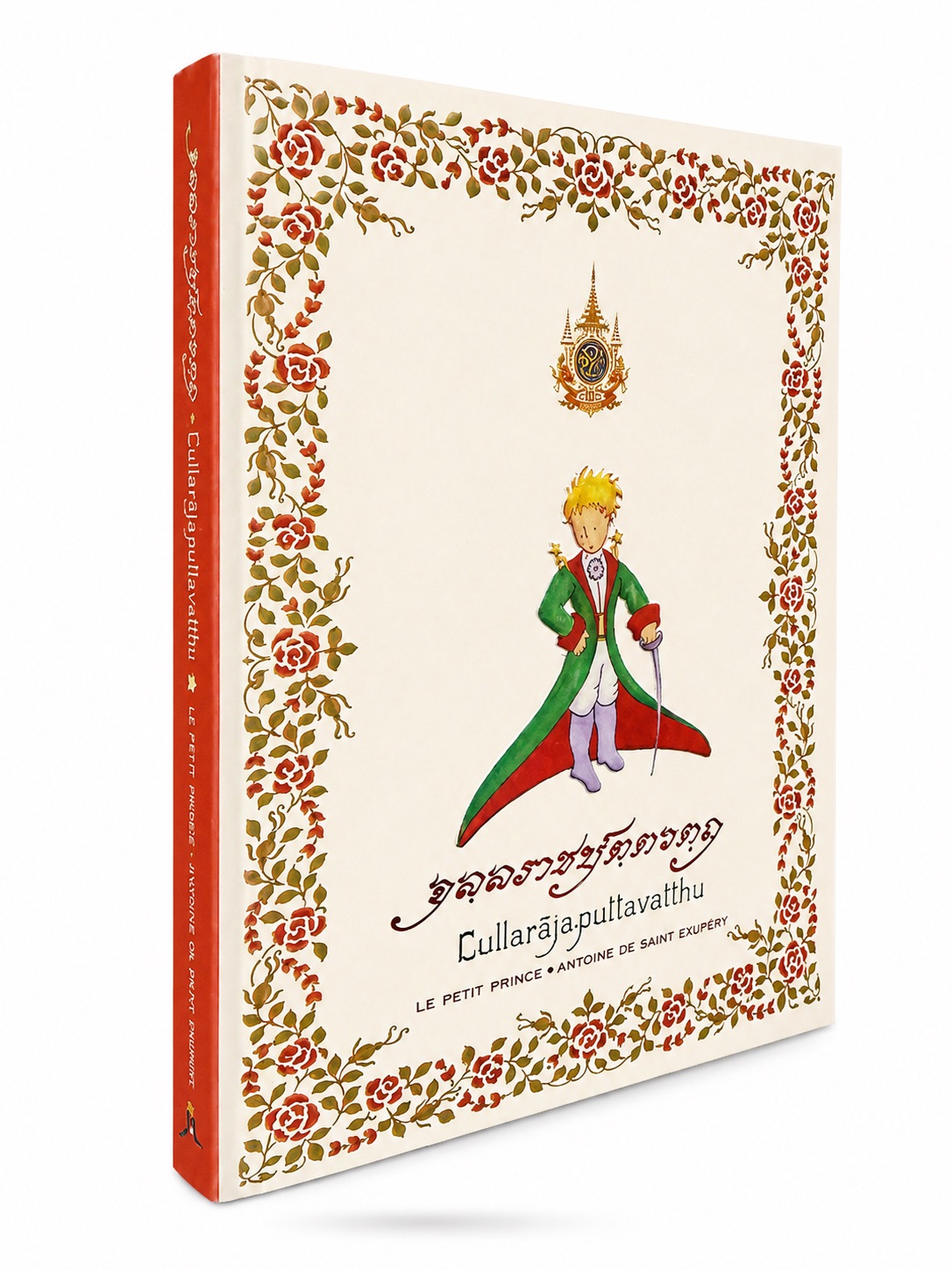
จุลลราชปุตตวตฺถุ (Cullarāja Puttavatthu) — in Pāli language.
Pāli occupies a singular position in the taxonomy of human languages. It is at once a living tongue and an ancient one, a language of no country yet spoken daily across a vast arc of the Buddhist world stretching from Sri Lanka to Japan. Belonging to the Middle Indo-Aryan branch of the Indo-European family, it evolved from the Prakrits — the vernacular languages of the Indian subcontinent — sometime in the first millennium BCE, diverging from Sanskrit in the direction of greater phonological simplicity whilst retaining much of that language’s structural elegance. It is the canonical language of Theravāda Buddhism, the vehicle in which the Buddha’s teachings were committed to writing in Sri Lanka around the first century BCE, and it has been maintained ever since as a sacred and scholarly medium by monastic communities across Southeast Asia. Unlike Sanskrit, which accrued the prestige of courtly and Brahmanical culture, Pāli retained a certain austere intimacy. The tradition holds that the Buddha himself taught in a vernacular close to it, making it not the language of the gods but the language of liberation, accessible in principle to all who sought it.
The cultural world of Pāli is inseparable from the Tipiṭaka — the Three Baskets of Theravāda scripture — and from the vast commentarial literature that grew around it over two millennia. In Thailand, Myanmar, Cambodia, Laos, and Sri Lanka, the study of Pāli remains central to monastic formation: young monks chant in it, senior scholars compose in it, and royal ceremonies invoke it as the language of highest solemnity. Thai Buddhist culture in particular has maintained an unusually vigorous tradition of Pāli scholarship, with a graded examination system — the Parian Dhamma — that tests monks on their command of the language at nine levels of increasing difficulty. It is within this living scholarly tradition that the present translation was conceived by a monk-scholar combining deep Pāli formation with the literary sensitivity required to render Saint-Exupéry’s deceptively simple prose into a language whose canonical register is among the most demanding in the world.
The title chosen for the Pāli edition is Cullarājaputtavatthu — rendered in romanised Pāli as Cullarājaputtavatthu, with the subtitle Antvāna de Sentessūperinā racitaṃ (composed by Antoine de Saint-Exupéry). The title is a masterpiece of linguistic tact: culla means small or lesser, rājaputta means son of a king or prince, and vatthu is a Pāli term for a story, tale, or account: a word carrying the specific resonance of the Jātaka tales, the canonical stories of the Buddha’s previous lives. To title the work Cullarājaputtavatthu is thus to place it, gently but deliberately, within the tradition of Buddhist narrative literature, suggesting that the little prince’s wandering and wondering belongs to the same family of moral tale-telling that has edified Buddhist communities for twenty-five centuries.
The edition itself is a production of considerable distinction. Published in Bangkok in 2026, it carries the Royal Emblem of His Majesty King Vajiralongkorn on the occasion of the King’s sixth-cycle birthday anniversary — a mark of royal patronage that situates this translation within the highest register of Thai cultural life, where Buddhist scholarship and royal ceremony have been entwined since the Sukhothai period.
What makes Cullarājaputtavatthu genuinely extraordinary is the degree to which Pāli and Saint-Exupéry prove, against all expectation, to be kindred sensibilities. The little prince’s method — patient, iterative questioning; the conviction that adults see only surfaces; the fox’s teaching that what is essential is invisible to the eye — resonates with profound directness against a tradition in which the dhamma is transmitted not through doctrine alone but through story, encounter, and the quality of attention one brings to the world. The rose, the baobabs, the drawing of a sheep inside a box: these are, in their way, the stuff of which upāya — skilful means — is made, the pedagogical indirection by which a teacher leads a student to understanding that cannot be directly stated. That a Thai monk should have recognised this affinity, and chosen to honour it by rendering the work into the oldest living literary language of Asia, is an act of interpretive intelligence that the little prince himself, one feels certain, would have understood entirely.