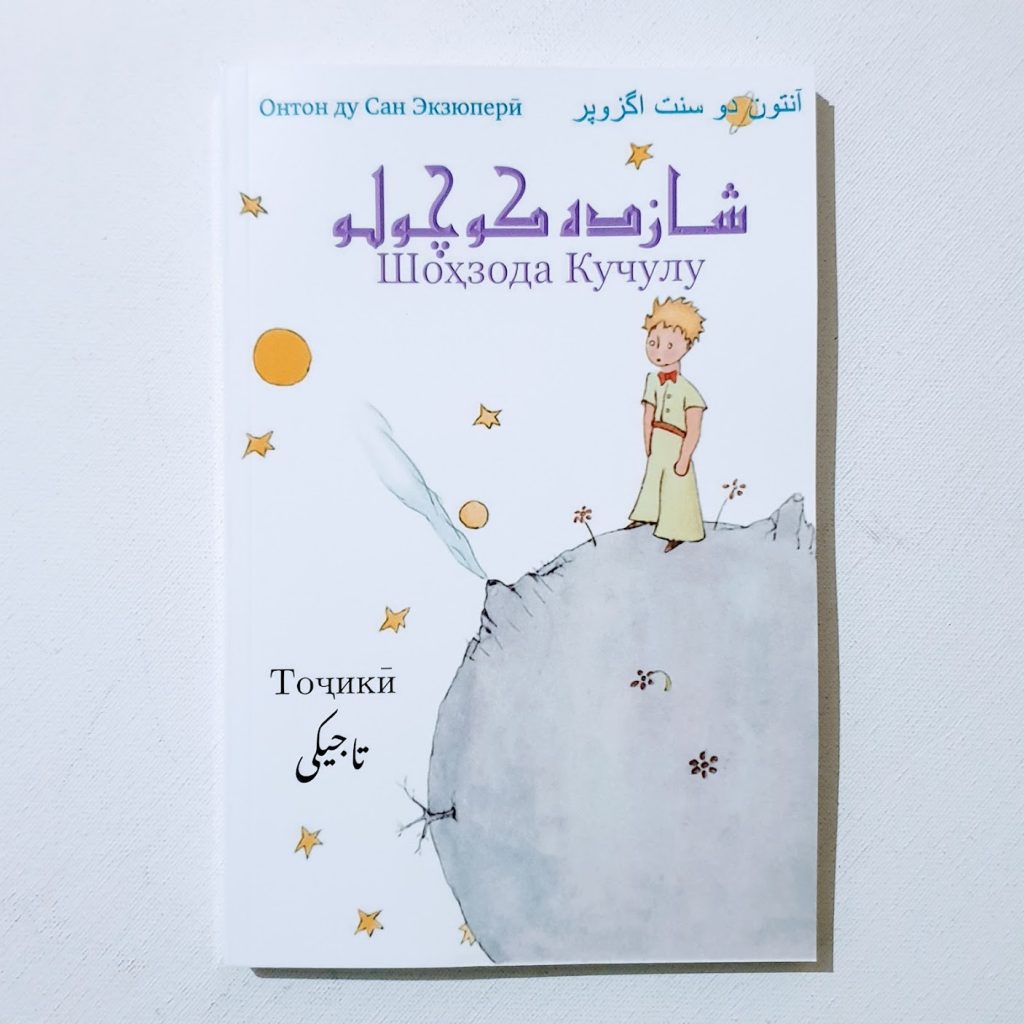
شــــازده كوچـولـو / Шоҳзода Кучулу / Syahzada Kujulu — in Tajik.
Тоҷикӣ, tojikī, is a Western Iranian language, a continuation of the same Persian that also gives Iran its Farsi and Afghanistan its Dari, so close to both that for most of its history speakers simply called it forsī, Persian, and only settled on the name Tajik as a mark of separate nationhood within living memory, formally declared the state language of Tajikistan as recently as 1989. Whether Tajik, Dari and Farsi are three languages or one language in three national costumes remains, even among linguists, as much a political question as a grammatical one, since a farmer from Samarqand and one from Mashhad, separated by a modern border neither of their grandparents recognised, can still largely follow one another.
The prestige underlying that shared inheritance was set in Bukhara itself, where the Samanid dynasty of the ninth and tenth centuries made New Persian, rather than Arabic, the language of court and poetry, and gave the Persian speaking world its first great poet, Rudaki, still honoured today in Dushanbe’s central park that bears his name. The dynasty’s founder, Ismail Samani, stands close by in bronze and gilt, and lends his own name to Tajikistan’s currency, the somoni, an entire national identity anchored, quite deliberately, to a medieval Persian court. That identity then received an unmistakable visual signature under Soviet policy in the twentieth century, which moved Tajik writing from its ancient Perso Arabic script to a Latin alphabet in 1928 and finally, in 1940, to Cyrillic, extended with six extra letters of its own, a change that cut the new Tajik Soviet Socialist Republic off, at a stroke, from the printed page of Iran and Afghanistan even as its spoken language remained largely intelligible with both.
Beyond its unique Cyrillic dress, Tajik carries a distinct accent of its own within the Persian family, shaped by long cohabitation with the Turkic world around it. Centuries of Tajik Uzbek bilingualism, especially strong around Bukhara, have left their mark on the phonology, word order and vocabulary of northern dialects, while the Soviet era added a further, heavier layer of Russian loanwords across government, science and technology, one that independence minded language planners have worked hard, since the late 1980s, to replace with native or Perso Arabic coinages instead. With some ten and a half million speakers across Tajikistan, where they form the great majority, and Uzbekistan, where many more identify as Tajik than official figures admit, the language stands today as living proof that a single Persian tongue can wear three different national faces, forsī in Tehran, dari in Kabul, tojikī in Dushanbe, and still, underneath the borders and the alphabets, largely recognise itself.
Download the PDF file here: [LINK]