
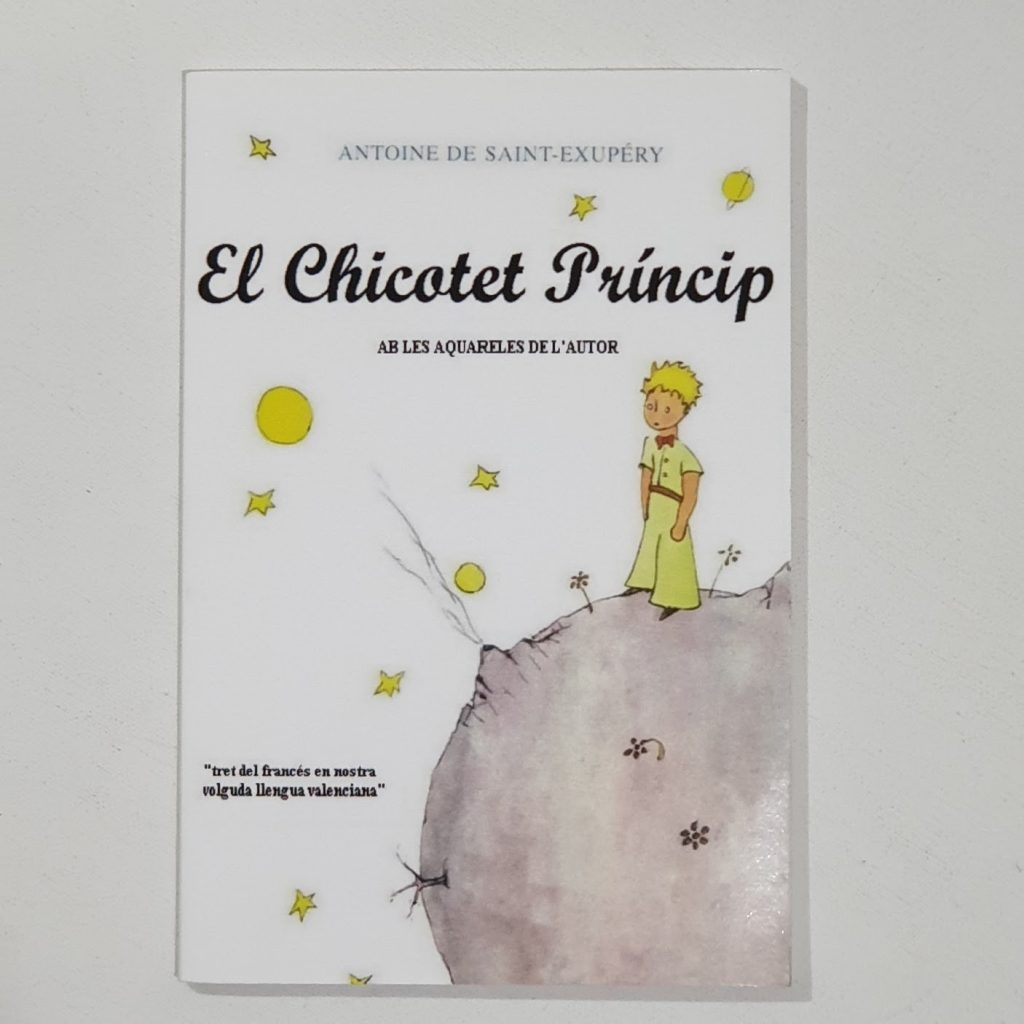
El Chicotet Príncip — in El Puig spelling of Valencian language.
The El Puig spelling, also known as the Normes del Puig, is a codification of the Valencian language created in 1979 as an alternative to the more widely accepted Normes de Castelló. It was developed by the Real Acadèmia de Cultura Valenciana (RACV) with the specific intent of differentiating Valencian from the Catalan linguistic standards. While the Normes de Castelló are the official standard used by the Valencian government and education system, the El Puig spelling is maintained by certain cultural and political associations that advocate for the linguistic independence of Valencian.
Linguistically, the El Puig spelling is unique because it prioritises local phonetic and morphological features of the Valencian speech over the academic norms of Catalonia. For example, it avoids certain Catalan graphic conventions, such as the use of the silent “h” in certain words and the use of “tz”, instead opting for spellings that reflect the historical and modern pronunciation specific to the Kingdom of Valencia. It also emphasizes the use of traditional Valencian pronouns and verb endings that have diverged from the Barcelonan standard over the centuries.
The relationship between Valencian and other languages in the region is a subject of significant social and political debate. Under the El Puig standard, Valencian is often viewed as a separate Romance language within the Occitano-Romance group, distinct from Catalan. In contrast, mainstream linguistics generally considers Valencian and Catalan to be two varieties of the same language, similar to the relationship between British and American English. Within the borders of Spain, Valencian exists alongside Castilian (Spanish), which serves as the official state language, and shares historical roots with other neighbouring tongues such as Aragonese and the various dialects spoken in Catalonia and the Balearic Islands.
In the broader context of the Valencian Community, the El Puig spelling represents a “secessionist” movement that seeks to preserve what it considers the authentic, uncorrupted identity of the Valencian people. While it is not the primary script taught in schools, it remains a vital symbol for those who wish to highlight the unique cultural and historical heritage of Valencia as a territory with its own distinct literary and linguistic lineage.