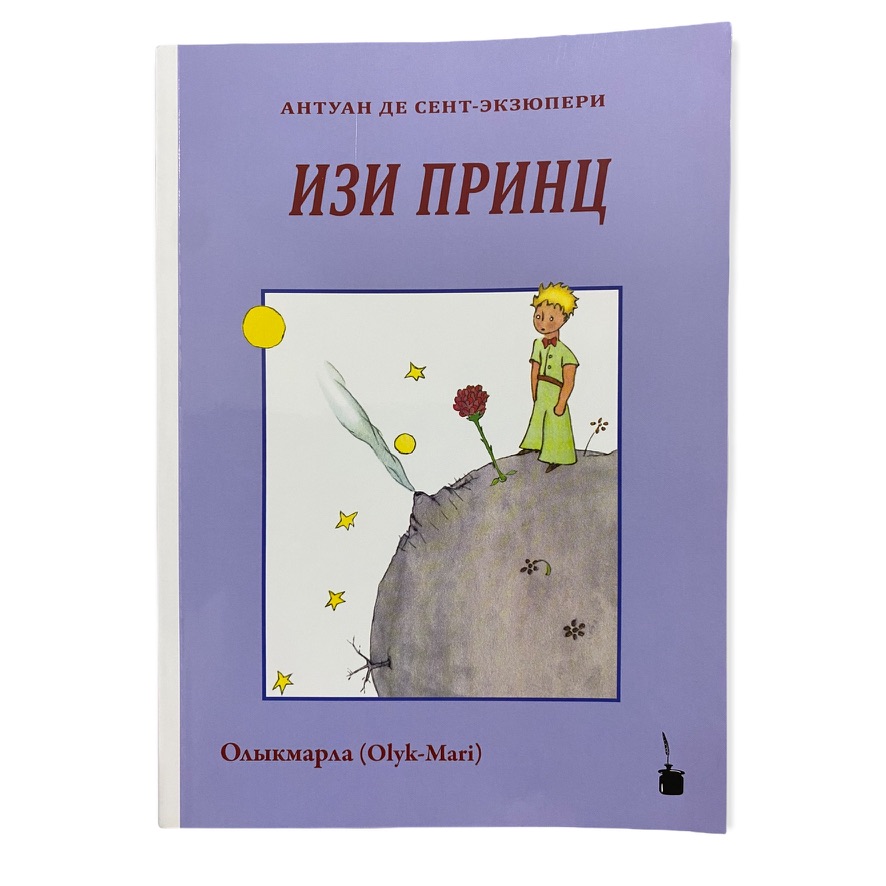
Изи Принц / Izi Prints — in Meadow Mari
Meadow Mari (олык марий, Olyk marij) or Eastern Mari belongs to the Uralic family, forming, together with its close sister tongue Hill Mari (кырык мары, Kyryk mary), the small but distinct Mari branch of that vast language group, whose more famous relatives include Finnish, Estonian and Hungarian far to the west. It is spoken along the great bend of the Volga river in the Mari El Republic and neighbouring regions of Russia, precisely where the dense forests of the taiga give way to open steppe, a borderland setting that has shaped the Mari people’s history and outlook every bit as much as their language.
That history has been a turbulent one, for the Mari, once known to the Russians by the old exonym Cheremis, lived for centuries within the orbit of Volga Bulgaria and then the Golden Horde before falling under Muscovite rule following the conquest of the Kazan Khanate in 1552. Fierce and repeated Mari resistance to that conquest, remembered as the Cheremis Wars, marked one of the longest running indigenous rebellions in early modern Russian history, and it was only slowly, over subsequent centuries, that the Mari were drawn fully into the Russian imperial and later Soviet fold, all the while quietly preserving a cultural identity distinct from their Slavic and Turkic neighbours alike.
Nowhere is that distinctiveness clearer than in the survival of the Mari Traditional Religion, an animist faith centred on sacred groves called kÿsoto, where communal prayer and sacrifice continue to this day, making the Mari one of the very last peoples in Europe to practise an indigenous pre Christian religion openly and without interruption. Linguistically too the Mari have preserved an unusual richness, maintaining not one but two standard literary languages, Meadow and Hill Mari, an arrangement remarkable for so modest a population, while their deeper Uralic kinship links them, however distantly, to the neighbouring Mordvinic tongues of Erzya and Moksha and, beyond that, to the wider Finno Ugric world stretching all the way to Finland and Hungary.