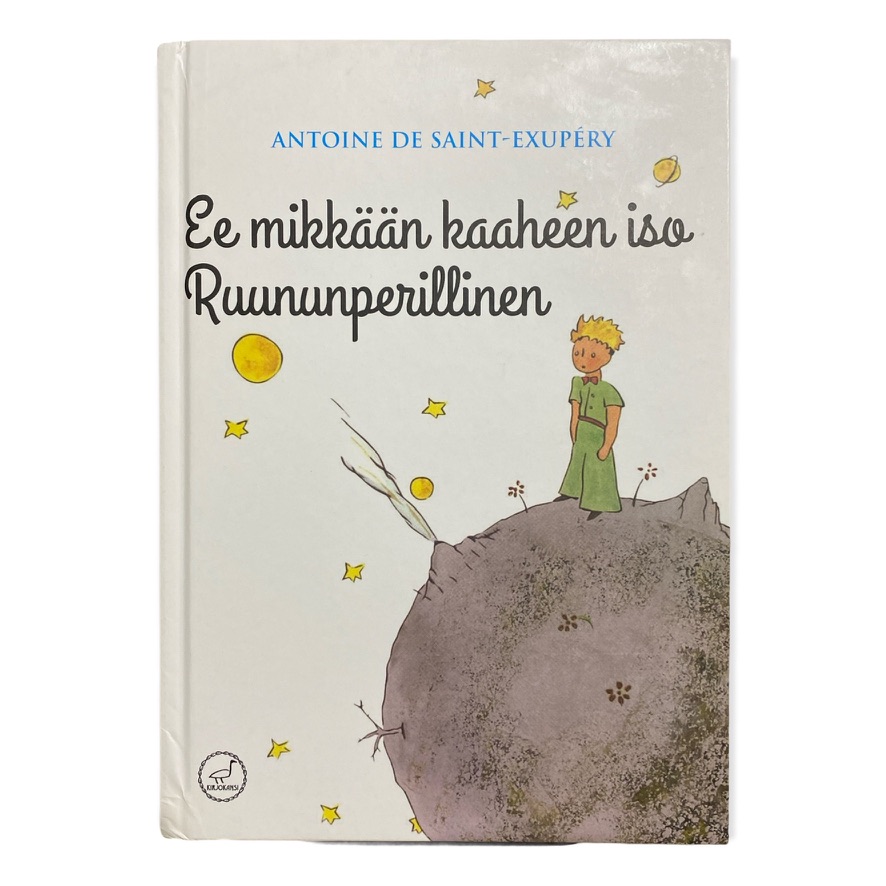
Ee mikkään kaaheen iso Ruununperillinen — in Savonian dialect of Finnish language.
The Savonian dialects (also called Savo Finnish or savolaismurteet) are forms of the Finnish language spoken in Savonia and other parts of Eastern Finland. Finnish itself sits within the Finnic branch of the Uralic family (uralilaiset kielet), one of the small handful of European tongues owing nothing to Indo-European ancestry, and its nearest kin are Karelian, Ingrian, Veps, Votic, Estonian, and the nearly vanished Livonian. Savonian belongs to the eastern half of the Finnish dialect continuum, and its lineage runs closer still to that neighbouring family: Savonian speech and the Karelian language proper descend from a shared Proto-Karelian once spoken around the shores of Lake Ladoga in the Iron Age, meaning that Savonian and standard literary Finnish, though both filed today under the same national language, are in truth cousins reunited under one administrative roof rather than parent and child.
Historically the Savonians (savolaiset) formed one of the three great medieval Finnish tribal groupings, alongside the Tavastians of Häme and the Karelians, and it was their agricultural technique — a fierce, land-hungry slash-and-burn husbandry known as kaskiviljely — that carried their dialect extraordinarily far beyond its Savo heartland during the sixteenth and seventeenth centuries: eastward into Kainuu and North Karelia, westward into Central Finland and South Ostrobothnia, and, most remarkably, across the Gulf of Bothnia into the forests of central Sweden, where communities of so-called metsäsuomalaiset (“Forest Finns”) preserved a Savonian-derived dialect in places such as Värmland for three centuries, its very last native speakers dying only in the 1960s. Culturally, the Savonian character has long been distilled into a single, affectionately mocking phrase, kiero savolainen (“the crooked Savonian”): a stereotype of elaborately indirect, circling speech, forever hedging and qualifying so as never to give offence or commitment, which plainer-spoken western Finns historically mistook for slyness rather than what it more truly is — a highly developed art of tact, wit, and understatement that still animates the region’s humour, its dialect literature, and its music.
Phonologically, Savonian distinguishes itself from standard Finnish chiefly by having quietly reversed a change the rest of the language underwent: where Proto-Finnic once possessed palatalised consonants that the literary standard subsequently lost, Savonian independently redeveloped them, alongside its own distinctive narrowing of diphthongs into long vowels, patterns of consonant gemination, and inserted “helping” vowels after certain syllable-final sounds — oddities that make it, in this one respect, phonologically closer to the deeper Uralic past than the polished Finnish spoken in Helsinki. That deeper past is vast: the Uralic family stretches from the Sami tongues of Arctic Scandinavia and Finnish’s own Balto-Finnic sisters, through Hungarian far away on the Danube, to the Ob-Ugric and Samoyedic languages scattered across Siberia, all ultimately descended from a Proto-Uralic tongue reconstructed to the forests around the Ural Mountains several thousand years before our era. Yet kinship on that scale buys little day-to-day understanding — Finnish shares with Hungarian and Sami only the family’s typological skeleton, its case-laden agglutination and vowel harmony, while their vocabularies have drifted into mutual incomprehensibility over millennia of separation. Savonian, then, occupies a curious double position: a rustic dialect subordinate to standard Finnish in prestige, yet one whose accidental conservatism lets it whisper, more faithfully than its polished sibling, something of the ancient Uralic tongue from which the whole sprawling family first arose.