
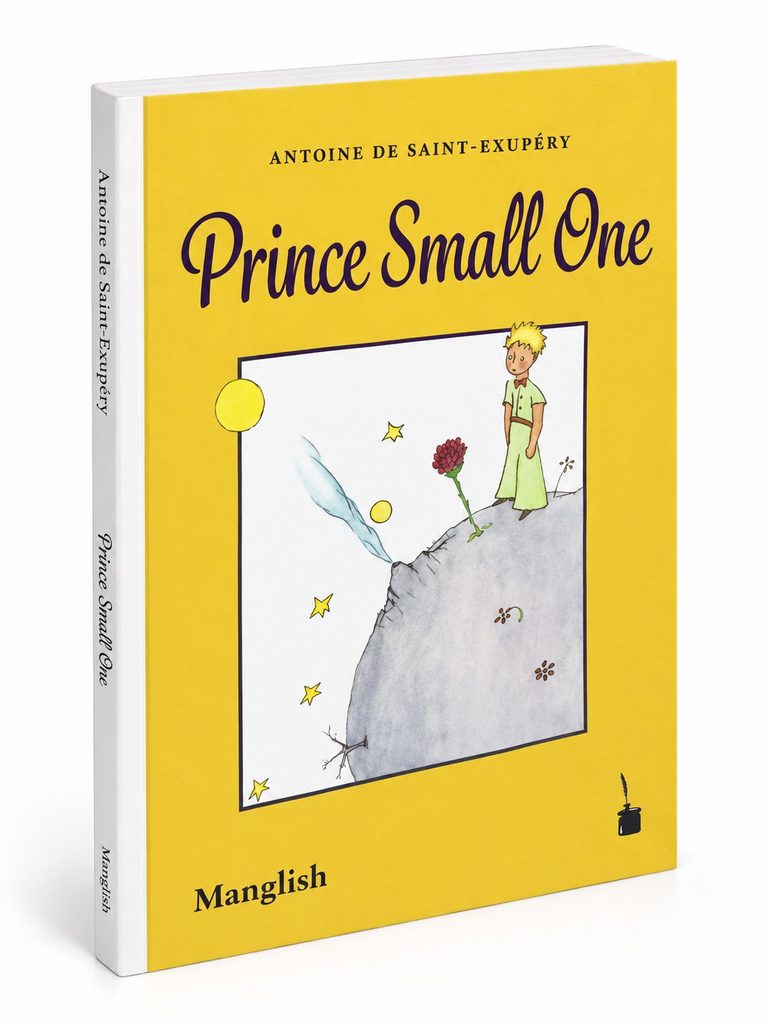
Prince Small One — in Manglish.
Manglish: a portmanteau of “Malaysian” and “English”. It denotes not a fully-fledged creole but rather the informal, basilectal register of Malaysian English: a register set deliberately against Bahasa Inggeris Standard Malaysia (Malaysian Standard English), the grammatically conservative variety alone permitted in schools and official use. Its ancestry lies in British colonial administration, under which English served as the tongue of government while Bahasa Melayu (the Malay language) remained the lingua franca of the street and market; out of that layered bilingualism, further seasoned by the Chinese and Tamil-speaking communities British rule had drawn into Malaya, emerged a household patois that Malaysians themselves often call Bahasa Rojak — literally “mixed language,” after rojak, the local salad whose entire charm lies in the clash of disparate ingredients tossed together.
Manglish shares its very origin with Singapore’s Singlish, the two having been, for practical purposes, one and the same tongue under British Malaya and the Straits Settlements; only after Singapore’s separation from Malaysia in 1965 did the two languages begin to drift apart, each shaped thereafter by its own nation’s demography. Malaysia’s ethnic Malay majority pulled Manglish further towards Malay vocabulary and sentence structure, whereas Singapore’s larger and more dominant Chinese population pulled Singlish more heavily towards Hokkien, Teochew, and Cantonese; the resulting siblings remain so alike that even many Malaysians and Singaporeans cannot reliably tell one from the other by ear, though each nation insists, with a certain proprietary pride, that its own version is the truer article. Culturally, Manglish thrives precisely where formal Malay, formal English, and the various Chinese and Tamil vernaculars all meet without ceremony — the mamak stall, the kopitiam, the office pantry — functioning less as a deficient English than as a badge of easy, unpretentious Malaysian belonging, even as the government’s Dewan Bahasa dan Pustaka (“Institute of Language and Literature”) continues to hold it at arm’s length as a threat to proper standards in both Malay and English alike.
Its most celebrated features are a small constellation of sentence-final particles borrowed wholesale from Cantonese, each carrying a precise emotional shading unavailable to standard English: lah (啦), which softens a command or invites solidarity (“Come lah!”); lor (囉), which signals a matter settled with faint resignation (“Like that lor”); and meh (咩), which turns a plain statement into a sceptical question (“Cannot meh?”). Alongside these sits the equally distinctive sentence-final one, thought to calque a Chinese nominalising particle, used to intensify or assert (“So expensive one!”), and the all-purpose verb got, pressed into service for both existence and possession in direct imitation of Malay ada and Chinese 有 (“This bus got air-con or not?”). Grammatically, Manglish drops verb inflection, favours topic-comment word order over the subject-first pattern of standard English, permits the dropping of pronouns and subjects entirely, and doubles words for emphasis (“short-short one”), while phonologically it is non-rhotic, flattens diphthongs into single vowels, and swaps the English “th” sounds for plain stops. The upshot is a language perched deliberately between worlds — recognisably English in its bones, yet answerable in almost every other respect to Malay, Cantonese, Hokkien, and Tamil, and standing, alongside Singlish, as one of the clearest living demonstrations of how a colonial tongue can be thoroughly repossessed by the streets it was once merely administered upon.