
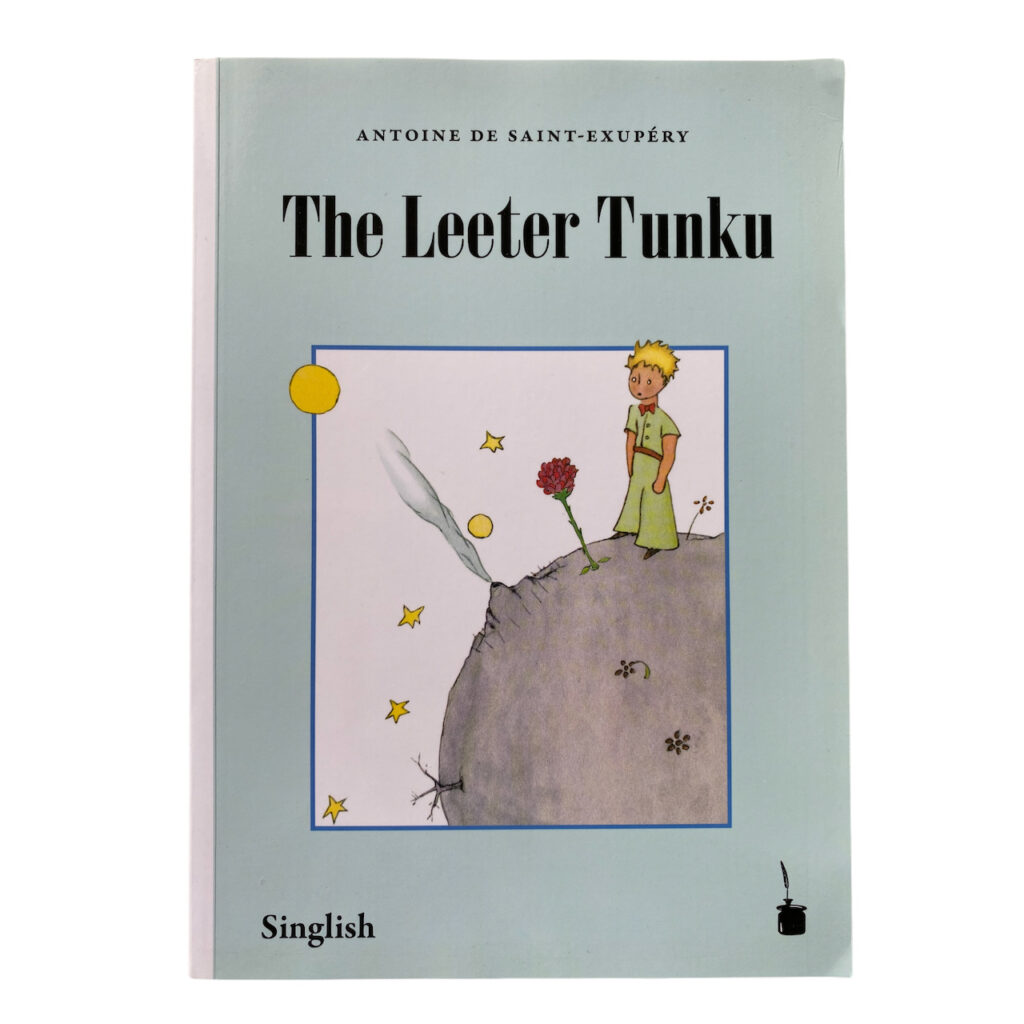
The Leeter Tunku — in Singlish.
Singlish: Singapore’s own portmanteau of “Singapore” and “English,” known to linguists more soberly as Singapore Colloquial English (SCE). It is the informal, richly hybridised vernacular that sits beneath Singapore Standard English in everyday use. It shares a common ancestor with Malaysia’s Manglish: both grew out of the same English-medium schooling and street-level multilingualism of British Malaya and the Straits Settlements, and only began to diverge as distinct varieties after Singapore’s separation from Malaysia in 1965, each thereafter shaped by its own nation’s demographic balance. Where Manglish leans towards Malay, Singlish leans more heavily on Chinese, a difference owed directly to Singapore’s Chinese-majority population and its markedly different linguistic architecture of state.
That architecture is unusual in its own right. Independent Singapore enshrined four official languages — English, Bahasa Melayu (Malay), Huáyǔ (华语, the local term for Mandarin Chinese), and Tamiḻ (தமிழ், Tamil) — of which Malay alone carries constitutional status as the symbolic national language, reserved for the anthem and military drill commands, while English does the real work of government, law, commerce, and schooling. Every Singaporean child is further required to study a “Mother Tongue” tied to registered ethnicity alongside English, a bilingual policy that, from 1979 onward, was reinforced by the Speak Mandarin Campaign — a deliberate state effort to fold the island’s Chinese population, once fluent in Hokkien, Teochew, Cantonese, Hakka, and Hainanese, into a single Mandarin-speaking bloc; the effect was dramatic, with speakers of those older varieties falling from just over half of ethnic Chinese Singaporeans in 1990 to barely one in nine by 2020. Singlish, meanwhile, quietly absorbed and preserved a great deal of what officialdom was trying to retire, carrying Hokkien and Cantonese vocabulary and cadence forward into everyday speech even as the dialects themselves receded from the home.
The state’s discomfort with the result became explicit on 29 April 2000, when Prime Minister Goh Chok Tong launched the Speak Good English Movement, describing Singlish bluntly as “English corrupted by Singaporeans” and a threat to the nation’s standing in “the global language of commerce, business and technology.” The rebuttal from ordinary Singaporeans was swift and has proved durable: the activist collective TalkingCock’s 2002 “Save Our Singlish” campaign, and a grassroots “Speak Good Singlish Movement” that followed in 2010, both insisted that Singlish was no mere corruption but “a patois” in its own right, with one advocate going so far as to call it “the only thing that makes us Singaporean.” That popular affection has since been vindicated from an unlikely quarter: since 2016 the Oxford English Dictionary has formally admitted a growing list of Singlish terms into English itself, among them kiasu (from Hokkien 驚輸, kiaⁿ-su, “afraid to lose,” describing a competitive, grasping anxiety about missing out), shiok (an exclamation of intense pleasure or satisfaction), and, more recently, alamak (an exclamation of dismay) and tapau (to take food away) — a rare case of a colonial vernacular sending words back up into the language that once ruled over it.
Grammatically and texturally, Singlish is unmistakable: its sentence-final particles — lah (啦), which softens or seeks solidarity; lor (囉), signalling weary resignation; meh (咩), turning a statement into pointed doubt — are drawn straight from Cantonese, while its topic-comment word order, dropped subjects and copulas, use of “already” as a completed-action marker, and fondness for reduplication (“small small only”) owe as much to Chinese and Malay syntax as to English. In this sense Singlish stands in a curious mirror relationship to the very policy that sought to suppress it: official English was designed from above to be the neutral thread binding Singapore’s Malay, Chinese, and Tamil communities into one nation, and Singlish, built from below out of exactly those same communities’ languages jumbled together, has ended up performing much the same unifying function — informally, disreputably, and, to most Singaporeans, far more affectionately.