
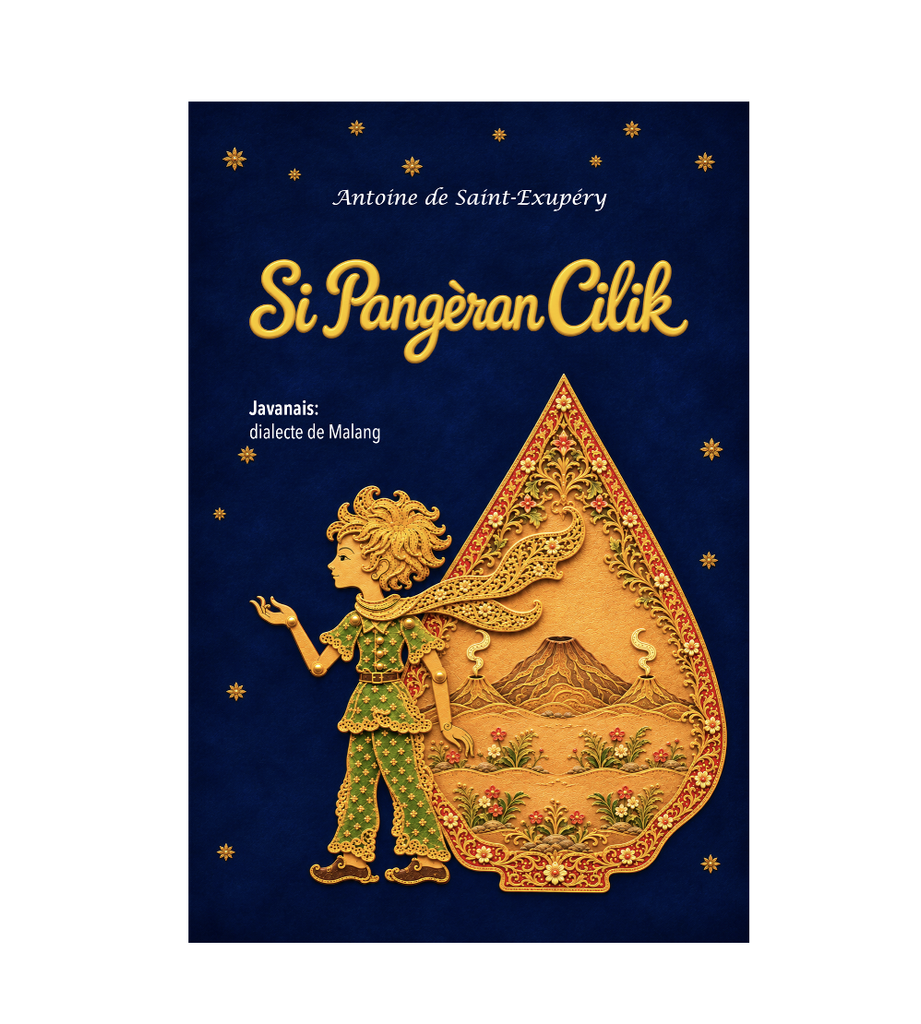
Si Pangèran Cilik — in Malang dialect of Eastern Javanese.
Malang Javanese (ꦧꦱꦩꦭꦔꦤ꧀, Basa Malangan) belongs to the Arekan family of East Javanese dialects, the brisk, plain spoken speech of Surabaya and Malang, which sits within Javanese and thus within the great Malayo Polynesian branch of the Austronesian languages. It is spoken in the cool highland city of Malang and its surrounding regency, a basin ringed by volcanoes, Arjuno, Kawi, Semeru and the Tengger massif, and it carries the characteristic East Javanese temperament: direct, warm and notably egalitarian, far less attached to the elaborate speech levels of the central Javanese courts, so that the familiar koen or awakmu for you and the ubiquitous rek, from arek, a youngster or mate, ring through its streets where Solo or Yogyakarta might reach for something more ceremonious.
Beneath this easy manner lies one of the deepest histories on the island. The Dinoyo inscription of 760 AD records the kingdom of Kanjuruhan in the Malang area, among the earliest polities attested in East Java, and in the thirteenth century the region became the seat of Singhasari, the realm of Ken Arok and of Kertanegara, whose ambitions laid the foundations for Majapahit, the greatest of the Hindu Buddhist empires of the archipelago. Centuries later the Dutch prized Malang as a temperate hill town of plantations, orchards and spacious tree lined boulevards, and in modern Indonesia it has grown into one of the nation’s foremost university cities, drawing students from every corner of the archipelago, so that for countless young Indonesians the cadences of Malang Javanese have been their very first encounter with life on Java.
What makes the dialect so instantly recognisable is its vigorous, expressive economy. Where central Javanese says ora for not, Malang says gak; where others say rampung for finished, Malang says mari; a puzzled why becomes lapo or opo o, and ndhek serves for at or in, while emphasis is conveyed by a delightful habit of stretching and rounding the first vowel, so that apik, good, swells into uapik and adoh, far, into uadoh, a feature that lends everyday speech a hearty, almost theatrical colour. The people proudly call themselves Arema, from arek Malang, a name also worn by the city’s fervently supported football club, and the dialect keeps lively company with related voices around it: the more courtly Mataraman Javanese spoken to the west, the archaic Javanese preserved by the Tenggerese communities in the highlands above Bromo, the Osing speech of Banyuwangi further east, and Madurese, whose speakers have settled across East Java in great numbers and left their imprint on local vocabulary and intonation. Malang Javanese thus stands as a vivid emblem of East Java itself, ancient in its roots, unpretentious in its manner, and generous in welcoming all who come to learn on its slopes.