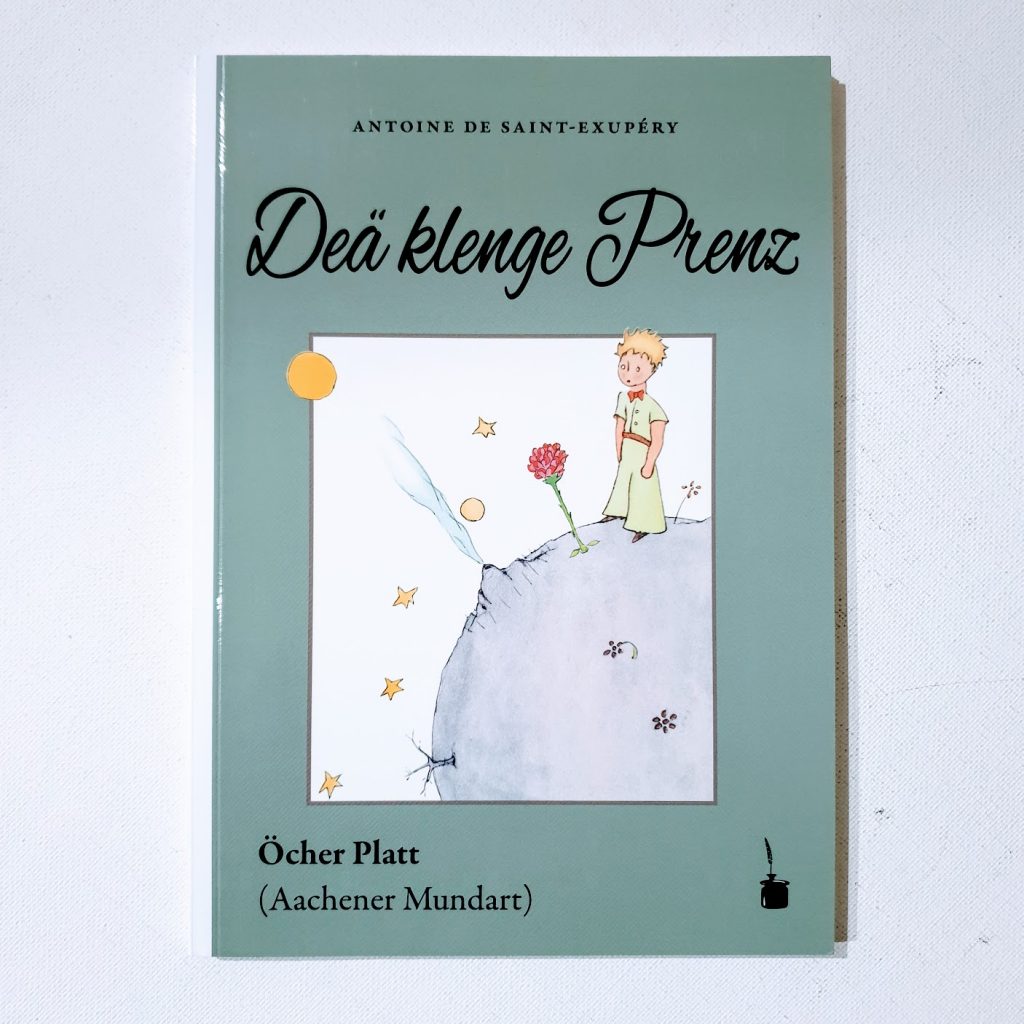
Deä Klenge Prenz — from Aachen.
Ripuarian Franconian (Ripuarisch) belongs to the Central Franconian dialect family, taking its name from the Ripuarian Franks (Ripuarier), the branch of the Frankish peoples who settled around Cologne rather than pushing further west into Gaul as their Salian cousins did, and its Aachen variety survives today as the Aachen dialect (Öcher Platt), a name that simply combines Öcher, the dialect’s own adjective form of Aachen (Oche), with Platt, the familiar North German word for plain, everyday speech. Like its Rhine Franconian relatives further south, Ripuarian sits within the great fan of isoglosses tracing the High German consonant shift’s gradual retreat, though Ripuarian marks its own particularly northern boundary through the so called Dorp Dorf line (Dorp-Dorf-Linie), the point at which the word for village shifts from the more Low German sounding Dorp to the fully High German Dorf, placing Öcher Platt right at the edge where Central German dialects begin shading into the Low Franconian world of Dutch and Flemish.
Aachen’s own history gives this dialect an unusually grand backdrop. The city was Charlemagne’s (Karl der Große) favoured residence and effective capital, chosen in large part for its Roman era thermal springs, themselves already exploited by the Romans, who called the settlement Aquae Granni after the Celtic healing god Grannus, and it was here that Charlemagne built his Palatine Chapel (Pfalzkapelle), the core of what is now Aachen Cathedral, the oldest cathedral in northern Europe and the first German site ever inscribed on the UNESCO World Heritage list. For some six centuries afterwards, from 936 through to 1531, German kings were traditionally crowned in that very cathedral, seated at times near the Throne of Charlemagne (Karlsthron) still visible in its upper gallery, and while no one can pin down Charlemagne’s own everyday Frankish speech with precision, it almost certainly belonged to the same broad Franconian family from which Ripuarian later emerged, lending Öcher Platt an evocative, if necessarily loose, claim to echoing something of the language once spoken in the shadow of an emperor’s own throne.
Öcher Platt’s most distinctive quality today, though, is its position at a genuine linguistic crossroads. Aachen sits almost exactly on the tripoint where Germany, Belgium, and the Netherlands meet, the so called three country corner (Dreiländereck), and Ripuarian speech here blends with startling ease into neighbouring Low Franconian dialects such as Limburgish (Limburgs), spoken just across the modern border, a dialect continuum that has never much respected the national frontiers drawn across it. Within Ripuarian itself, Öcher Platt remains the smaller, quieter sibling of Cologne’s far more famous dialect, Kölsch, which enjoys its own established spelling conventions, dictionaries, and an entire carnival song tradition built around it, yet the two share enough underlying grammar and vocabulary to mark them unmistakably as branches of the same family, a family whose deepest root, fittingly enough, still stands in stone beneath Aachen’s great cathedral dome.