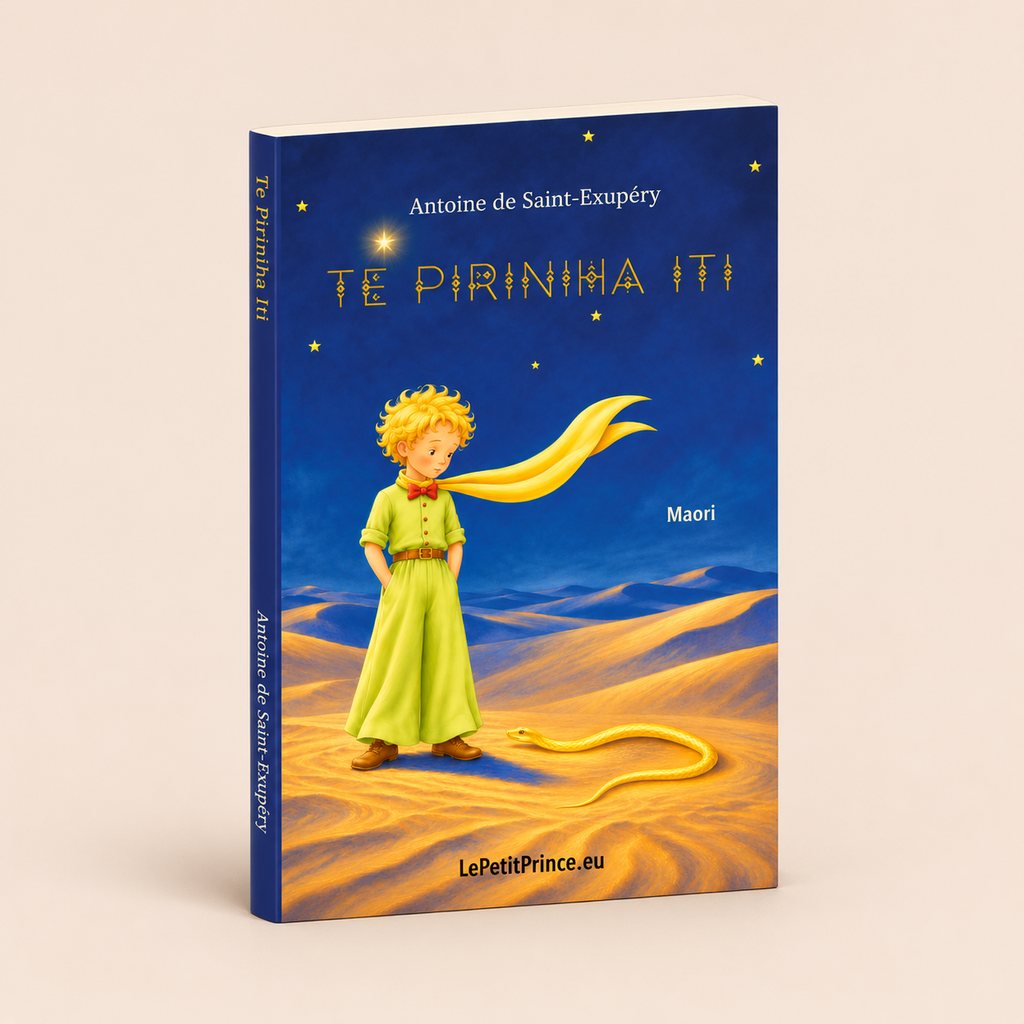
Te Piriniha Iti — in Maori.
Māori (te reo Māori) is the language of the tangata whenua, the people of the land, of Aotearoa New Zealand, and it belongs to the Eastern Polynesian branch of the Austronesian family, within a Tahitic subgroup it shares most closely with Tahitian and Cook Islands Māori, and more broadly with Hawaiian, Marquesan and the speech of Rapa Nui on Easter Island. That kinship stretches astonishingly far, for the Austronesian family reaches back through Polynesia, Melanesia, and Southeast Asia islands, to its ancient homeland in Taiwan, so that a Māori speaker counting rua, toru, rima or naming the eye mata and the fish ika echoes words that a Malay or Indonesian speaker would recognise at once as dua, lima, mata and ikan, cousins separated by some five thousand years and half the circumference of the earth.
The ancestors of the Māori reached Aotearoa from eastern Polynesia around the thirteenth century, making these islands the last great landmass on earth to be settled by human beings, and they arrived aboard the voyaging canoes (waka) whose names still define tribal identity, every iwi tracing its descent through whakapapa, the genealogical lineage that binds people to their ancestors, their land and the ancestral homeland of Hawaiki. Out of that voyage grew a rich culture of carved meeting houses on the marae, the sacred facial tattoo of tā moko, the ceremonial challenge and dance of the haka, and the deep concepts of mana, prestige and spiritual authority, and tapu, sacredness, the latter reaching English as taboo through its Polynesian cognates. In 1840 the Treaty of Waitangi (Te Tiriti o Waitangi) was signed between the British Crown and Māori chiefs, yet its English and Māori texts differed on the crucial question of sovereignty, and in the decades that followed land loss, urbanisation and schools that punished children for speaking their own tongue brought the language perilously close to collapse by the mid twentieth century.
The revival that followed is among the most admired in the world. The language nests of Te Kōhanga Reo, opened from 1982 to immerse preschool children in te reo, were followed by Māori medium schools, and in 1987 Māori became an official language of New Zealand, its revitalisation now woven into public broadcasting, place names and national ceremony. The language itself is elegantly economical, built on just fifteen letters, five vowels, whose long forms are marked with a macron, and ten consonants including the digraphs wh and ng, and it varies gracefully across regions, the southern Kāi Tahu dialect famously replacing ng with k. Te reo Māori thus stands as both the southernmost outpost of a language family born in Asia and a vivid emblem of a Pacific nation’s identity, a tongue that crossed the widest ocean on earth, nearly fell silent, and found its voice again.