อะนาด พญาแนะ (A-nàat Pha-yaa-náe) — in Moken language.
The Moken are a semi-nomadic Austronesian people inhabiting the Mergui Archipelago, a scattered chain of some eight hundred islands straddling the maritime border between southern Myanmar and Thailand. For centuries they have lived almost entirely at sea, dwelling in wooden vessels called kabang and coming ashore only reluctantly, regarding land as a place of the dead. Their language, Moken, belongs to the Moken-Moklen branch of the Malayo-Sumbawan family within Western Austronesian — a classification that places them, however distantly, in the same vast linguistic family as Indonesian, Malay, and the languages of the Philippines. What distinguishes Moken most profoundly, however, is not its genealogy but its intimate entanglement with the sea: the language possesses an extraordinarily rich maritime vocabulary, with precise terms for tides, currents, reef formations, and species of marine life that have no equivalent in any neighbouring tongue, while famously lacking words for concepts such as “when,” “want,” or linear time, i.e. a lexical absence that speaks volumes about a cosmology oriented entirely around the rhythms of ocean and tide.
Moken culture is built upon oral transmission, communal memory, and a profound spiritual relationship with the sea and its ancestral spirits. The moken — the people themselves, whose name may derive from a term meaning “submerged” or “sea-drowned” — have long resisted incorporation into the nation-states that claim their waters. They gained international attention after the 2004 Indian Ocean tsunami, when Moken communities suffered remarkably few casualties: their elders had preserved oral knowledge of the laboon, the “wave that eats people,” passed down across generations and recognisable in the behaviour of receding tides. This episode illustrated, with painful clarity, the survival value of indigenous knowledge systems that modernity has persistently undervalued. Today, however, the Moken face acute pressure from tourism, environmental degradation, fishing restrictions, and the forced sedentarisation policies of both Thailand and Myanmar, all of which are eroding the very conditions under which their language and culture can be meaningfully transmitted to the young.
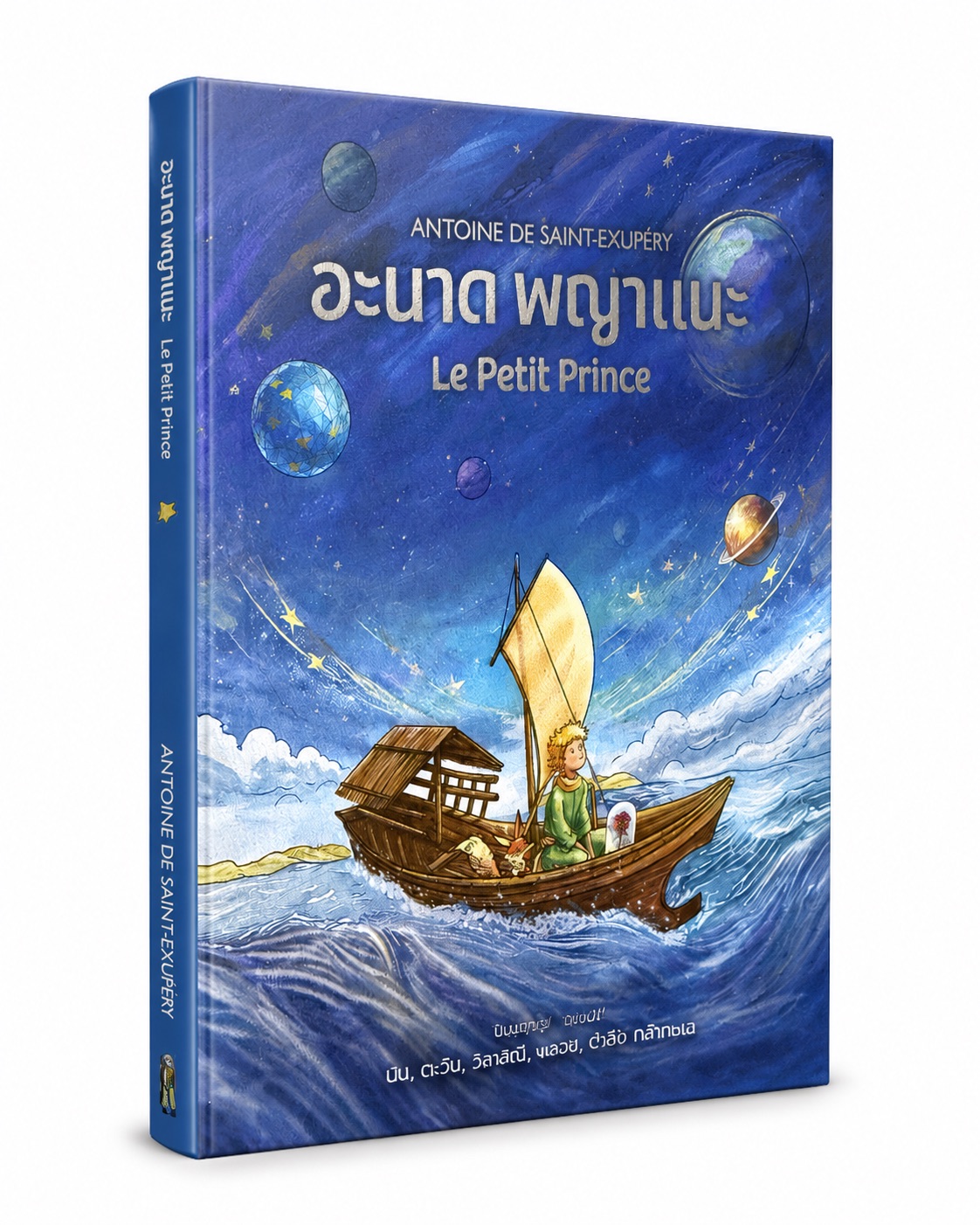
อะนาด พญาแนะ (A-nàat Pha-yaa-náe) is was translated by a team of Moken speakers — Nin, Tawan, Willasinee, Phloi, and Tamling Klaathale, the family name Klaathale meaning, fittingly, “brave at sea.” Because Moken possesses no indigenous writing system, the text is rendered in Thai script, a practical necessity that nonetheless introduces a layer of phonological approximation, as Thai orthography cannot fully capture certain Moken consonantal and tonal features. The cover illustration, departing from the classic desert imagery of Saint-Exupéry’s original, depicts the Little Prince aboard a traditional sailing vessel amid a vast nocturnal sea — a quietly radical act of cultural translation that relocates the story’s existential wandering from the Saharan sands to the open waters that define Moken existence.