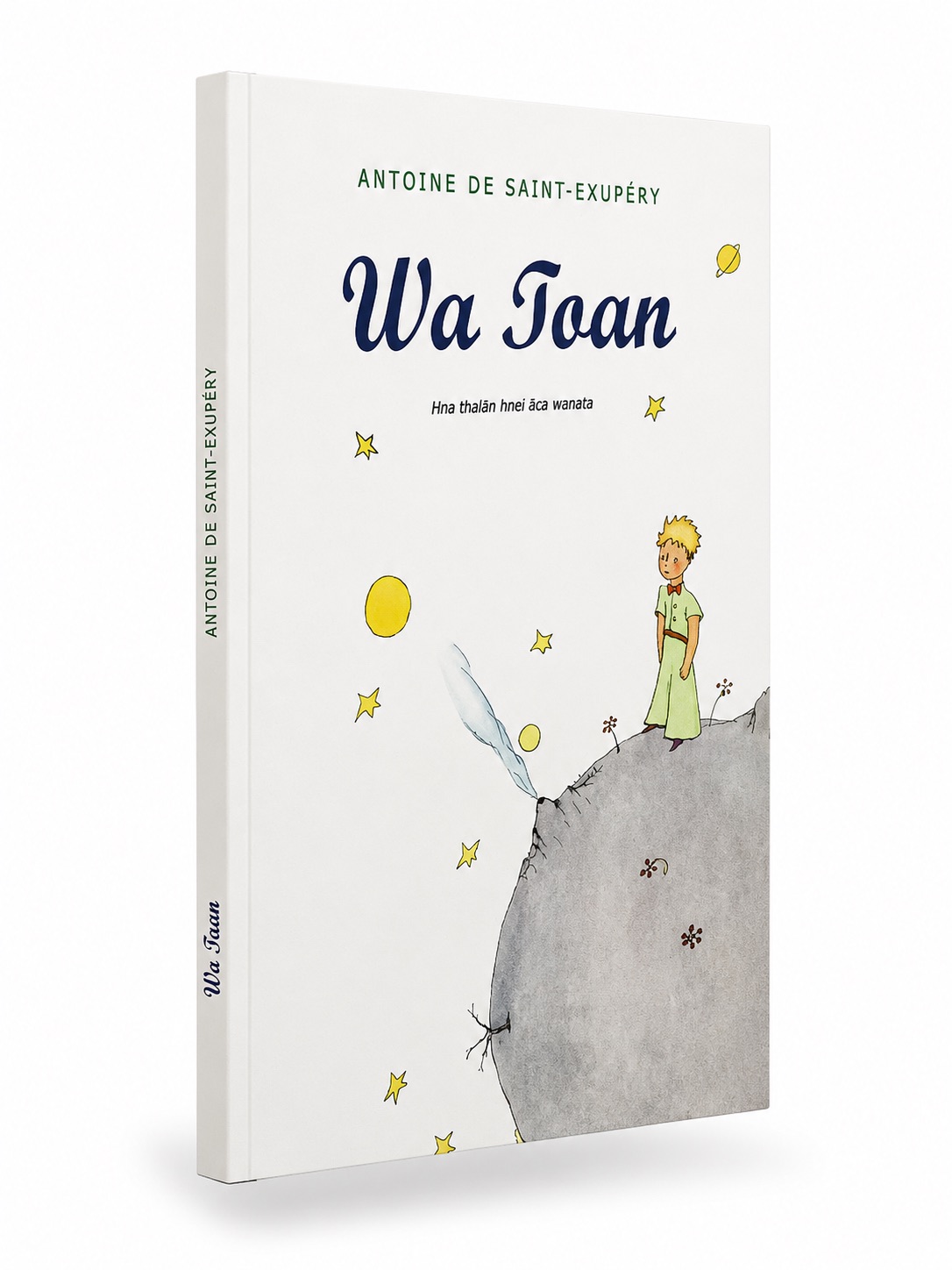
Wa Toan — in Nengone language.
Nengone is the indigenous language of Maré, the southernmost of the three principal Loyalty Islands lying some one hundred kilometres east of the main island of New Caledonia in the southwestern Pacific. It belongs to the Loyalty Islands branch of the New Caledonian languages, itself a subdivision of Southern Oceanic within the vast Austronesian family — placing Nengone in linguistic kinship with its island neighbours Drehu of Lifou and Iaai of Ouvéa, whilst remaining mutually unintelligible with either. The Nengone-speaking people, known as the Meaill or simply as the people of Maré, number some eight to ten thousand, and their language retains a vigorous presence in daily life, ceremonial exchange, and oral tradition, even as French — the administrative and educational language of New Caledonia — exerts its customary gravitational pull upon the younger generation. Nengone is notable among Pacific languages for its relatively complex nominal morphology and its elaborate system of spatial orientation, which encodes not merely direction but the speaker’s relationship to the sea, the land, and the interior of the island with a precision that reflects centuries of intimate habitation of a small, densely known place.
The culture of Maré is shaped by the twin pillars of customary law — la coutume in the French rendering — and a Protestant Christianity that arrived with London Missionary Society evangelists in the 1840s and was adopted with remarkable thoroughness, such that the two systems have long since woven themselves into a single, distinctly Maréan fabric. Social life is organised around clans, chiefly hierarchies, and the ceremonial exchange of goods — yams, cloth, and money — that punctuates every significant life event from birth to death. The island itself, a raised coral plateau of austere limestone beauty, is largely treeless in its interior but ringed by coastal forest and reef, and its people have historically been formidable navigators and traders within the Loyalty Islands chain. The Kanak identity — a term embracing all indigenous Melanesian peoples of New Caledonia — carries particular political weight on Maré, whose population participated actively in the independence movement of the 1980s and continues to navigate the complex sovereignty arrangements that define New Caledonia’s unresolved constitutional future.
Wa Toan — rendered in Nengone, the title translates approximately as “The Little One” or “The Small Person,” with toan carrying connotations of youth and smallness and wa functioning as a definite article — is the Nengone translation of Le Petit Prince, published as part of the broader Kanak language publishing initiative that has produced Loyalty Islands editions in Drehu and Iaai alongside Nengone. The subtitle line visible on the cover reads moe thalin inet ace warate, which situates the work within the Nengone oral and literary tradition. The translation itself represents a considerable linguistic achievement: Nengone’s phonological and syntactic structures diverge significantly from French, and the rendering of Saint-Exupéry’s philosophical register — its layered ironies, its adult melancholy wearing the costume of a children’s book — into a language whose literary tradition has been primarily oral demands both scholarly precision and cultural sensitivity.