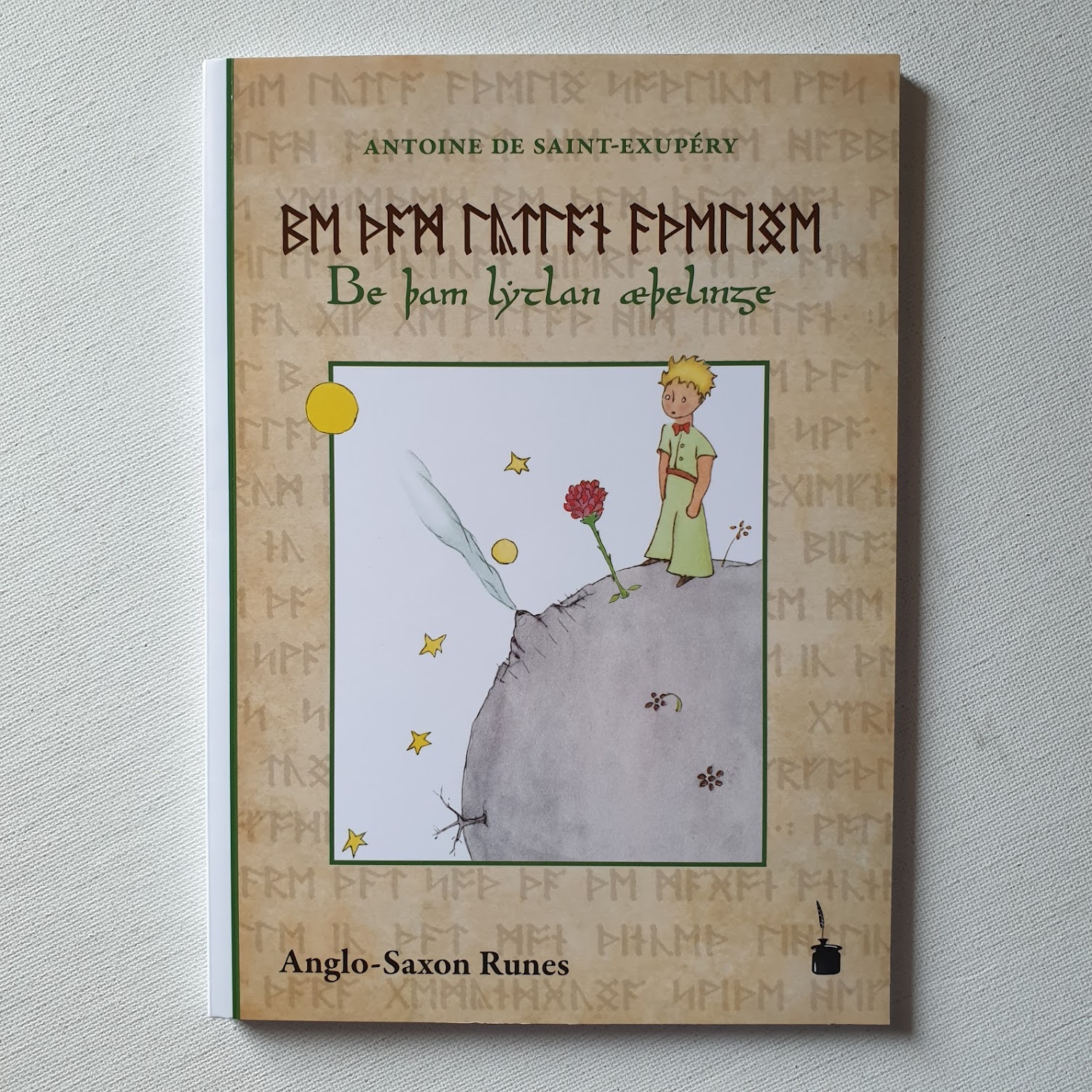
ᛒᛖ ᚦᚪᛗ ᛚᚣᛏᛚᚪᚾ ᚫᚦᛖᛚᛁᚾᚷᛖ (Be þam lȳtlan æþelinge) — in Old English Language, Runic alphabet.
The script that first carried Old English into permanent form was not the familiar Latin alphabet at all but futhorc (ᚠᚢᚦᚩᚱᚳ), the Anglo Saxon runic alphabet, itself an expanded descendant of the older Elder Futhark (ᚠᚢᚦᚨᚱᚲ / fuþark) used across the whole Germanic speaking world from around the second century onward. Elder Futhark almost certainly grew out of contact with the literate cultures of the Mediterranean and the Alps, its letterforms likely adapted from Old Italic scripts such as Etruscan or Raetic, then reshaped into straight, angular strokes suited to carving into wood, bone, metal, and stone rather than writing with pen and ink. Both futhark and futhorc take their curious names simply from the sound values of their first six characters, f, u, th, a or o, r, and k or c, in the same spirit as alphabet takes its name from alpha and beta, and each individual rune carried, beyond its sound, a full name and meaning of its own, so that the rune for f was also the word feoh, wealth or cattle, and the rune for th was also thorn (ᚦ / th), the very word for the plant, turning the alphabet itself into a small mnemonic poem of everyday and symbolic concepts rather than a set of arbitrary marks.
What makes the Anglo Saxon version of this script especially interesting is the direction it evolved once English speakers settled in Britain and their language began drifting away from its continental cousins. Where Scandinavia, entering the Viking Age, actually simplified its runic alphabet down to a lean sixteen characters, the so called Younger Futhark, forcing several distinct sounds to share a single symbol, the Anglo Frisian world took the opposite path entirely, expanding the original twenty four runes to as many as thirty three in order to capture new vowel and consonant sounds that had emerged in English and Frisian speech, among them wynn (ᚹ / w), the rune for w. Much of what is known about the meaning and use of these English runes comes from a single remarkable source, the Old English Rune Poem, a set of short mnemonic verses reciting each rune’s name and associated wisdom, preserved in only one medieval manuscript that was then tragically destroyed in the Cotton library fire of 1731, surviving today only because a scholar named George Hickes had transcribed and printed it a few decades earlier. Runes themselves survive on a handful of extraordinary physical objects rather than everyday documents, most famously the Franks Casket, an intricately carved eighth century whalebone box that mixes runic Old English inscriptions with Latin lettering and blends Christian, Roman, and native Germanic legendary scenes on its panels, and the Ruthwell Cross in Dumfriesshire, a towering stone monument carved with runic lines from what is effectively an early version of The Dream of the Rood, one of the very first pieces of English religious poetry.
Christianity, arriving formally with Augustine’s mission to Kent in 597, gradually brought the Latin alphabet with it, and over the following century or two Latin letters steadily displaced runes for most everyday writing. Yet the runic script never quite vanished, leaving behind one of the rarer legacies any pre Christian European writing system can claim, a permanent graphemic footprint inside a later, entirely different alphabet: two runes, thorn (þ) and wynn (ƿ), were carried directly into the new Latin based English alphabet and continued in active use for centuries, alongside runes lingering separately in charms, amulets, and other quietly magical or protective contexts that Christian scribes were never entirely able to stamp out. Thorn in particular enjoyed a long afterlife, surviving informally into early printing, where continental presses lacking a thorn character substituted the visually similar letter y in its place, giving rise to the familiar, and thoroughly misunderstood, Ye Olde, a phrase that was never actually pronounced ye at all but simply the, disguised behind a runic letter dressed up, by pure typographical accident, as something else entirely.