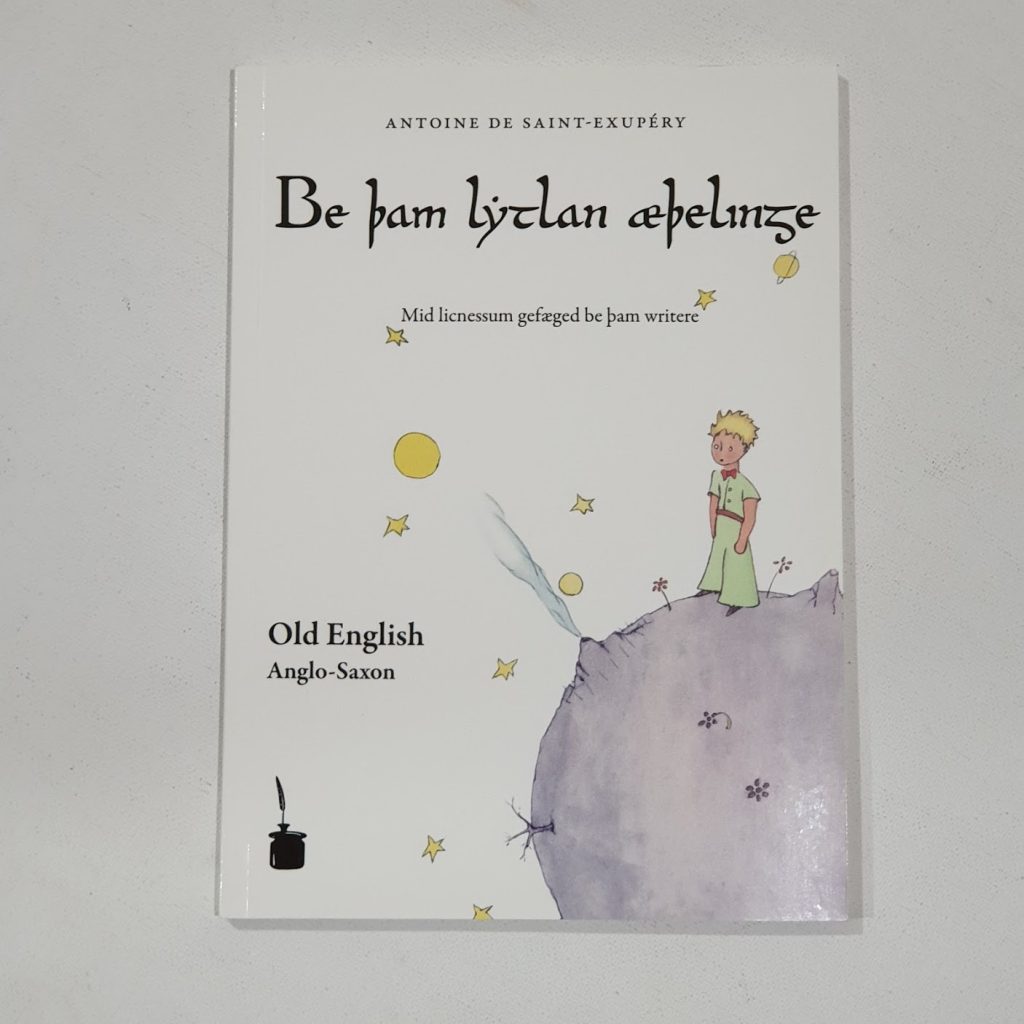
Be þam Lẏtlan Æþelinge, in Old English or Anglo-Saxon language.
Old English, Anglo Saxon, or called by its own speakers Englisc (Ænglisc), is the earliest recorded form of the English language, spoken and written across Britain from roughly the middle of the fifth century until the upheavals following the Norman Conquest of 1066 gradually reshaped it into Middle English. It belongs to the West Germanic branch of the Indo European family, sharing that branch with Old Saxon, Old Frisian, Old Dutch, and Old High German, and its very closest relative by far is Old Frisian, spoken along the North Sea coast of what is now the Netherlands and Germany, close enough in structure and vocabulary that linguists group the two together as Anglo Frisian, a reminder that English began life not as an island language at all but as one strand of a tightly knit continental North Sea speech community. Grammatically it was a richly inflected tongue, marking nouns, adjectives, and pronouns for case, number, and gender in ways that would strike a modern English speaker as closer to German or Icelandic than to anything spoken in England today, and it survives across four main regional dialects, Northumbrian, Mercian, Kentish, and West Saxon, the last of which, thanks to royal patronage, eventually became the standard for most surviving literature.
That royal patronage belonged above all to King Alfred the Great of Wessex, known in his own tongue as Ælfred (Ælfred / Aelfred), who reigned from 871 to 899 and, alarmed at the collapse of Latin learning under sustained Viking assault, personally championed the translation of key Latin texts into vernacular English prose, commissioned the compiling of the Anglo Saxon Chronicle as an ongoing year by year record of the kingdom’s history, and helped forge a shared sense of Englishness, or Angelcynn, the race of the Angles, out of what had until then been a patchwork of rival Anglo Saxon kingdoms, the so called Heptarchy of Northumbria, Mercia, East Anglia, Essex, Kent, Sussex, and Wessex. The language itself had arrived with the Angles, Saxons, and Jutes who migrated from their continental homelands, among them Angeln in what is now Schleswig, after the Roman withdrawal from Britain in the early fifth century, and before its speakers adopted the Latin alphabet under Christian missionary influence from the seventh century onward, they had already been writing, sparingly, in the runic Futhorc script; even after switching to Latin letters, English retained several runic derived characters unknown in modern printing, among them thorn (þ / th) and eth (ð / th), both used for the th sound, wynn (ƿ / w) for w, and ash (æ / ae) for a distinctive vowel sound, giving Old English manuscripts a visibly different alphabet from the one we read today even where the underlying words are recognisable cousins of modern English.
What makes Old English genuinely distinctive as literature, and not merely as an ancestor language, is its poetic technique: rather than rhyme, Old English verse relies on alliteration and a driving four stress rhythmic line, richly decorated with kennings, compressed metaphorical compounds such as hronrād (whale-road), meaning the sea, or bānhūs (bone-house), meaning the body, a technique shared across the wider Germanic poetic tradition and reaching its supreme expression in the anonymous epic Beowulf, the oldest surviving long poem in any Germanic language. Its relationships with the other languages of early medieval Britain were curiously lopsided: contact with the Brythonic Celtic languages already spoken there, ancestors of Welsh and Cornish, left remarkably few loanwords in English given centuries of proximity, its clearest legacy surviving instead in river and place names such as the Thames and the Avon, whereas contact with Old Norse, brought by Viking settlers who carved out the Danelaw across northern and eastern England from the ninth century, ran far deeper, seeding English with everyday words such as sky, skin, leg, knife, window, and even the pronouns they, them, and their, and very likely helping to accelerate the grammatical simplification that would, within a few centuries of the Norman Conquest, turn the heavily inflected Old English of Beowulf into something recognisably closer to the English spoken today.