
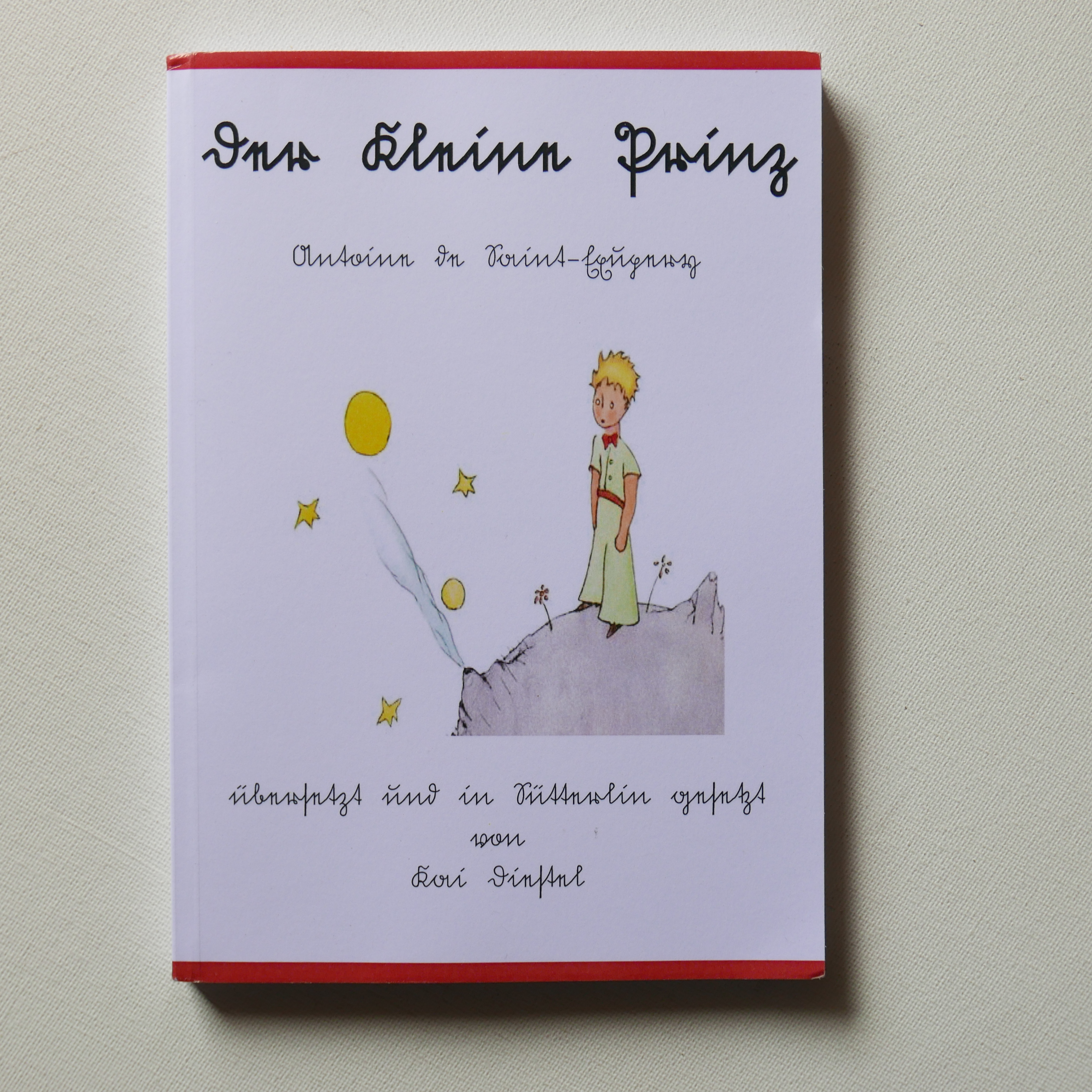
Der Kleine Prinz — in German, written in Sütterlinschrift.
Sütterlinschrift is the German handwriting style that most people, even many Germans, picture when they imagine old fashioned German script, yet it is quite distinct from Fraktur, which was strictly a printing typeface rather than something anyone actually wrote by hand. Sütterlin takes its name, unusually directly for a national script, from a single identifiable individual, the Berlin graphic artist Ludwig Sütterlin, commissioned by the Prussian Ministry of Culture in 1911 to design a clearer, more teachable cursive hand for schoolchildren, and introduced into Prussian classrooms from 1915 onward before spreading across Germany and Austria through the 1920s and 1930s. Rather than inventing something wholly new, Sütterlin essentially restyled and simplified Kurrentschrift, the older German cursive tradition that had itself descended over some four centuries from late medieval Gothic cursive hands, so that educated Germans of the interwar years lived with two visually related but distinct blackletter systems side by side, reading their newspapers set in Fraktur while writing their own letters, in a rather more angular and ornate hand, in Sütterlin.
What makes Sütterlin’s story genuinely striking is how cleanly, almost surgically, its entire lifespan was shaped by state decree rather than by the slow organic drift that governs most scripts. Having been deliberately engineered into existence by government commission in 1911 and rolled out nationally through the following two decades, it was then abolished just as deliberately in January 1941, swept away by the very same Nazi circular, the Normalschrifterlass, that killed off Fraktur in print, and justified by the identical fabricated pretext that both scripts were somehow of Jewish origin, a claim invented to cover what were almost certainly far more pragmatic wartime considerations about legibility and standardisation across occupied Europe. In barely thirty years, then, Sütterlin passed from official birth to official death, an unusually tidy bookend for a writing system, especially set against something as gradually and mysteriously evolved as runic script or as centuries deep as Fraktur itself.
The most touching consequence of that abrupt 1941 cutoff is a very particular and quietly poignant generational rift still felt in German families today. Anyone educated in German schools before that ban generally learned to read and write Sütterlin fluently and often kept using it privately for decades afterwards, while everyone schooled afterwards, however fluent in modern German, typically cannot read a word of it without special training, which means that letters, diaries, and old family papers written by grandparents or great grandparents can sit in a drawer as genuinely illegible to their own descendants, not because the language has changed but because the alphabet itself has quietly gone extinct within living memory. This has given rise to a small but active community of specialists and dedicated Sütterlin courses, Sütterlin-Kurse, who help hobbyist genealogists engaged in Ahnenforschung, ancestor research, decode old parish registers, the Kirchenbücher, and personal correspondence, a rare and rather moving case in which the barrier between one generation and the next is not a foreign language at all, but simply the shape of the letters themselves.