
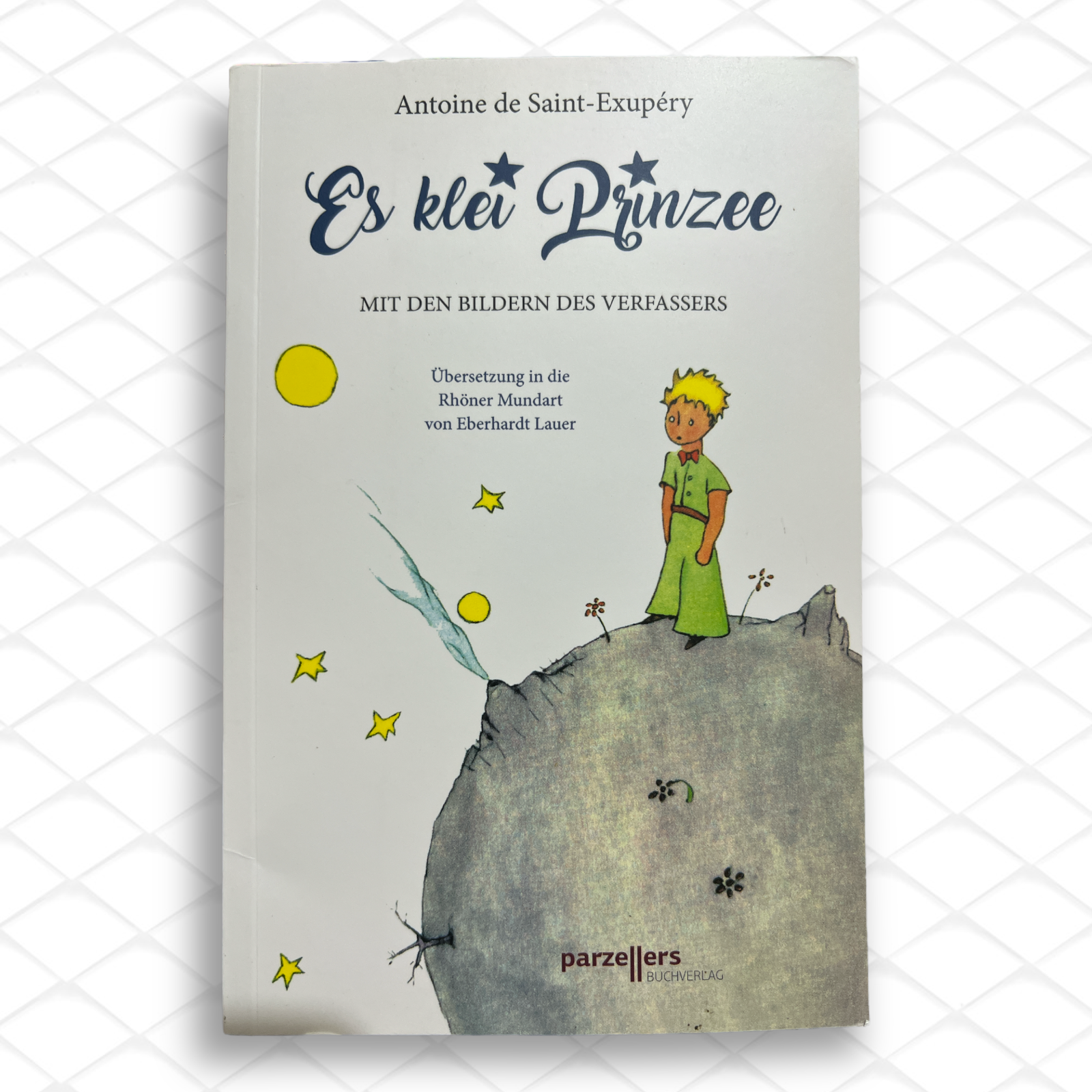
Es Klei Prinzee — in Rhönerisch.
The Rhön dialect (Rhönerisch) belongs to East Franconian (Ostfränkisch), a branch of the Franconian dialect family distinct from the Rhine Franconian and Ripuarian varieties discussed earlier, and it is spoken across the Rhön, a range of low, volcanic hills that happens to sit exactly where the modern German states of Bavaria, Hesse and Thuringia meet. The landscape itself has earned the Rhön a rather poetic nickname, the Land of Open Distances (Land der offenen Fernen), for its unusually open, sparsely wooded highland character, so different from the denser forests typical of central Germany that the whole area was designated a UNESCO Biosphere Reserve in 1991, one of the first in the newly reunified country. Linguistically the dialect sits in a similarly in-between position, part of the Central German continuum yet edging, by virtue of its location in northern Bavaria, towards some of the sound patterns more usually associated with Bavarian further south.
For much of its history the Rhön was among the poorest corners of Germany, its thin volcanic soil and exposed climate earning it the grim old nickname the poorhouse (Armenhaus) and driving waves of emigration through the nineteenth century, yet this same unpromising terrain produced one of the more delightful surprises in German aviation history. The Wasserkuppe, the Rhön’s highest peak, became in the 1920s the birthplace of organised glider flying, its steady, obstacle free winds drawing pioneering aviators to hold the very first Rhön gliding competitions there, so that a remote, dialect speaking farming region unexpectedly found itself at the literal cradle of modern soaring flight.
The Rhön dialect today is a dialect known for its distinctly melodic, almost singing intonation, closely bound up with the region’s pastoral character and its long association with sheep farming, particularly the hardy local Rhön sheep (Rhönschaf) breed that still grazes the open highland pastures the dialect’s own nickname describes.