
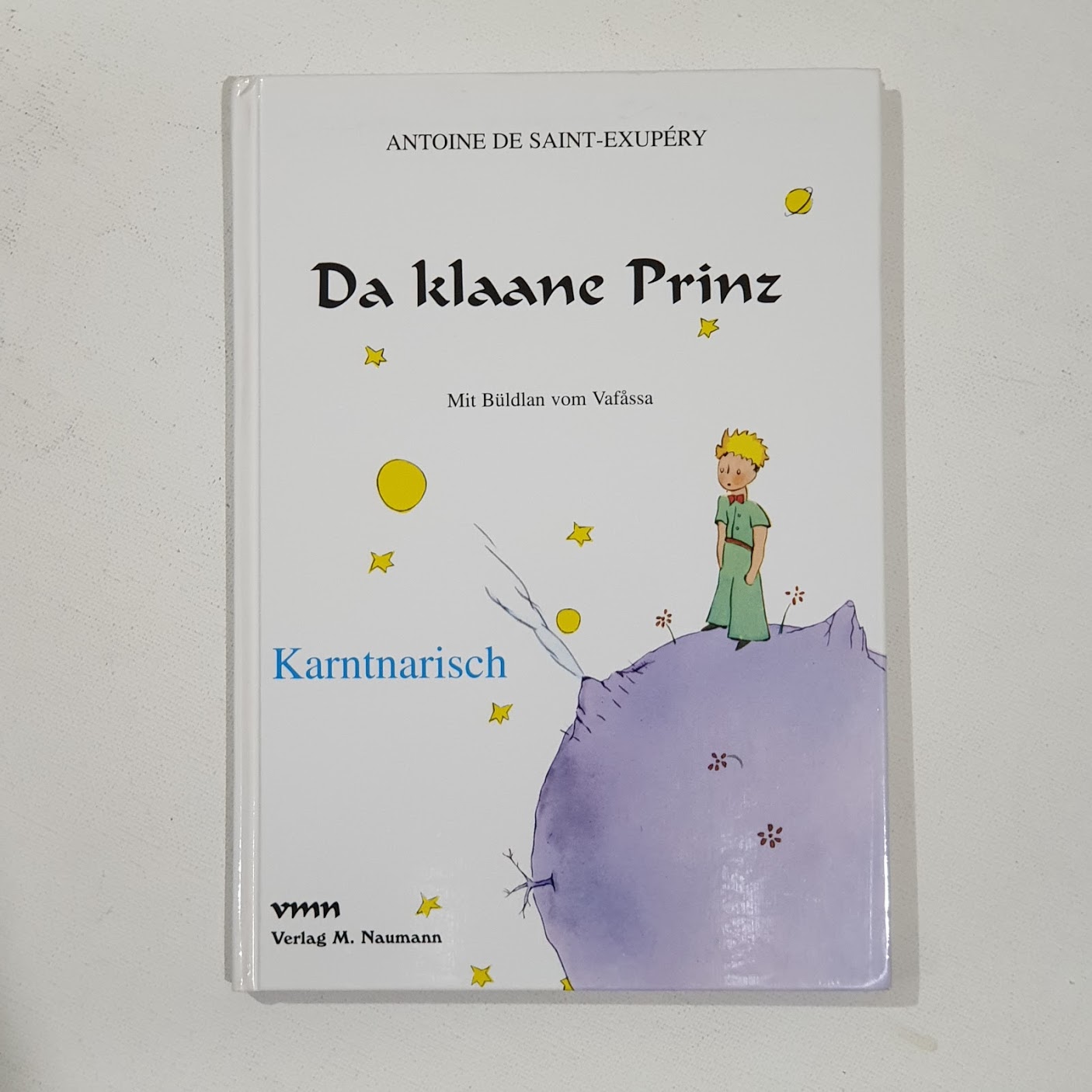
Da Klaane Prinz – in Carinthian dialect of Austro-Bavarian German.
Carinthian (Karntnarisch) belongs to the Austro-Bavarian branch of Upper German within the West Germanic family, and is spoken across Carinthia (Kärnten), the sunniest and southernmost of the Austrian states, a land of turquoise Alpine lakes and high peaks pressed hard against the Slovenian and Italian borders. What strikes any visitor first is the dialect’s distinctly musical, almost sung intonation, a rising and falling melody in ordinary speech that sets it apart even from its closest Bavarian cousins further north, and that locals themselves take evident pride in as the unmistakable sound of home.
That distinctiveness has genuinely ancient roots, for Carinthia was once the heartland of Carantania, one of the earliest Slavic polities to emerge in early medieval Europe, centuries before Charlemagne’s empire reorganised the region along Germanic lines. Remarkably, a fragment of that Slavic political inheritance survived every later change of ruler and tongue in the extraordinary ducal enthronement ceremony performed at the Prince’s Stone (Fürstenstein), in which a local peasant, speaking the old Slovene tongue, formally installed each new duke of Carinthia, a ritual that persisted for centuries even as the surrounding duchy became thoroughly Germanic and was eventually absorbed into the Habsburg lands.
That layered Slavic and Germanic inheritance still shapes Carinthian life and language today, nowhere more visibly than in its place names, Klagenfurt itself carrying the parallel Slovene name Celovec, a reminder of the long standing Slovene speaking minority with whom Carinthian German speakers have shared this valley for well over a thousand years. Vocabulary and cadence alike bear the imprint of that neighbourly contact, giving Carinthian a flavour noticeably different from Styrian or Tyrolean, its fellow southern members of the Austro-Bavarian family, while the dialect’s association with the region’s celebrated yodelling tradition and its relaxed, lake bound way of life around the Wörthersee only deepens the sense of Carinthian as a language thoroughly at home in its own particular corner of the Alps.