
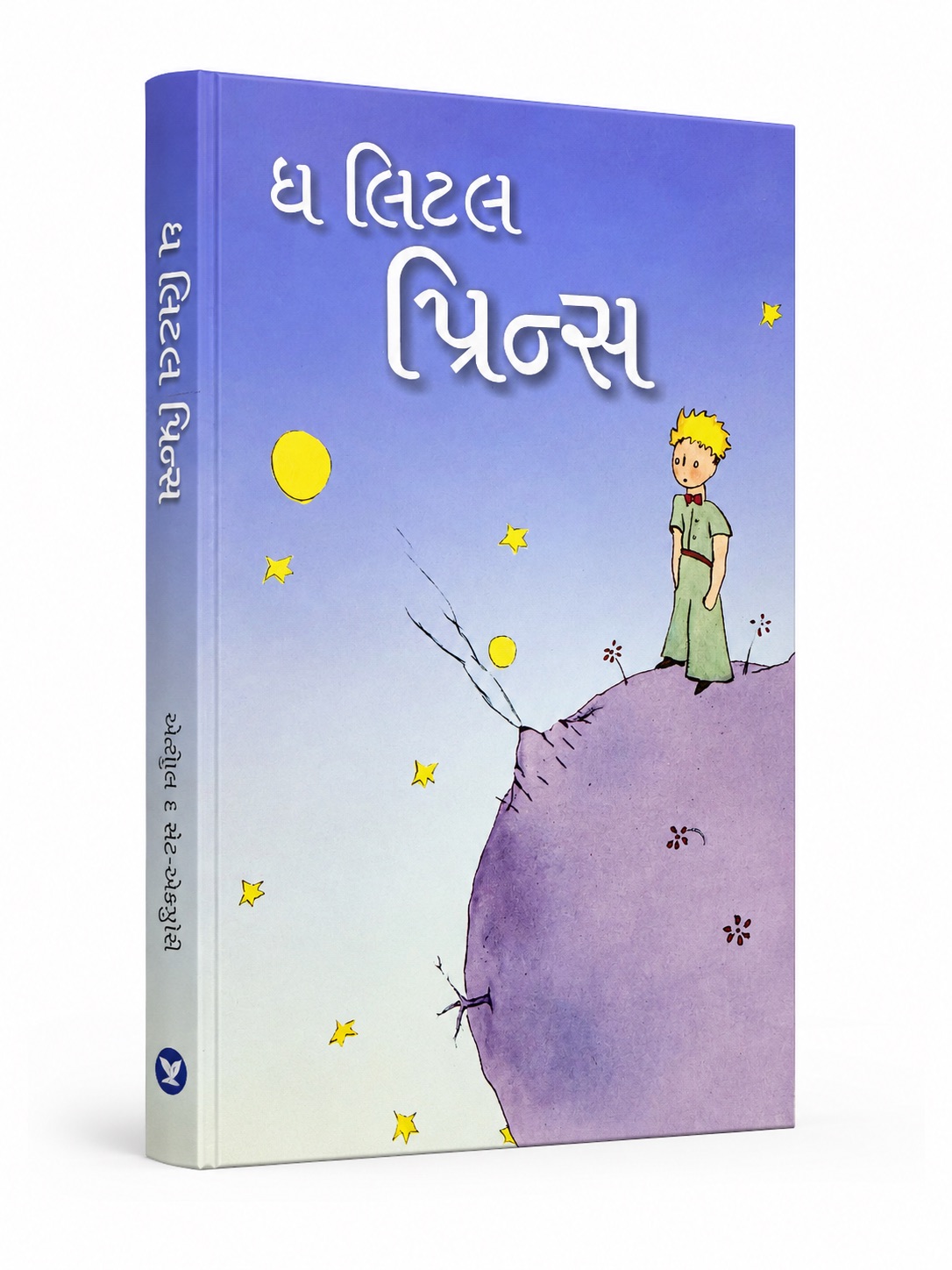
ધ લિટલ પ્રિન્સ (lit: The Little Prince) — in Gujarati.
Gujarati is one of the major literary languages of the Indian subcontinent, spoken by some sixty to seventy million people principally in the state of Gujarat on India’s western coast, as well as in substantial diaspora communities. It belongs to the Indo-Aryan branch of the Indo-European family, descending from Sanskrit through the Apabhramsha vernaculars of western India, and shares its closest genetic ties with Rajasthani, from which it diverged in the medieval period. Its script — the distinctively rounded Gujarati lipi, a derivative of the Devanagari system that dispensed with the horizontal headline characteristic of Hindi and Marathi — is among the most immediately recognisable writing systems of South Asia, lending Gujarati texts a flowing, open quality that is entirely its own. The language possesses a literary tradition stretching back to the twelfth century, with a rich heritage of devotional poetry, mercantile correspondence, Jain philosophical literature, and modern fiction, and it was the mother tongue of two figures who shaped the twentieth century more profoundly than almost any other: Mahatma Gandhi and Muhammad Ali Jinnah — men who between them partitioned a subcontinent and whose arguments about what it meant to be Indian reverberate still.
Gujarati culture is formed at the intersection of three powerful traditions: the mercantile, the devotional, and the reformist. The Gujarati trading communities — the Banias, the Jains, the Bohras, the Khojas — developed across centuries a culture of meticulous record-keeping, long-distance trust networks, and a certain pragmatic cosmopolitanism that carried Gujarati speakers from the dhow ports of the Arabian Sea to the cotton exchanges of Manchester and the corner shops of Leicester. Alongside this commercial culture runs a deep vein of bhakti devotionalism — the ecstatic poetry of Narsinh Mehta, the saint-poet who sang of Krishna in the fifteenth century and whom Gandhi considered the ideal Gujarati — and a reformist intellectual tradition that produced not only Gandhi but also Dayananda Saraswati and a disproportionate number of India’s independence-era leaders. It is a culture that has historically been comfortable moving between worlds — between the sacred and the commercial, the local and the global, the traditional and the adaptive — and this ease of translation, in the broadest sense, may partly explain why Gujarati literature has proven receptive to works from beyond its borders.
This edition, ધ લિટલ પ્રિન્સ, transliterated as Dha Liṭal Prins, is a bhavanuvad, which is not a literal translation but a rendering that prioritises the emotional and spiritual essence — the bhava — of the original over word-for-word fidelity. It is a respected mode of translation with ancient roots in Sanskrit commentary practice, where capturing the inner truth of a text was considered more important than reproducing its surface.