
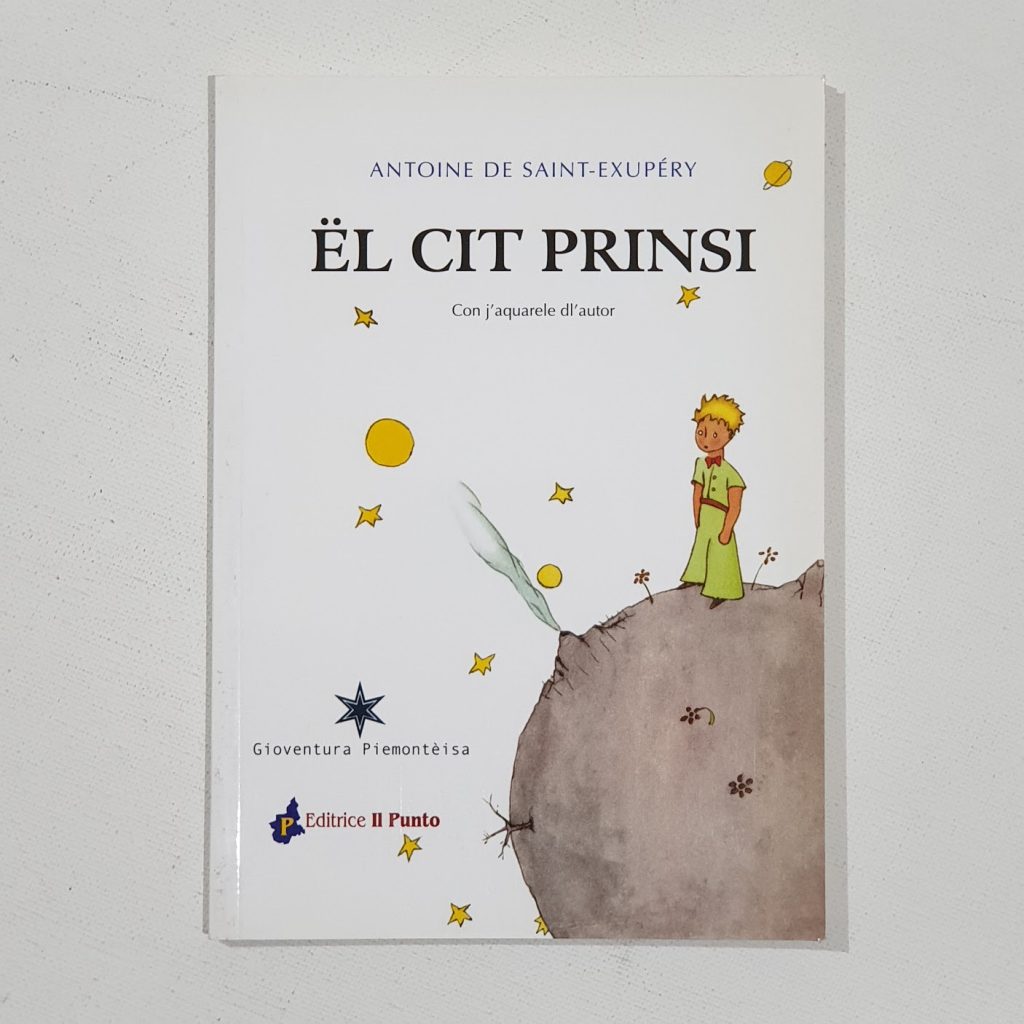
Ël Cit Prinsi — in piedmontese / piemontèis / lenga piemontèisa / piemontese.
Piedmontese is a Gallo-Italic language spoken by somewhere between one and two million people in the Piedmont region of northwestern Italy, with smaller communities in the Ligurian Alps, and in the Occitan and Arpitan valleys of the western Alpine arc where it exists in complex contact with those languages. It belongs to the Gallo-Italic branch of Romance — the northern Italian languages that, unlike Tuscan-derived Standard Italian, underwent the same sound changes that produced French and Occitan, diverging from the southern Romance continuum at a relatively early stage. Its closest relatives within Gallo-Italic are Lombard to the east, Ligurian to the south, and Emilian-Romagnol further east still — languages that share with Piedmontese a characteristic reduction of final vowels, a system of clitic subject pronouns absent from Standard Italian, and a phonological inventory that includes sounds, such as the front rounded vowels rendered in Piedmontese orthography as ë and ö, that betray the language’s proximity to the Gallo-Romance world across the Alps.
Piedmont’s cultural history is inseparable from its political one. The region was the heartland of the House of Savoy, whose gradual expansion from a small Alpine county to the kingdom that unified Italy between 1859 and 1871 made Turin briefly the capital of a new nation — a role the city relinquished with characteristic aristocratic composure when Rome became the permanent capital in 1871. This Savoyard heritage gave Piedmont a cultural self-confidence and a tradition of administrative competence that distinguish it from most other Italian regions, and it left behind an architectural legacy of baroque palaces, formal gardens, and colonnaded streets that makes Turin one of the most coherent and underappreciated cities in Europe. Piedmontese language and culture flourished within this courtly context: the language was used in theatre, poetry, and comic literature from the seventeenth century onward, producing a substantial written tradition that includes the playwright Carlo Goldoni’s Piedmontese-inflected comedies and a rich vein of dialect poetry that continued well into the twentieth century. The Gioventura Piemontèisa — the Young Piedmont association whose imprint appears on the cover of Ël Cit Prinsi — is part of this tradition of active cultural maintenance, representing the organised effort to keep Piedmontese alive as a literary and civic language in the face of Standard Italian’s dominance in education and public life.
The title Ël Cit Prinsi is a small lesson in Piedmontese phonology and grammar: ël is the masculine definite article, cognate with French le and Occitan lo but with the characteristic Piedmontese centralisation of the vowel; cit — small — is a word with no direct equivalent in Standard Italian, derived from a root shared with French petit and Occitan chic, immediately marking the text as belonging to a Romance tradition that looks north and west rather than south toward Tuscany; and prinsi for principe shows the characteristic Piedmontese reduction of final syllables that gives the language its clipped, energetic rhythm so different from the open vowels of Standard Italian.