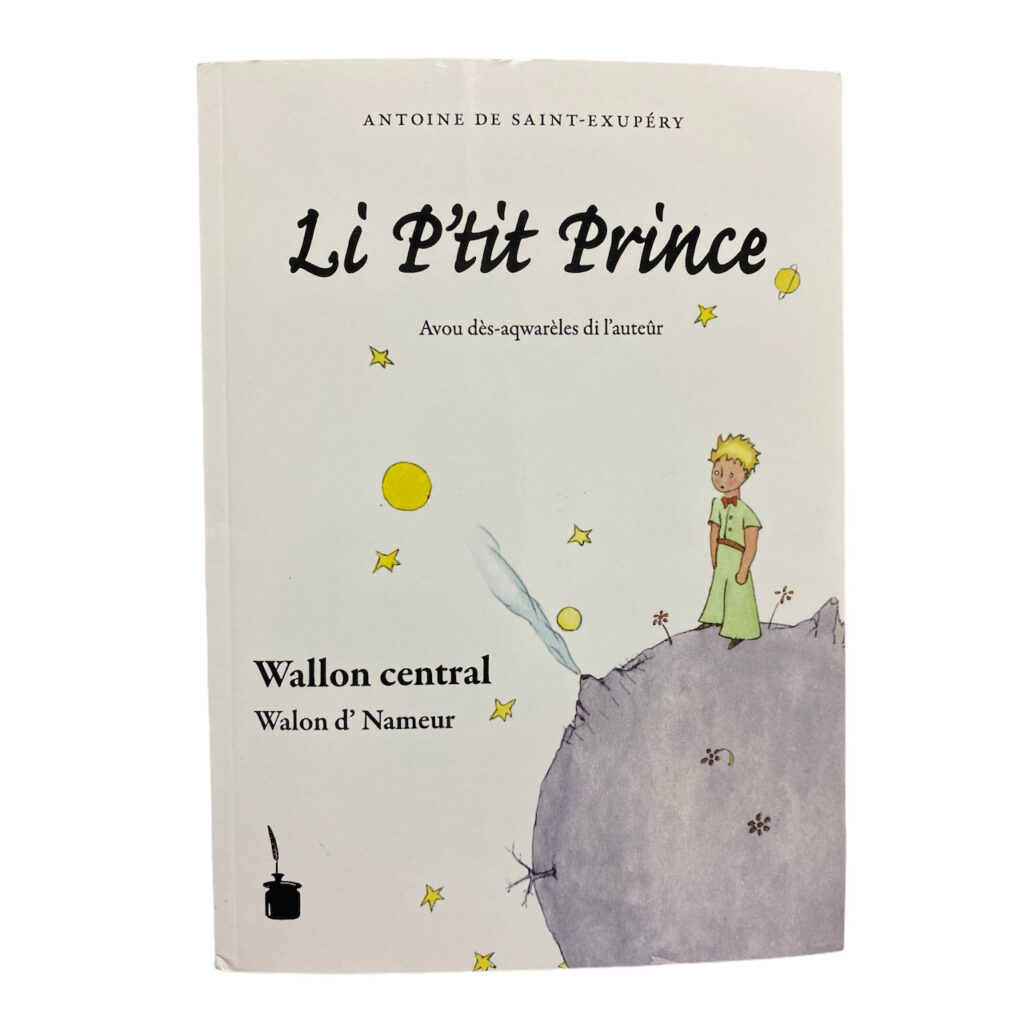
Li P’tit Prince — in Wallon language.
Walloon (Wallon) belongs to the Oïl language family within Gallo Romance, making it a genuine cousin of French itself rather than a mere dialect of it, alongside siblings such as Picard and Norman, and it remains native to Wallonia, the French speaking southern half of Belgium. Most linguists in fact classify Walloon as a distinct language in its own right, sufficiently different from standard French in sound, grammar and vocabulary to stand apart, a Romance tongue that grew up in close daily contact with its Germanic neighbours across the linguistic frontier that has always run through Belgium.
That very name carries a wonderfully unexpected story, for Walloon and Wallonia both descend from the old Germanic root Walh, the word Germanic speaking peoples once used for their Romance or Celtic speaking neighbours, the same root that gave English the word Welsh for the Celtic speakers of Britain and that surfaces again, astonishingly, in Wallachia and Vlach far away in the Balkans. Three peoples separated by the length of a continent thus still carry echoes of a single ancient Germanic label. That same border position between Romance and Germanic worlds also shaped the language itself, for Walloon absorbed a distinctive layer of Frankish and later Germanic loanwords quite different from those found in standard French, while the medieval prince bishopric of Liège helped foster one of the earliest written literary traditions among all the Oïl languages besides French.
Walloon’s cultural life reached its richest flowering during Wallonia’s nineteenth and early twentieth century heyday as the industrial heartland of Belgium, when coal pits and steelworks filled with Walloon speaking workers who carried the language into a thriving popular theatre, cabaret and song tradition, théâtre wallon, still performed with evident affection in towns and villages today. Decades of francisation in schools and administration through the twentieth century pushed everyday use of the language into steep decline, yet Walloon persists as a proud marker of regional identity, a Romance language that grew to maturity not in isolation but precisely at the meeting point of France’s linguistic orbit and the Germanic world beyond, and that still bears the marks of both in every sentence.