

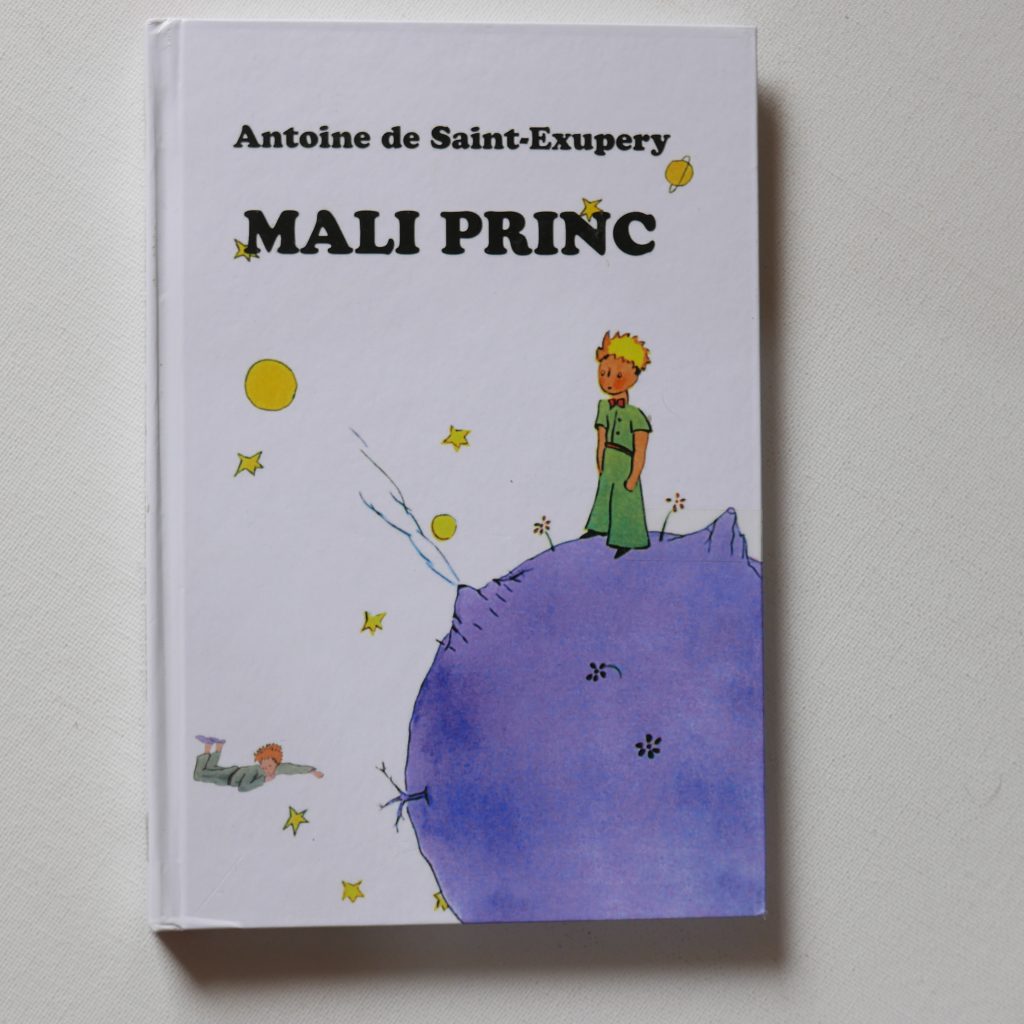
Mali Princ – in Bosnian languag
The Bosnian language belongs to the South Slavic group and developed within a region long shaped by cultural convergence rather than uniformity. Historically, Bosnian emerged from the same Štokavian dialectal base shared with Serbian, Croatian, and Montenegrin, yet it evolved under distinctive social and religious conditions. Medieval Bosnian literacy employed a range of scripts, including Cyrillic (in its local Bosnian form), Glagolitic, and later Latin, reflecting Bosnia’s position at the intersection of Eastern and Western Christian traditions. The Ottoman period added a further layer of influence, introducing Islamic scholarship and a lexical stratum derived from Turkish, Arabic, and Persian, which became an enduring feature of Bosnian expression.
What sets Bosnian apart culturally is precisely this synthesis of influences. Situated between Catholic, Orthodox, and Islamic civilisations, Bosnia developed a linguistic identity that accommodated plurality without rigid demarcation. The Bosnian language preserves a noticeable number of Oriental loanwords, particularly in domains of daily life, administration, and spirituality, lending it a tonal and lexical texture distinct from its closest relatives. While Latin script is predominant today, Bosnian historically demonstrated scriptal flexibility, a trait shared with but expressed differently from neighbouring Serbian and Croatian traditions. This layered heritage has made Bosnian not merely a variant of a shared dialect continuum, but a language shaped by a unique historical experience.
In comparison with other Slavic languages, Bosnian remains structurally close to Serbian, Croatian, and Montenegrin, with high mutual intelligibility across grammar and core vocabulary. At the same time, its lexical choices, stylistic preferences, and cultural references mark it as distinct in use and sensibility. Beyond the immediate South Slavic sphere, Bosnian shares the broader Slavic features found in Slovenian, Bulgarian, and Macedonian, yet it retains a stronger link to the western South Slavic dialectal tradition. Its contribution to Slavic diversity lies not in structural divergence, but in demonstrating how a language can remain grammatically conservative while culturally expansive.
In the wider Slavic context, Bosnian serves as an example of how language reflects historical coexistence rather than linguistic isolation. Its development underscores the fact that Slavic languages were never sealed systems, but living mediums shaped by trade, faith, governance, and everyday contact. Today, Bosnian continues to function as a marker of cultural identity while remaining firmly embedded in the South Slavic linguistic family. In doing so, it illustrates a broader truth of Slavic history: that shared linguistic roots do not preclude distinctive voices, and that historical complexity, when preserved rather than erased, enriches the whole.