
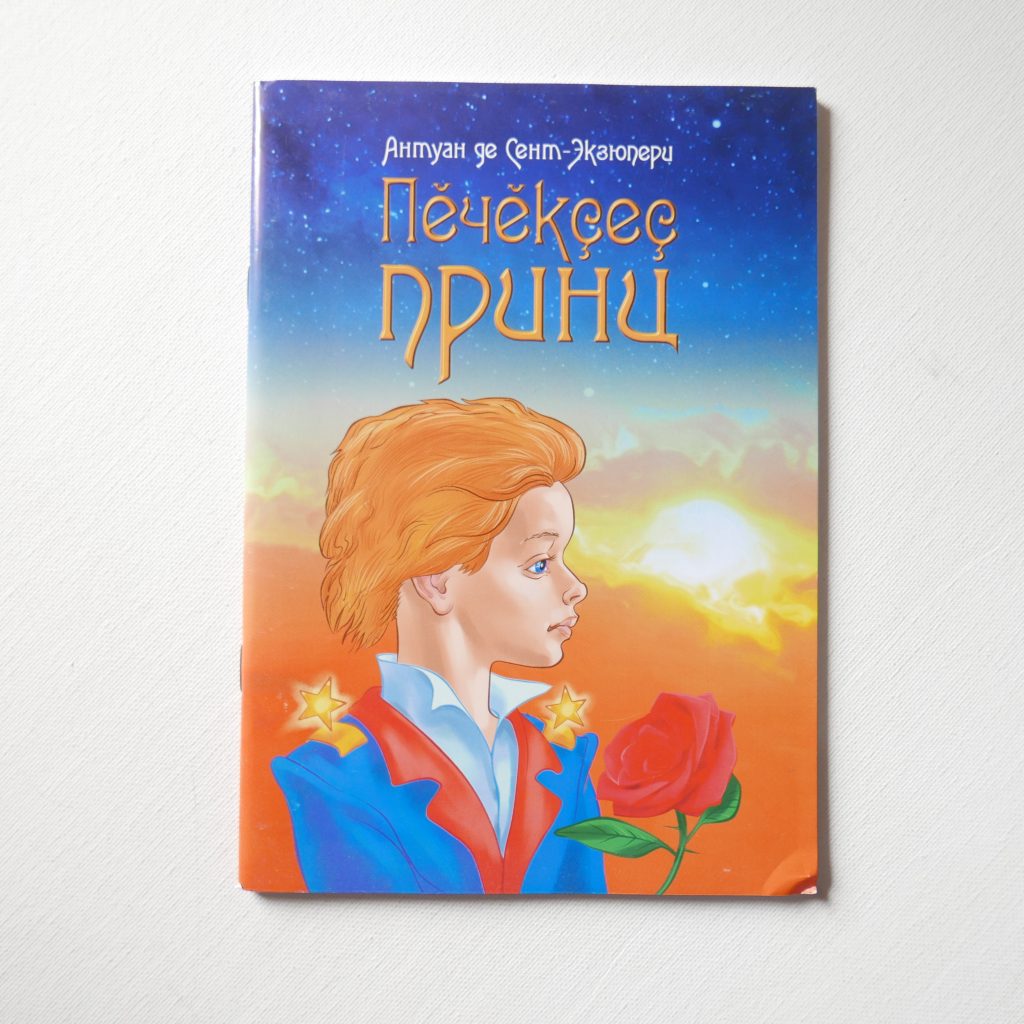
Пӗчӗӄҫеҫ Принц (Pèchèkses Prints) — in Chuvash language.
Chuvash (Чӑваш чӗлхи, Chăvash chĕlhi) occupies a position in the Turkic family unlike any other living tongue: it is the sole surviving representative of the Oghur, or Bulgaric, branch, a lineage that split from the rest of Turkic so early that its cousins are essentially all extinct, known to scholars only through scraps of Old Bulgar and Khazar inscriptions. Where the vast common Turkic family, stretching from Istanbul to Yakutsk, shares a recognisable core of consonants (words for iron, stone, or horse using z and sh sounds), Chuvash instead shows r and l in their place, a pattern linguists call rhotacism and lambdacism. A Turkish speaker hearing Chuvash would catch almost nothing familiar, even though both languages ultimately spring from the same Central Asian root; it is rather like an Italian trying to make sense of Romanian’s Slavic-inflected cousin, recognisably related on paper, yet worlds apart on the tongue.
The people who speak it, some one million strong, live chiefly in the Chuvash Republic (Чӑваш Ен, Chăvash En), a modest region straddling the middle Volga within the Russian Federation, with further pockets scattered across Tatarstan, Bashkortostan, and Siberia through Soviet era resettlement. Their ancestors were the Volga Bulgars, a medieval trading civilisation that built a sophisticated state along the river long before the Mongol conquests scattered it; one branch of that people pushed south and eventually became the Danube Bulgarians, who abandoned their Turkic tongue for Slavic, while the northern remnant clung on in the forests and became the Chuvash. Centuries of neighbourly life among Russians, Tatars, and the Finno-Ugric Mari and Mordvin peoples left deep marks: the vocabulary carries old borrowings from Persian and Arabic through Volga Bulgar trade routes, later layers of Russian administrative and technical terms, and even a scattering of words shared with Hungarian, a linguistic echo of contact stretching back over a thousand years to the steppe.
What makes Chuvash especially striking today is how deliberately its modern written form was shaped. Before the nineteenth century it existed mainly as a spoken language; it was the pedagogue Ivan Yakovlev, himself of Chuvash peasant stock, who in the 1870s devised a Cyrillic based alphabet fitted with extra letters unique to the language, Ӑ ӑ, Ӗ ӗ, and Ҫ ҫ, to capture sounds Russian orthography could not render, among them a reduced central vowel and a soft hissing sibilant found nowhere else in the Cyrillic writing world. That alphabet gave Chuvash a literature, a press, and eventually official status alongside Russian within its republic, even as the number of fluent young speakers has quietly declined under the pull of Russian language schooling and urban migration. It remains, nonetheless, a living linguistic fossil of sorts: a direct thread back to the Bulgar khanates of the early medieval Volga, preserved not in some remote mountain valley but in the heartland of European Russia, still spoken in villages where the old vowel harmony and case endings of Bulgaric Turkic survive largely intact.