
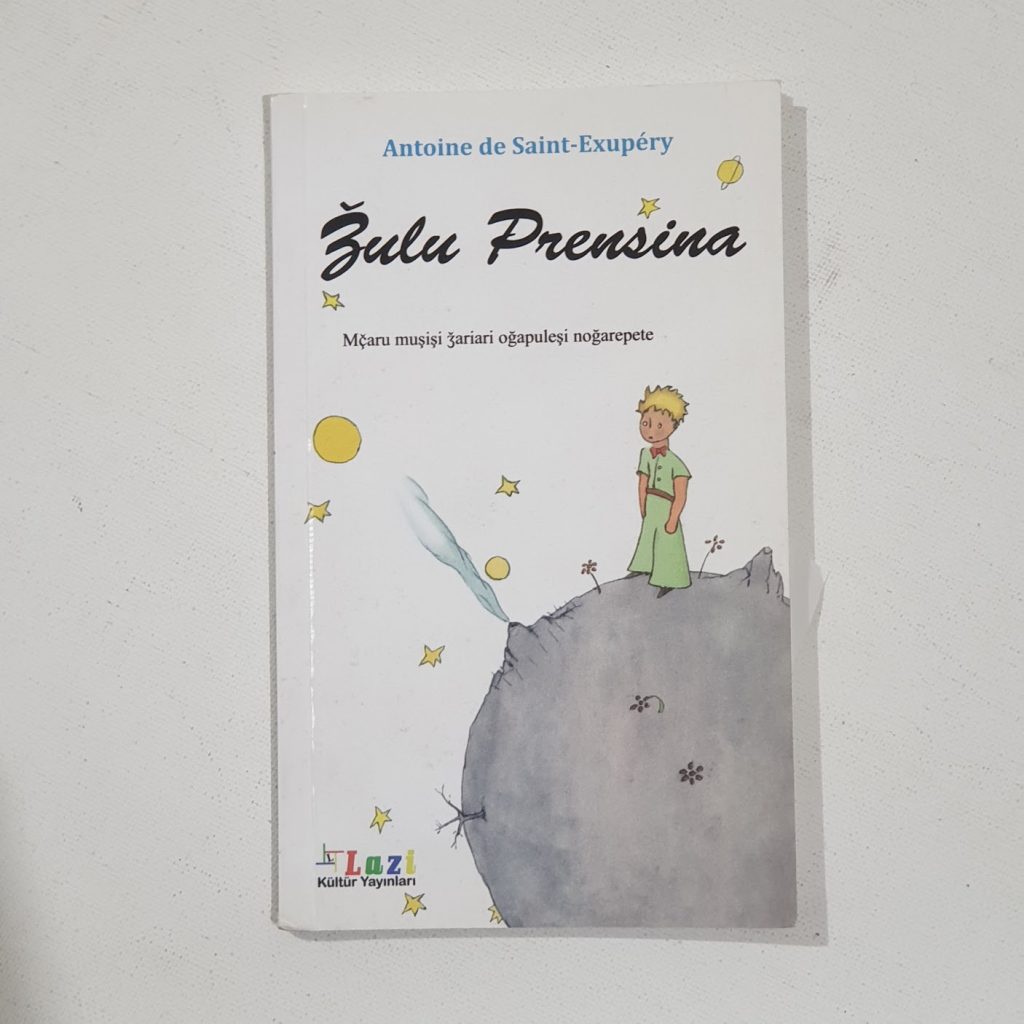
Žulu Prensina — in Çxala dialect of Laz language.
ლაზური ნენა (Lazuri Nena, “the Laz tongue”) belongs to the Kartvelian, or South Caucasian, family, where it forms the Zan branch together with its close sibling მარგალური ნინა (Margaluri Nina, Mingrelian). Glottochronological reckoning places the Zan languages’ split from Common Kartvelian as far back as the eighth century BC, making Laz and Georgian (ქართული ენა, Kartuli Ena) sisters descended from a common ancestor rather than parent and dialect, whatever the popular misconception to the contrary. Laz and Mingrelian themselves remained a single Zan continuum for a further millennium and a half, only pulling apart around the seventh century AD, when Arab pressure on Byzantium drove Georgian-speaking populations from Iberia westward into Imereti, Guria, and Adjara, cleaving the Zan-speaking world in two; the northern half became Mingrelian, settled around Samegrelo in western Georgia, while the southern half became Laz, carried onward to the Black Sea littoral of what is now north-eastern Turkey. The two remain only partially mutually intelligible today, their speakers typically falling back on Turkish or Georgian to bridge the gap — a fittingly modest inheritance from what was once a single tongue.
The Laz trace their lineage to the ancient land of კოლხეთი (Kolkheti, Colchis), of Golden Fleece renown, and to the Byzantine-era kingdom of Lazica, whose people were drawn into Christendom under Justinian in the sixth century. Their subsequent history diverged sharply from that of their Georgian and Mingrelian kin: following the Ottoman conquest of Lazistan in 1547, the Laz converted gradually to Sunni Islam over the following century and a half, while those same Zan communities remaining under Constantinople’s ecclesiastical sway were instead Hellenised, adopting Pontic Greek and, in time, a Greek identity altogether. What survived of a distinctly Laz culture took shape around the rhythms of the eastern Black Sea coast — fishing and seamanship, the cultivation of hazelnuts and, later, tea, and a musical tradition built upon the kemençe (spike fiddle), the guda (bagpipe), and above all the Horon, a driving line dance whose origins are thought to lie in pre-Christian ritual. The twentieth century dealt the language a further blow: Turkish nationalising policy suppressed even the name “Lazistan” from 1926 and forbade the public use of Laz outright between 1980 and 1991, a rupture from which the tongue has never fully recovered — its speaker count collapsing from over sixty thousand at the 1935 census to barely twenty thousand today, earning it UNESCO’s designation of “definitely endangered,” notwithstanding a modest revival since the 1990s, including its introduction as an elective school subject in 2013.
Structurally, Laz displays the family’s characteristic imbalance between an elaborate consonant system and an economical five-vowel inventory (a, e, i, o, u), married to an agglutinative grammar in which nouns decline through as many as eight cases and verbs may carry upwards of fifty distinct prefixes marking spatial orientation alone — a degree of morphological richness that leaves a single verb doing the descriptive work of an entire English clause. Its very script is a mark of its divided fate: the great majority of speakers, settled within Turkey, write it in a Latin alphabet adapted from Turkish since 1984, while the small remaining community in Georgia’s Adjara region uses the Georgian Mkhedruli script instead, so that one language is, quite literally, written two different ways depending on which side of a modern border its speakers happen to have been born. That fracture sits within a wider one, for the eastern Black Sea and southern Caucasus form one of the most linguistically chaotic corners of Eurasia: Kartvelian Georgian and Mingrelian, Indo-European Armenian and Pontic Greek, Turkic Turkish, and, a little further along the coast, the wholly unrelated Northwest Caucasian languages all jostle within a few hundred kilometres of one another, none mutually intelligible with the rest. Within that thicket, Laz stands truly alone save for its one remaining sibling, Mingrelian, and even that kinship yields only a partial, imperfect understanding — the last surviving fragment of a language family that Colchis once knew as a single voice.