
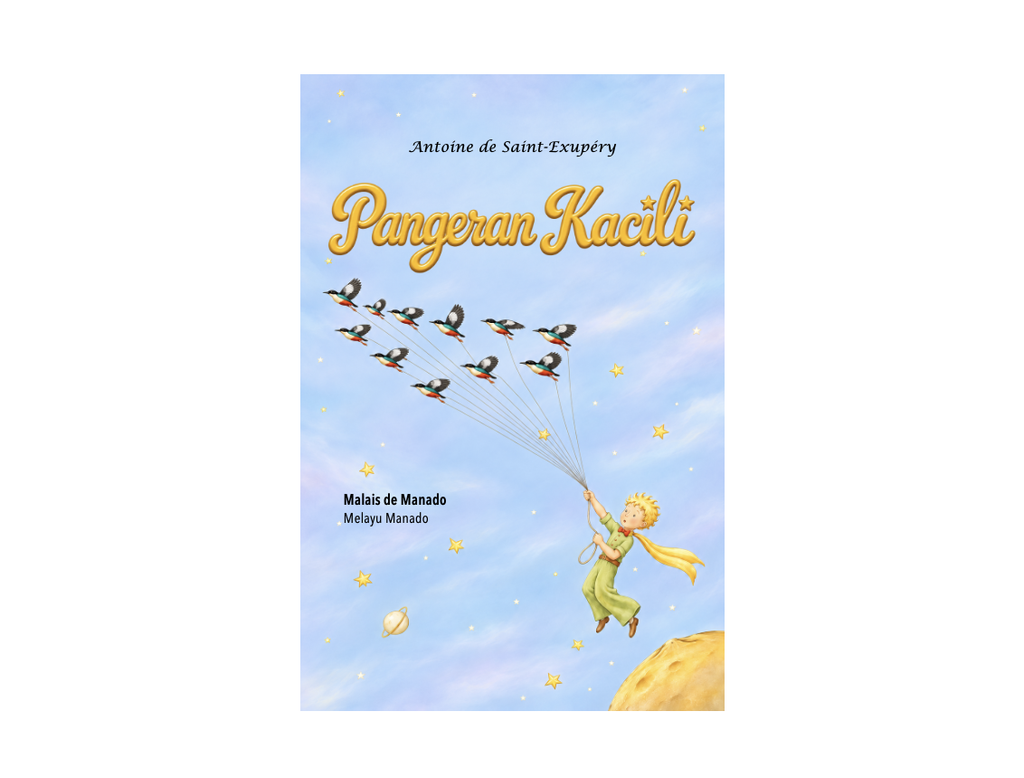
Pangeran Kacili — in Melayu Manado.
Manado Malay (Bahasa Manado) belongs to the family of Malay contact languages scattered across eastern Indonesia, the trade born cousins of Ambonese, Kupang, North Moluccan and Papuan Malay, all ultimately Malayic and Austronesian in origin yet each grown up far from the Malay heartland of Sumatra and the peninsula. It is spoken in and around Manado, the bright harbour city at the northern tip of Sulawesi, and across the Minahasa highlands and much of the province of North Sulawesi, where it has become not merely a lingua franca but the everyday mother tongue of a large and proud population, its spirit captured in the province’s celebrated motto torang samua basudara, we are all brothers and sisters.
Its roots lie less in Sulawesi itself than in the spice trade of the Moluccas, for the language descends chiefly from the Malay of Ternate, whose sultans long held sway over the northern Sulawesi coast, and it was layered over the centuries by successive European visitors. Portuguese and Spanish seafarers, the latter arriving from their bases in the Philippines in the seventeenth century, left words that still sound through daily speech, kadera for chair from cadeira, lenso for handkerchief from lenço, garpu for fork from garfo and testa for forehead, before the VOC established its fort at Manado and, with the missionaries who followed, drew the Minahasa into a deeply Christian, Dutch schooled world that made Manado Malay the natural language of church, school and commerce. Beneath it lies a far older Minahasan heritage of ancestral stone sarcophagi called waruga, of the sacred meeting stone of Watu Pinawetengan where the founding clans are said to have divided their lands, and of a cuisine as fiery and inventive as its people.
What gives Manado Malay its unmistakable character is a grammar quite unlike standard Indonesian, beginning with its pronouns, for here kita means simply I rather than the inclusive we, while ngana means you, torang we, ngoni you all and dorang they, torang and dorang being forged from older phrases meaning we people and they people (kita orang, dia orang). Possession is marked with the little particle pe, so that kita pe rumah is my house, a construction it shares with pung in Ambonese and Melayu Kupang, while nyanda serves for no, so for already and mo for will, giving everyday speech a quick, clipped and cheerful rhythm. Around it lie the region’s indigenous Austronesian languages, Tondano, Tombulu, Tonsea, Tontemboan and their neighbours, together with Sangir to the north and the Gorontalo and Mongondow languages to the west, all of which belong not to the Malayic branch but to the Philippine subgroup, closer kin to Tagalog and Cebuano than to Malay. Manado Malay has steadily drawn speakers away from these ancestral tongues, and so it stands today as both a triumph and a quiet threat, a vivid, warm and thoroughly local voice of northern Sulawesi that grew from the meeting of spice traders, Iberian sailors, Dutch pastors and Minahasan clans.