
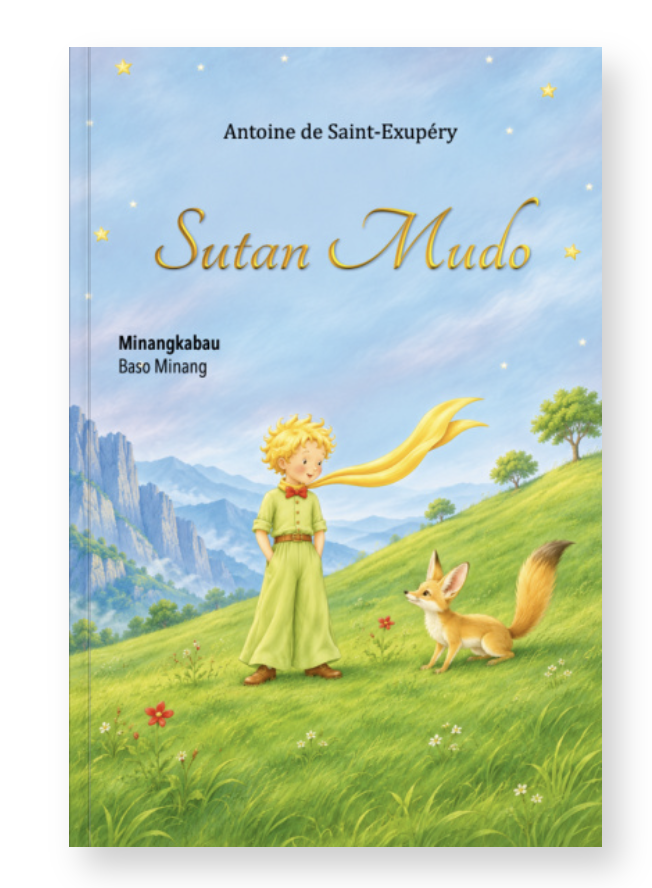
Sutan Mudo — in Minangkabau.
Minangkabau (Baso Minangkabau) belongs to the Malayic branch of the Austronesian family, so close a cousin of Malay that linguists have long debated whether it should count as a separate language or as a richly distinctive member of the wider Malay continuum, and it is the mother tongue of the Minangkabau people of the highlands of West Sumatra, a land of volcanic peaks, terraced rice fields and the soaring, horn roofed great houses (rumah gadang) whose upswept ridges are said to echo the curving horns of the water buffalo. That animal sits at the very heart of the people’s identity, for according to a cherished legend the name itself means the victorious buffalo, recalling a contest in which the clever Minang, challenged by an invading Javanese host, sent a hungry calf fitted with sharpened horns against their rivals’ mighty bull and so won their freedom without a battle.
Historically the highlands were the seat of the kingdom of Pagaruyung, associated from the fourteenth century with Adityawarman, a prince of Majapahit descent whose inscriptions in Old Malay and Sanskrit still dot the region, before Islam took deep root and fused with local custom in the celebrated principle adat basandi syarak, syarak basandi Kitabullah, custom founded upon religious law, and religious law founded upon the Book of God. What makes Minangkabau society so remarkable in the world is that this devout Muslim people remain the largest matrilineal community on earth, with ancestral houses, rice land and clan membership passing through the female line, while young men have traditionally been urged to leave home on merantau, the restless journey outward in search of learning and fortune. That outward impulse carried Minang speakers across the Strait of Malacca to found the matrilineal communities of Negeri Sembilan in Malaysia, scattered Padang restaurants to every corner of the archipelago, and produced a disproportionate share of Indonesia’s founding intellectuals and writers, among them Mohammad Hatta, Sutan Sjahrir, Agus Salim, Tan Malaka and Hamka, alongside the novelists whose works helped shape modern Indonesian literature itself.
Linguistically Minangkabau delights in a set of regular, almost musical sound correspondences with standard Malay that make it instantly recognisable: final a rounds into o, so that apa and kita become apo and kito; endings such as at and it shift into ek and ik, so that empat becomes ampek and bukit becomes bukik; while ut and ur open into uik and ua, turning rumput into rumpuik and dapur into dapua. Once written in the Arabic based Jawi script and now in Latin letters, the language lives most vividly in its oral arts, in the sung epic tales called kaba, in the circular dance drama of randai, and in a vast treasury of proverbs and aphorisms through which elders still counsel the young. Standing beside Malay as a sibling rather than an offspring, and having lent its own speakers’ energy to the very making of Indonesian, Minangkabau remains a language at once proudly local and quietly cosmopolitan, rooted in the mothers’ houses of the highlands yet forever setting out, like its young men of old, to see what lies beyond the hills.