
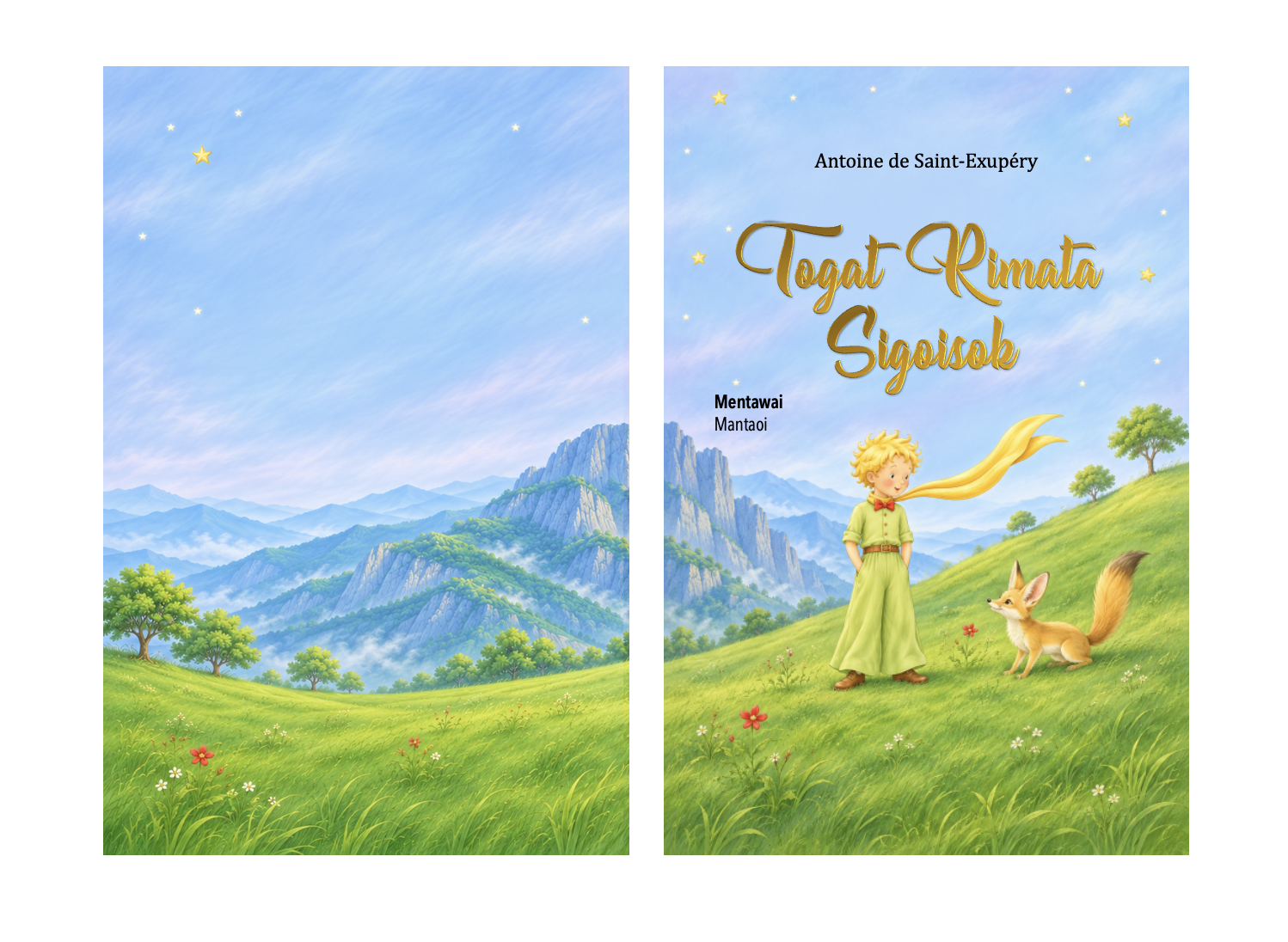
Togat Rimata Sigoisok — in Mentawai language.
Mentawai belongs to the Austronesian family, within a grouping that linguists call the Northwest Sumatra and Barrier Islands languages, and its closest relatives are not the Malayic tongues of the Sumatran mainland but Nias to the north, the speech of Simeulue, and more distantly the Batak languages of the northern Sumatran highlands. It is spoken on the Mentawai Islands, Siberut, Sipora and the two Pagai islands, a chain lying some hundred kilometres off the west coast of Sumatra across a deep strait that kept them apart from the mainland for long ages, so long that the islands nurture their own endemic primates found nowhere else on earth, and a culture that developed with remarkably little of the Indian, Islamic or Javanese influence that reshaped so much of the rest of the archipelago.
That isolation preserved one of the most distinctive ways of life in Southeast Asia. Mentawai communities traditionally lived in great clan houses called uma, sustained themselves on sago, taro, pigs and the forest, and ordered their world through Arat Sabulungan, an animist faith in which every person, animal, plant and object possesses a soul that must be kept content, with harmony mediated by the sikerei, shaman healers famed for their ritual dances and their knowledge of medicinal plants. Their bodies told their stories through titi, the elaborate full body tattoos often claimed to be among the oldest continuous tattooing traditions in the world, while filed teeth were long regarded as a mark of beauty. The twentieth century brought a harsh reckoning, as Dutch missionaries and then the Indonesian state sought to replace these customs, culminating in a government ban on Arat Sabulungan in 1954 that obliged islanders to adopt an officially recognised religion and drove much of the old ritual life into the remoter forests of Siberut, where it endures most strongly to this day.
The language itself mirrors that layered story, falling into several dialects across the islands, with the speech of Siberut differing noticeably from that of Sipora and the Pagai islands, and carrying a vocabulary rich in the intimate knowledge of forest, river and spirit that its speakers’ way of life demanded. Its lexicon stands strikingly free of the Sanskrit and Arabic loanwords that colour Malay, Minangkabau and Javanese, giving linguists a valuable glimpse of an Austronesian tongue that developed largely on its own terms, even as Indonesian now presses steadily upon it through schools, churches and the growing traffic of surfers and visitors drawn to the islands’ celebrated waves. Mentawai thus endures as the voice of a small island world that long kept its own counsel, a living reminder that the Austronesian story in Sumatra is far older and more varied than the familiar tale of Malay trade and kingdoms alone.