
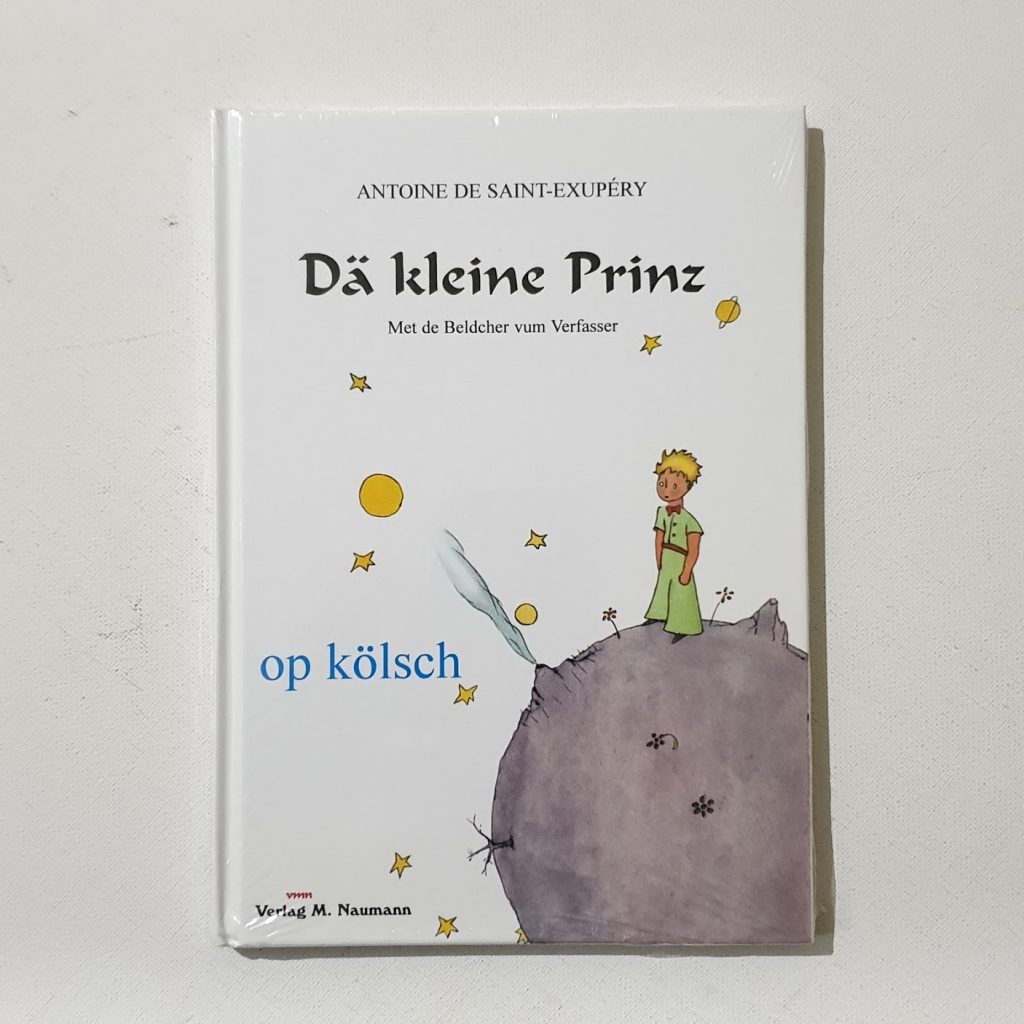
Dä Kleine Prinz — from Köln / Cologne.
The Cologne dialect (Kölsch) is the flagship member of the Ripuarian Franconian family discussed alongside its smaller Aachen cousin, Öcher Platt, sharing the same Central Franconian roots and the same Dorp Dorf line marking Ripuarian’s northern edge, yet Kölsch stands apart from almost every other German dialect in one striking respect: it has its own dedicated language academy. The Academy for our Cologne Language (Akademie för uns kölsche Sproch), founded in 1983 and pointedly named in Kölsch itself rather than standard German, maintains a standardised spelling system, publishes dictionaries and grammars, and actively promotes the dialect, giving a supposedly humble regional vernacular something close to the institutional weight that the Académie française gives standard French, a genuinely rare honour for what outsiders might otherwise dismiss as merely a local accent.
That civic self confidence has deep historical roots. Cologne began life as the Roman colony Colonia Claudia Ara Agrippinensium, founded in 50 AD and named for the empress Agrippina the Younger, who had been born there, and the modern names Köln and Kölsch both descend directly from that single Latin word Colonia, meaning the dialect’s very name preserves a linguistic fossil of Roman imperial administration nearly two thousand years old. Medieval Cologne grew into one of the great cities of Christendom, its enormous cathedral, the Cologne Cathedral (Kölner Dom), built to house the Shrine of the Three Kings (Dreikönigsschrein), relics believed to belong to the biblical Magi, drawing pilgrims from across Europe and placing the city, and by extension its native speech, at the centre of continental religious and commercial life for centuries, a history that left Cologne with an outsized sense of its own importance that Kölsch speakers still carry today.
What keeps Kölsch genuinely thriving, rather than merely respected, is its extraordinary modern cultural life. Cologne Carnival (Kölner Karneval), one of the largest and most exuberant such festivals anywhere in the world, runs almost entirely in Kölsch, and generations of Cologne songs (Kölsche Lieder) by bands from Bläck Fööss to BAP have carried the dialect far beyond the Rhineland as genuine popular music rather than folkloric curiosity, giving Kölsch a level of everyday vitality most German dialects can only envy. Linguistically it has its own quiet surprises too, including a periphrastic progressive construction built with am plus the infinitive, ich bin am schaffe for I am working, functioning remarkably like the English progressive tense in a way standard German lacks entirely. Even the local beer carries the dialect’s name, protected since the Kölsch Convention (Kölsch-Konvention) of 1986 so that only breweries within a defined radius of the city may legally call their pale ale Kölsch, traditionally served in small glasses called Stangen in the brewhouse taverns, Brauhäuser, where the dialect, the beer, and the city’s whole sense of itself all come pleasantly, and quite literally, to the same table.