
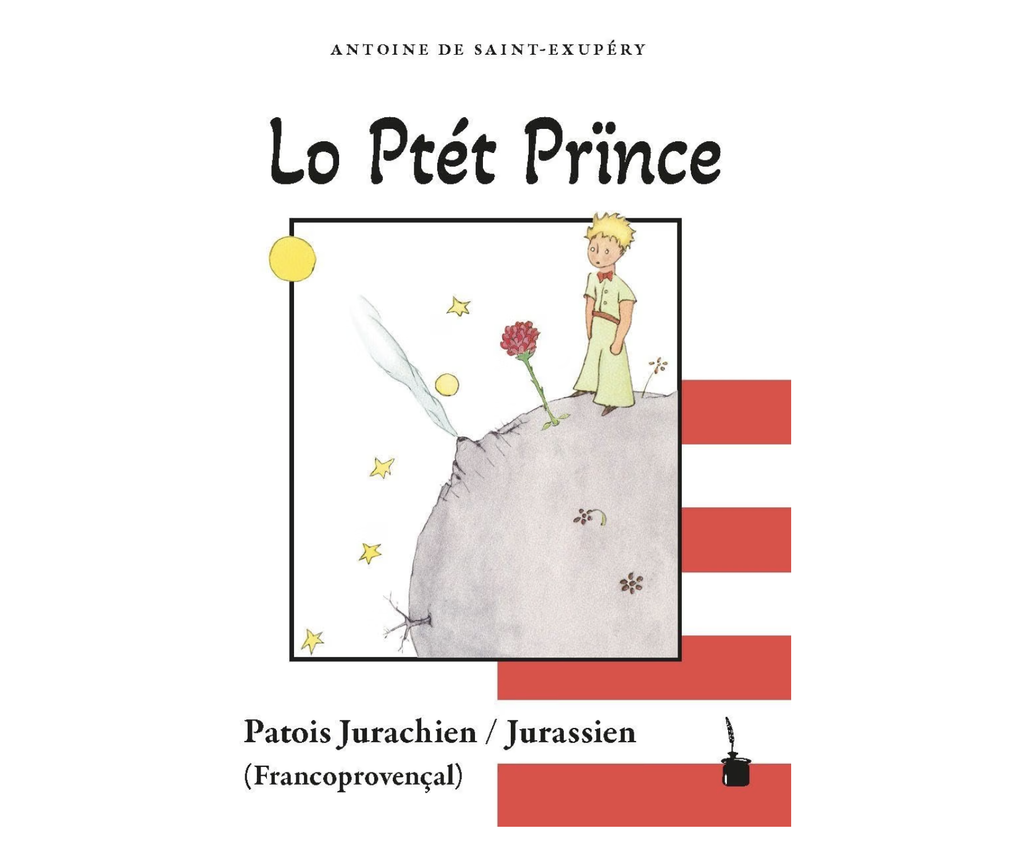
Lo Ptét Prïnce, the Little Prince rendered into patois jurassien, also called patois jurachien, is the work of Michel Choffat, a patois enthusiast from Buix in the Ajoie district of the Canton du Jura, who took up the translation as a personal challenge after fellow enthusiasts from Fribourg, met at the Romandy and International Patois Festival held annually in Porrentruy, pointed out that Saint Exupéry’s little book had somehow never appeared in Jura speech at all. Choffat leaned on Jean Marie Moine’s patois dictionary to track down words that had genuinely fallen out of everyday use, and by his own account the trickiest part of the whole undertaking was not vocabulary at all but orthography, since a single French phrase can be legitimately rendered several different ways once written down in a language that never had a settled spelling system of its own.
Exactly where that patois sits within the Gallo Romance family is, it turns out, a genuinely open question rather than a tidy fact, and the book itself sits at the centre of that disagreement. Its own publisher classifies it as Francoprovençal, also called Arpitan, the same broad Romance branch that covers most of French speaking Switzerland, from Geneva to Fribourg to Valais. Yet the most focused piece of scholarship on this particular patois, the Université de Neuchâtel’s own dedicated research project on Jura speech, classifies it instead within the langue d’oïl family, the branch that also produced standard French, and places it closest of all to Franc Comtois, the speech of neighbouring Franche Comté just across the modern French border, a kinship close enough that recent Swiss press coverage has floated Franc Comtois as a candidate for a fifth national language of Switzerland. Both readings have real weight behind them, one from the publisher who worked directly on bringing this specific translation into the world, the other from academics who have spent years mapping Jura speech village by village, and the honest position is simply that patois jurassien sits in genuinely contested territory between the two, a small patois caught, rather fittingly, on the very frontier where Switzerland’s oïl and Francoprovençal speaking worlds meet.
What is not in dispute is the patois’s more recent history, and it is a familiar and slightly melancholy one. Like most regional speech of French speaking Switzerland, it lived almost entirely in the mouth rather than on the page for centuries, the daily language of villages that once fell under the temporal rule of the Prince Bishopric of Basel before shifting, after 1815, into the orbit of the canton of Bern and, eventually, the modern Canton du Jura created in 1979. Industrialisation and, more decisively, the nineteenth and early twentieth century public school system did the real damage, actively discouraging patois in the classroom in favour of standard French as the language of progress, so that by the 1950s the transmission of patois jurassien from parents to children had essentially stopped, leaving today’s fluent speakers almost entirely among the elderly. What survives now survives as heritage rather than habit, kept alive through festivals such as the one in Porrentruy that prompted Choffat’s own translation, through dictionaries, recordings, theatre, and song, and, since 2018, through formal recognition by the Council of Europe as a protected minority language of Switzerland, a modest but real piece of legal shelter for a patois that, a century ago, no one thought would need protecting at all, and whose own family tree, fittingly enough, is still being argued over even as its last fluent voices grow fewer.