
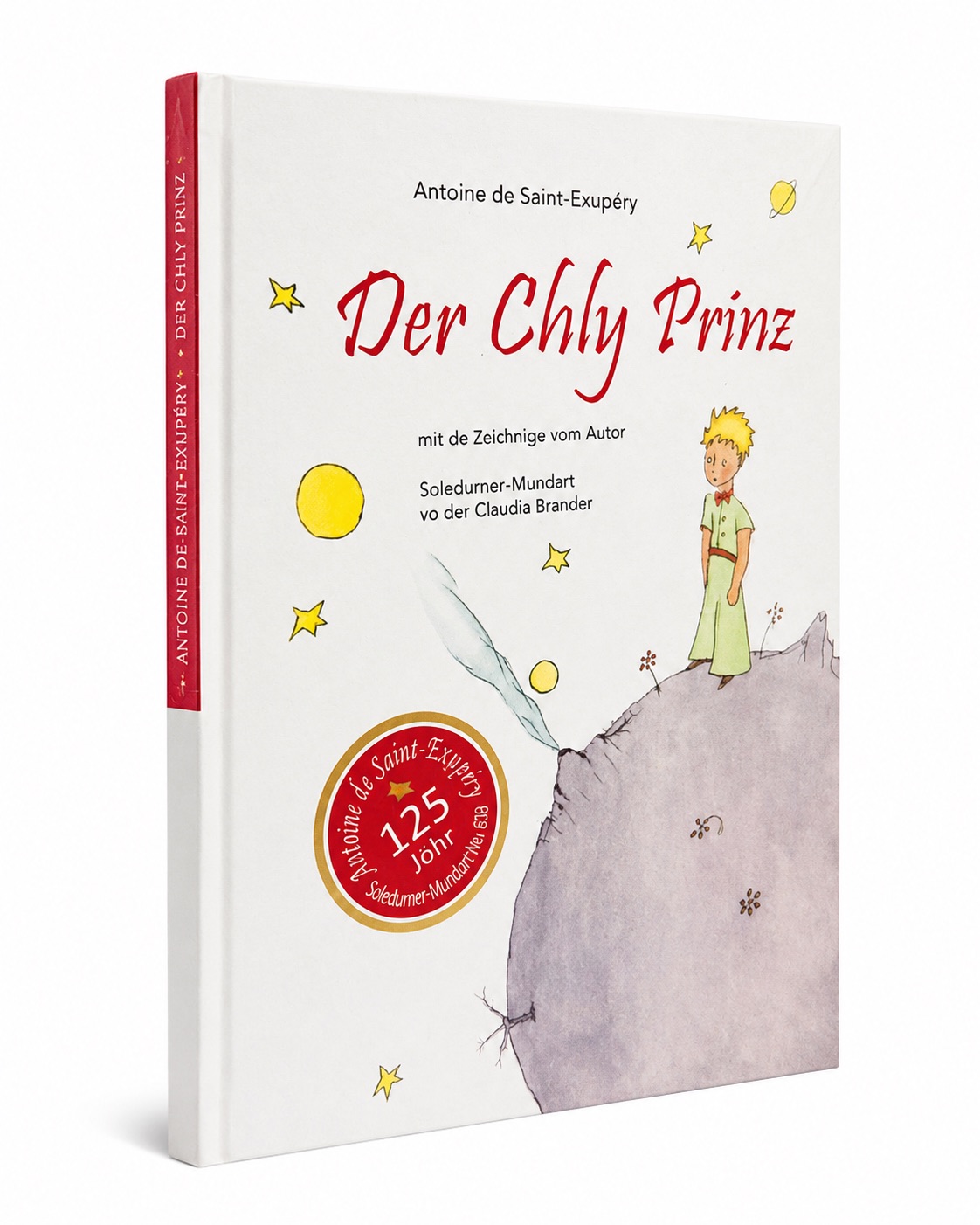
Der Chly Prinz — in Solothurn German.
Solothurner Mundart is the dialect of German spoken in and around the canton of Solothurn in northwestern Switzerland. It belongs to the High Alemannic branch of Upper German. Within the mosaic of Swiss German dialects, it occupies a transitional position between Bernese German to the south and the Basel dialects to the northwest, absorbing influences from both whilst maintaining a distinctly local character. Like all Swiss German dialects, it exists in stable diglossia with Standard German: Hochdeutsch serves for reading, writing, and formal contexts, whilst the dialect governs virtually all spoken life, from kitchen conversation to parliamentary debate. This arrangement is in Switzerland simply the natural order. The dialect is not a degraded form of the standard but a separate register with its own dignity and its own community of fiercely loyal speakers.
Solothurn itself is one of the most coherent Baroque cities in Switzerland. The old town, compressed within a bend of the River Aare, presents a streetscape of fountains, guild facades, and the magnificent St. Ursus Cathedral, completed in a single campaign between 1762 and 1773. The canton has historically been a Catholic enclave within a predominantly Reformed region, contributing to a cultural self-consciousness that extends to language: Solothurners are aware that their dialect is neither the prestige Swiss German of Zürich nor the romantically rustic speech of the alpine cantons, but something in between: urban, educated, and possessed of phonological quirks that mark a speaker’s origin to any attentive Swiss ear. The name Soledurner, the dialect’s own term for itself, derives from Soleure, the French name for the city, pointing to the canton’s long bilingual border with the French-speaking Jura immediately to the west.
Der Chly Prinz was published to mark the 125th anniversary of Saint-Exupéry’s birth. The edition coincides with a development of considerable significance for the city: the opening of the Museum Der kleine Prinz und seine Welt in the heart of Solothurn, housed in the historic Palais Besenval at Kronengasse 1. The museum is the direct consequence of Jean-Marc Probst‘s extraordinary LPP collecting life. His foundation now holds over 4,500 copies of the work, and it is this collection that made the museum possible. The foundation aims to preserve the cultural heritage of Saint-Exupéry and make his messages of friendship, humanity, and imagination accessible to a wide audience through exhibitions, guided tours, and educational programmes. That Solothurn — a Baroque city of quiet distinction in the Swiss Mittelland — should become the permanent home of the world’s most significant Little Prince collection is fitting: it is precisely the kind of place where the essential things, invisible to the casual eye, have long been carefully kept.