
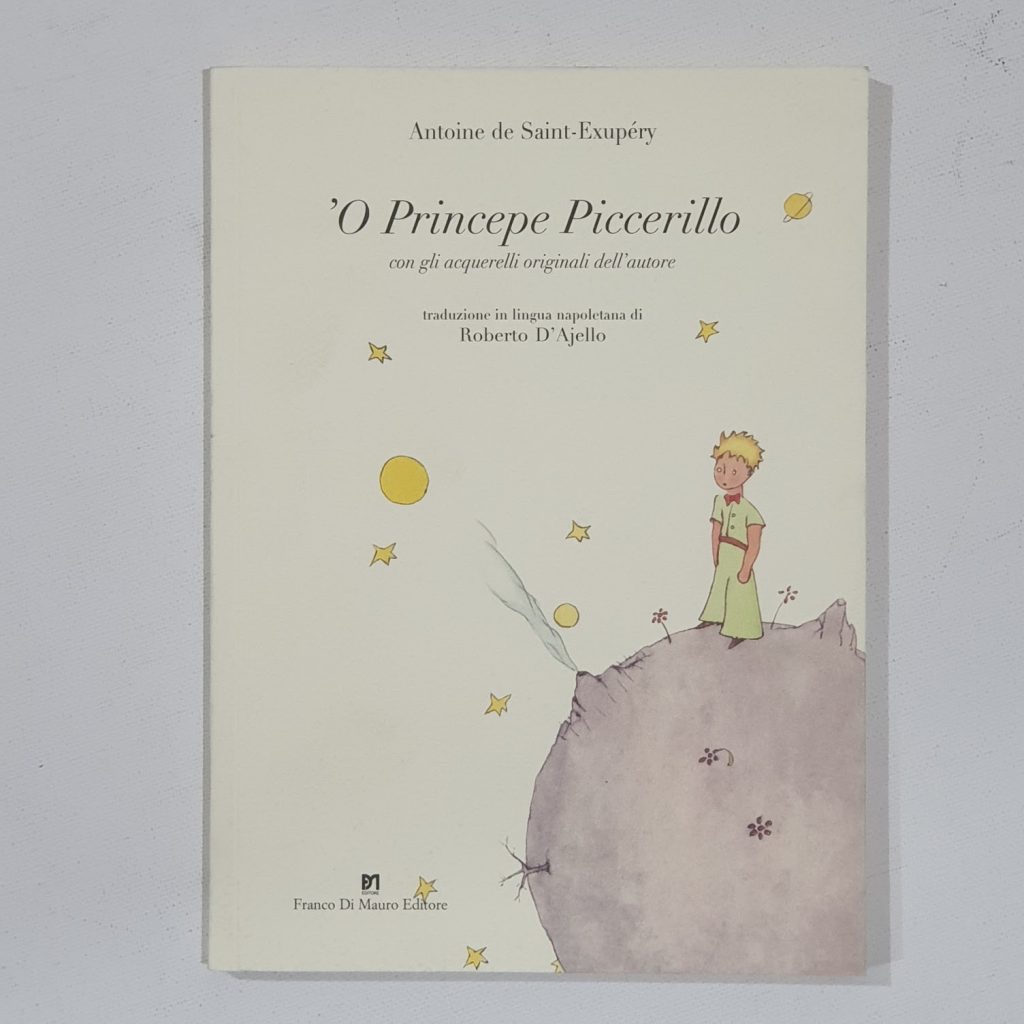
‘O Princepe Piccerillo — in Neapolitan / ‘O Napulitano / Napoletano.
The Neapolitan language is a vibrant Romance language spoken primarily in the city of Naples and across much of southern Italy, including Campania, Abruzzo, Molise, Puglia, and Calabria. Unlike the regional dialects of the north, Neapolitan is recognised by UNESCO as a distinct language with a rich literary history that dates back several centuries. It served as a prestigious court language during the Kingdom of Naples and remains one of the most culturally influential tongues in Italy, largely due to its central role in the world-famous tradition of Neapolitan song and theatre.
Linguistically, Neapolitan is classified within the Italo-Dalmatian branch, making it a closer relative to standard Italian and Sicilian than to the Gallo-Italic languages of the north. However, it possesses unique phonological traits that make it instantly recognisable. One of its most striking features is the schwa [ə], an unstressed, neutral vowel sound used at the end of words, which gives the language its characteristic rhythmic flow. Furthermore, it frequently employs “doubled” initial consonants (syntactic gemination) and specific vowel shifts that distinguish it from the Tuscan-based standard Italian. While it traditionally uses the Latin alphabet, its orthography is notable for the frequent use of apostrophes to indicate the apheresis or apocope of letters, reflecting the melodic contractions of the spoken word.
Within the context of Italy’s linguistic landscape, Neapolitan exists alongside a plethora of other regional languages, yet it maintains a particularly strong presence in daily life. While standard Italian is the language of administration and formal education, Neapolitan is the language of the heart, used for informal communication, humour, and artistic expression. It shares certain grammatical structures with other southern varieties like Sicilian, yet it remains distinct in its vocabulary and pronunciation. In the broader Romance family, it bears the historical marks of the various powers that ruled Naples, containing lexical influences from Spanish, French, and even Greek, reflecting the city’s ancient origins as Neapolis.