
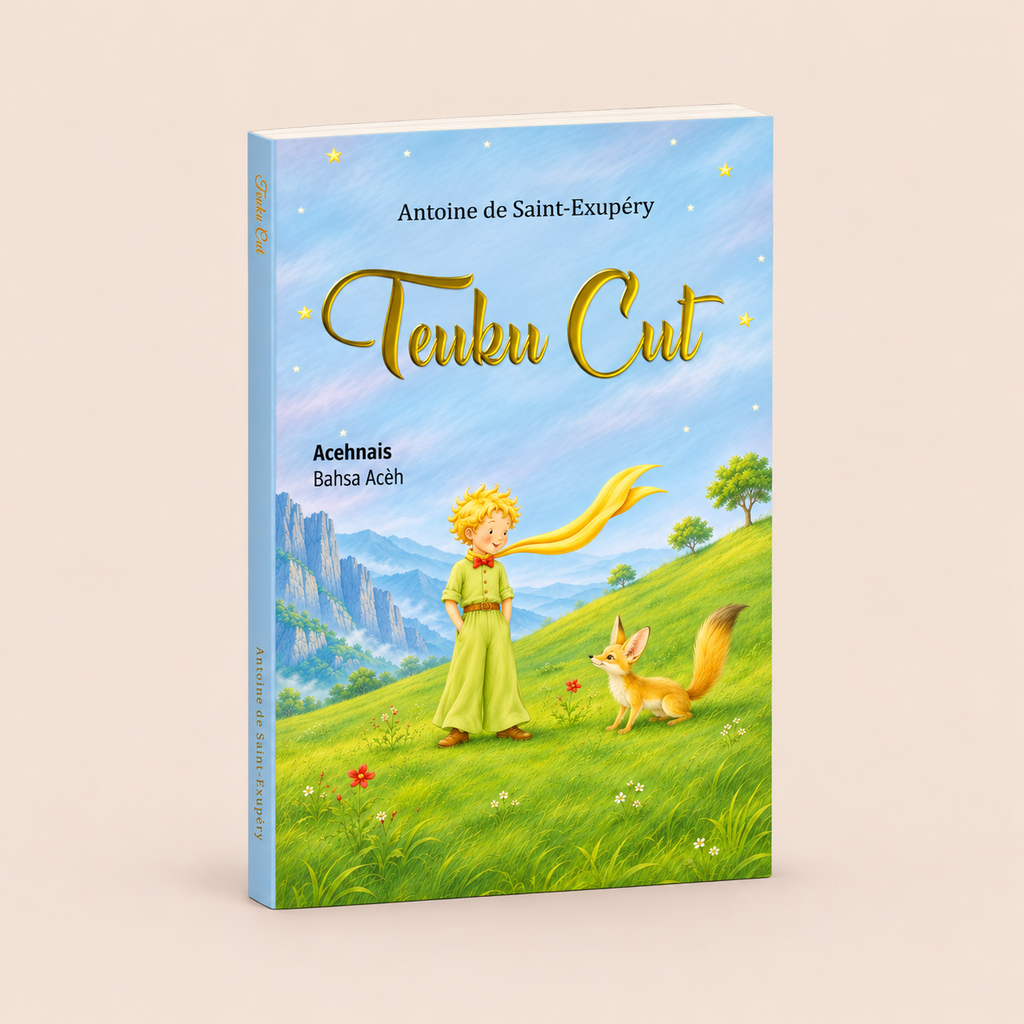
Teuku Cut — in Acehnese.
Acehnese (بهسا اچيه, Bahsa Acèh) is one of the great surprises of the Indonesian archipelago, for although it is spoken at the very northern tip of Sumatra, its closest relatives are not the Malay and Batak languages of its neighbours but the Chamic languages of mainland Southeast Asia, Cham of Vietnam and Cambodia, Jarai and Rade of the Vietnamese highlands, and even Tsat, spoken by a small Muslim community on the Chinese island of Hainan. Together they form the Aceh Chamic branch of the Austronesian family, and the prevailing view holds that Acehnese descends from Chamic speakers who crossed the sea from the coast of ancient Champa well over a thousand years ago, bringing with them a language already reshaped by long contact with the Mon Khmer world, a heritage that shows in its abundance of vowels, its nasal vowel sounds and its numerous Austroasiatic loanwords, all quite unlike anything else in Sumatra.
The Acehnese coast became the gateway through which Islam entered the archipelago, first in the port kingdom of Samudra Pasai, whose sultan Malik al Salih died in 1297 and which Ibn Battuta visited in 1345, and then in the Sultanate of Aceh Darussalam, which under Sultan Iskandar Muda in the early seventeenth century grew into a formidable maritime power, controlling the pepper trade and rivalling the Portuguese at Malacca. Aceh’s devotion and learning earned it the enduring title Serambi Mekkah, the Veranda of Mecca, the point from which pilgrims set sail, and its court nurtured scholars such as Hamzah Fansuri, Nuruddin ar Raniri and Abdurrauf of Singkil, who wrote chiefly in Malay but made Aceh a beacon of Islamic thought for the whole region. That same fierce identity sustained one of the longest colonial wars in history against the Dutch from 1873, inspired by the stirring verse epic Hikayat Prang Sabi and heroes such as Teuku Umar and Cut Nyak Dhien, and it echoed again in the long conflict with Jakarta that ended, after the devastation of the 2004 tsunami, with the Helsinki peace accord of 2005 and the special autonomy Aceh enjoys today.
Acehnese literature is overwhelmingly poetic, its great hikayat composed in a rhyming verse metre meant to be chanted aloud, and the language has traditionally been written in the Arabic based Jawi script, known locally as Jawoe, before Latin letters became the norm. Linguists prize it for its grammar as much as its sound, for Acehnese is a celebrated example of active and stative alignment, in which verbs carry small pronoun markers whose form depends on whether the subject acts deliberately or simply undergoes a state, a system quite different from Malay. Around it lies a lively mosaic of neighbours, the Gayo and Alas of the highlands, belonging to the same Northwest Sumatra grouping as Batak, the Aneuk Jamee speech of the western coast, descended from Minangkabau settlers, the Malay of Tamiang in the east, and the languages of Simeulue offshore. Acehnese thus stands as a Chamic island on Sumatran soil, a living link between the vanished kingdom of Champa and the proud sultanate that welcomed Islam to Southeast Asia.
Buy it here: [LULU]