
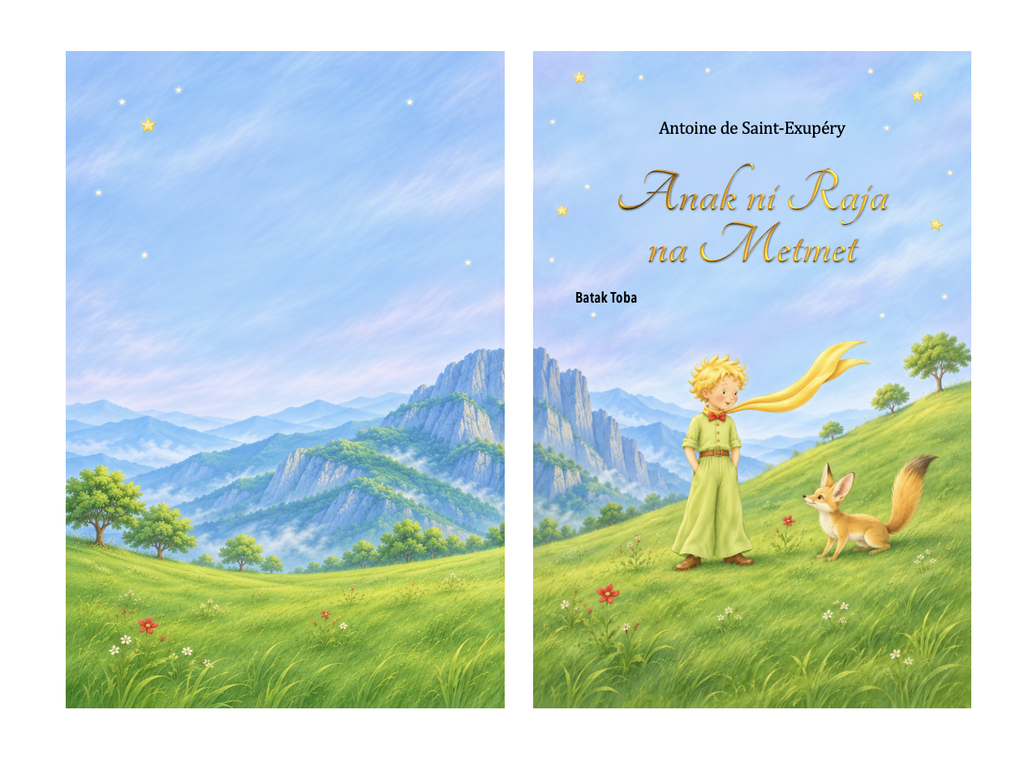
Anak ni Raja na Metmet — in Batak Toba.
Batak Toba (ᯂᯖ ᯅᯖᯂ᯲ ᯖᯬᯅ, Hata Batak Toba) belongs to the Batak branch of the Northwest Sumatra and Barrier Islands languages within the Austronesian family, a grouping it shares more distantly with Nias and Mentawai off the western coast. It is spoken around the shores of Lake Toba in North Sumatra, the vast caldera left by one of the greatest volcanic eruptions known to science some seventy four thousand years ago, whose waters now cradle the island of Samosir and whose surrounding highlands, recognised as a UNESCO Global Geopark, form the spiritual homeland of the Toba people. According to tradition every Toba Batak descends from Si Raja Batak, the first ancestor who came down upon the sacred mountain of Pusuk Buhit on the lake’s western shore, and to this day a Toba speaker meeting a stranger will often begin not with the weather but with the question of clan, tracing the shared genealogy (tarombo) until both know precisely how they are related.
That instinct springs from the elegant kinship order known as dalihan na tolu, the three hearth stones, in which every person stands at once among their own patrilineal clan (marga), their wife givers (hula hula), owed deep respect, and their wife takers (boru), owed care and support, a triangle that governs weddings, funerals and the exchange of the handwoven ulos cloths that bind families together. The Toba also possess their own script, the Indic derived surat Batak, once used above all by the datu, priest healers who recorded divination, medicine and magic in folding books of tree bark called pustaha, a legacy of the ancient Indian contact that also left Sanskrit words in the old religion, its supreme deity bearing the title Debata Mulajadi Na Bolon, from the same root as the Sanskrit devata. The highlands long resisted outside rule, and the priest king Sisingamangaraja XII fought the Dutch until his death in 1907, while from the 1860s the German missionary Ingwer Ludwig Nommensen laid the foundations of a Christian community that would make the Toba Batak one of the great Protestant peoples of Asia, his translation work also giving the language a substantial written literature in Latin letters.
Within its own family Toba belongs to the southern Batak languages alongside Angkola and Mandailing, with Simalungun standing somewhere between the southern group and the northern languages of Karo, Pakpak and Alas, the northern and southern ends being different enough that a Toba and a Karo speaker cannot readily understand one another. Around them lie quite different neighbours, the Malay of the eastern coast, Minangkabau to the south and Acehnese to the north, against which the Batak languages have always stood as an inland Austronesian world of their own. Toba culture remains vividly alive in the thunderous gondang drum ensembles and the stately tortor dance, and the Toba gift for song has filled Indonesian churches, stages and recording studios for generations, so that this lakeside language, ancient in its kinship and its script, sounds today with a remarkable confidence far beyond the volcanic rim that gave it birth.