
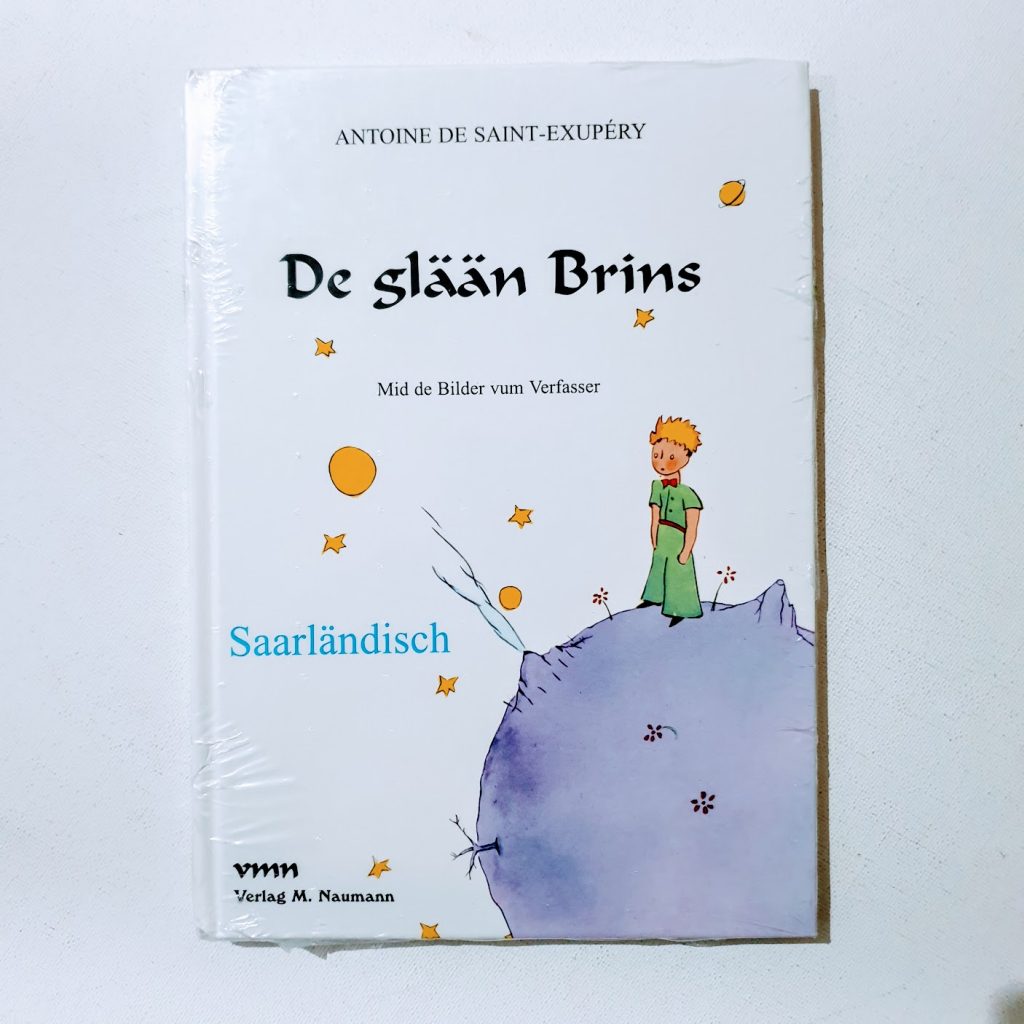
De Glään Brins — from Saarland.
Rhenish Franconian (Rheinfränkisch) belongs to the Central German dialect family, sitting inside the broader Franconian continuum that also gave rise, at its western edge many centuries ago, to something rather grander: French itself. The same Frankish tribes who pushed into Roman Gaul and eventually shifted to speaking Gallo Romance, becoming linguistically French even as they lent the country their name, had cousins who stayed put along the Rhine and Moselle, and it is their speech, evolved over a millennium and a half, that survives today as the Franconian dialects of western Germany, among them the everyday speech of Saarland, often called simply Saarland German (Saarländisch), a small federal state wedged tightly between France, Luxembourg, and the rest of Germany, a geography that has shaped its language every bit as much as its politics.
What makes Rhenish Franconian especially rewarding for dialectologists is that it sits directly astride one of the most famous linguistic boundaries in Europe, the Rhenish Fan (Rheinischer Fächer), a bundle of isoglosses that fan outward from the lower Rhine marking exactly how far south the High German consonant shift managed to travel before losing steam, turning Low German dat into Central German das and eventually Upper German Bavarian das again in a slightly different guise, with several of these lines running right through the Franconian dialect zone rather than cleanly separating it from its neighbours. Saarland itself sits partly within Moselle Franconian territory in its west and Rhine Franconian proper further east, meaning the state is, quite literally, a living transect through the very isoglosses that define how German dialects gradually shade into one another, a linguistic borderland mirroring, almost too neatly, the region’s long political life as a contested strip between French and German power.
That political history left an unusually visible fingerprint on the vocabulary itself. Centuries of shifting rule, from Louis XIV’s territorial reunions through Napoleonic administration to the Saar’s twentieth century spells under League of Nations oversight and French economic union before its return to West Germany in 1957, seeded Saarland German with a noticeably richer layer of French loanwords than most other German dialects carry, words such as Trottoir for pavement, borrowed wholesale from French, or Bredullje, a fix or predicament, echoing the French bredouille, small everyday reminders of a border that has moved back and forth more times than most Europeans could easily list. Today Saarländisch survives chiefly as the informal, spoken half of a diglossia with Standard German (Hochdeutsch), nursed along by local pride, dialect comedy, and regional broadcasting even as younger generations lean ever further towards the standard, leaving this small Franconian speech as one of the more charming living monuments to just how thoroughly France and Germany have, over the centuries, leaned into and shaped one another.